QUICK SUMMARY
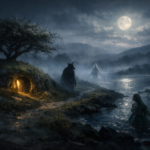
Irish water spirits are supernatural beings connected to lakes, rivers, and the sea. They often appear as beautiful or familiar figures, but their presence is rarely safe. These beings reflect both the danger and mystery of water in Irish belief, where calm surfaces can hide something far older and less forgiving.
Irish folklore does not treat water as empty space. Lakes, rivers, and coastal waters are seen as places of presence, where something may be watching, waiting, or passing through.
Stories of water spirits appear across Ireland, often tied to specific locations. These beings are not distant myths. They belong to the landscape. They are encountered at the edge of the shore, in still water, or in moments when something feels slightly wrong.
Some take human form. Others appear as animals. Nearly all of them exist between worlds, moving freely between the natural and the supernatural.
What Are Irish Water Spirits?
Irish water spirits are entities believed to inhabit bodies of water, from deep lakes to coastal shores. Unlike creatures in distant mythologies, these beings are closely tied to real places. Many stories describe specific rivers, pools, or stretches of coastline where they are said to appear.
They are not simply monsters. In many cases, they are intelligent, aware, and capable of interacting with humans. Some speak. Some lure. Some simply watch.
Water, in Irish tradition, is a boundary. It separates land from depth, safety from uncertainty, and the known world from something far less understood. Water spirits exist along that boundary.
Types of Irish Water Spirits
While the category is broad, several well-known figures appear repeatedly in Irish folklore.
The Merrow
The merrow (pronounced: MER-oh) is perhaps the most familiar Irish water spirit. Often described as a sea-dwelling being with human features, the merrow can move between land and ocean. In some stories, they are capable of forming relationships with humans, though these encounters rarely end without consequence.
The Each-Uisge
The each-uisce (pronounced: EACH-ISH-ka), sometimes called a water horse, is far more dangerous. It is said to appear as a beautiful horse near water, luring people to ride it. Once mounted, the creature carries its victim into the water, where escape becomes impossible.
The Dobhar-Chú
The dobhar-chú (pronounced: DOW-er KHOO) is a creature of lakes and rivers, often described as a massive, hound-like being. Unlike more deceptive spirits, it is openly feared. Stories describe sudden attacks and a presence that signals immediate danger rather than subtle temptation.
These figures differ in form and behavior, but they share a connection to water as a place of transformation and risk.
Common Traits of Water Spirits
Despite their differences, Irish water spirits often share several defining characteristics.
Shape-Shifting
Many water spirits can change form, appearing human, animal, or something in between. This ability allows them to approach unnoticed or appear harmless at first glance.
Deceptive Beauty
Some spirits, particularly those tied to the sea, are described as striking or otherworldly. This beauty is not meant to comfort. It draws people closer.
Connection to Liminal Spaces
Water itself is a liminal space, but these beings are often encountered at the edges: shorelines, riverbanks, and crossings. These are places where the boundary between worlds feels thin.
Unpredictability
Unlike creatures that follow clear rules, water spirits are often inconsistent. Some stories describe them as curious or even gentle. Others portray them as deadly. This unpredictability is part of what makes them feared.
Why Water Spirits Exist in Irish Folklore
Water has always been essential to life, but it has also been a source of danger. Drowning, storms, and unseen depths made it one of the most feared elements in everyday life.
Water spirits can be understood as a way of explaining that danger.
They give form to:
- the pull of deep water
- the sudden shift from calm to deadly
- the feeling of being watched in empty places
They also serve as warnings. Many stories involve individuals who ignore signs, approach water carelessly, or trust something that feels slightly wrong.
In this way, water spirits are not just supernatural beings. They are expressions of caution.
The Presence of Water in Irish Belief
In Irish tradition, water is rarely neutral. It is often tied to:
- entrances to the Otherworld
- sacred wells and healing sites
- boundaries between life and death
Water spirits exist within this larger framework. They are not isolated figures but part of a broader understanding of the landscape as something alive and aware.
To encounter water is, in many stories, to stand at the edge of something deeper than it appears.
Final Thoughts
Irish water spirits are not simply creatures of myth. They represent a way of seeing the natural world as active, responsive, and sometimes dangerous.
They remind us that not everything can be understood by what is visible. A calm lake may hide movement beneath the surface. A quiet shoreline may not be empty.
And in Irish folklore, it is often at these edges where something is most likely to appear.