In Short
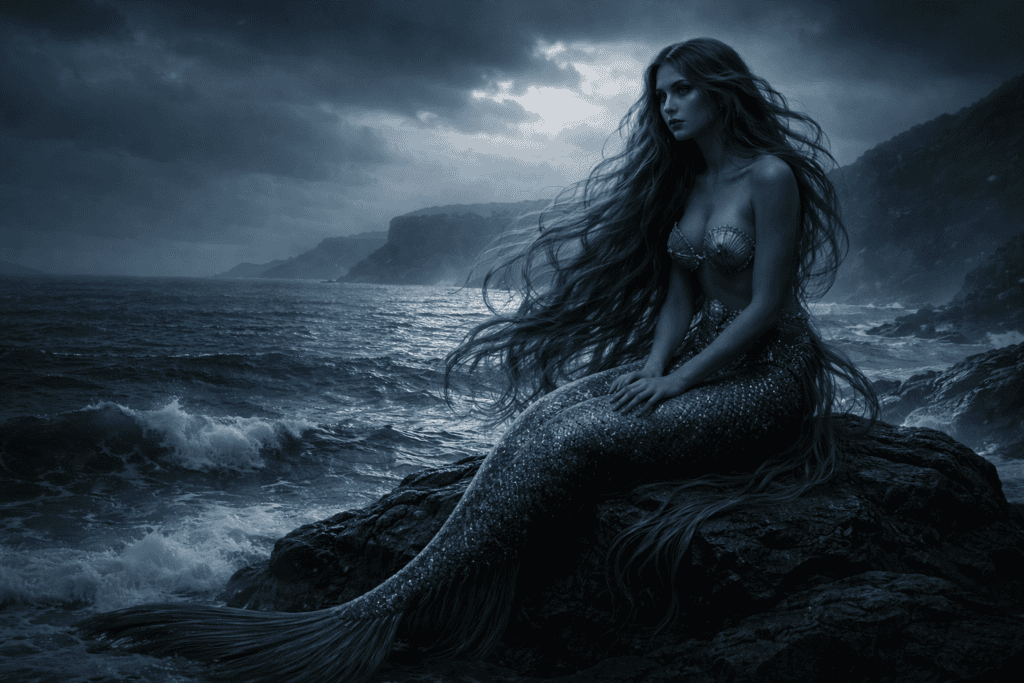
The merrow (pronounced MER-oh, from the Irish murúch) is the mermaid of Irish folklore: a sea being with a fish’s tail who lives beneath the waves off the Irish coast. Female merrows are beautiful and wear a magical red cap that lets them pass between the sea and dry land. In the best-known story, a Kerry fisherman steals a merrow’s cap, marries her, and raises a family with her, until she finds the cap again and returns to the sea. Male merrows, by contrast, are said to be ugly but good-natured.
| Irish name | Murúch; Middle Irish murdúchann |
|---|---|
| Pronunciation | MER-oh |
| What it is | A sea being, half human and half fish |
| Magic object | The cohuleen druith, a red cap that lets her move between sea and land |
| Female merrows | Beautiful, with long green hair |
| Male merrows | Ugly, with green teeth and hair, but friendly |
| Best-known tale | “The Lady of Gollerus,” Thomas Crofton Croker, 1828 |
| Earliest mermaid in Irish sources | Lí Ban of Lough Neagh, recorded in the annals under AD 558 |
| Omen | A sign of coming storms to fishermen |
What Is a Merrow?
Early one fine morning on the Dingle Peninsula, a young fisherman walking the shore of Smerwick Harbour sees a beautiful woman sitting on a rock, combing her long green hair. Beside her lies a little red cap. He knows at once what she is, and he knows the story: whoever holds a merrow’s cap holds the merrow. He slips over, pockets the cap, and she has no choice but to go home with him.
That is the opening of “The Lady of Gollerus,” the most famous merrow story in Irish folklore. The merrow is Ireland’s mermaid, a being of the sea with the upper body of a person and the tail of a fish. Like the other fairy peoples of Irish tradition, the merrows have their own world, with houses and treasures beneath the waves, and they come ashore only now and then, to the danger or fortune of the humans who meet them.
Where the Name Comes From
The English word merrow comes from the Irish murúch. The collector Thomas Crofton Croker explained it as meaning “sea maid,” from muir, “sea.” An older Irish word, murdúchann, seems to combine muir with a word for chanting or song, and describes sea women who lured sailors with their singing, much like the sirens of Greek legend. Medieval Irish writers knew those sirens from translations of classical stories, and the two ideas seem to have blended.
What Merrows Look Like
The nineteenth-century collectors agreed on a vivid picture. A female merrow is beautiful from the waist up, with a fish’s tail below, covered in greenish scales, and she spends much of her time combing her long green hair. She has a thin, delicate web between her fingers.
Male merrows are another matter. According to Yeats, they have green teeth, green hair, pigs’ eyes, and red noses. It is no wonder, he added, that merrow women sometimes preferred handsome fishermen. Yet the male merrows were usually described as good-natured rather than dangerous.
Merrows could also take other shapes. Yeats recorded that they sometimes came ashore in the form of little hornless cows.
The Magic Red Cap
The key to merrow lore is the cap. In Croker’s stories it is called the cohuleen druith, from the Irish cochaillín draíochta, “little magic hood.” It is a small red cap, sometimes said to be covered with feathers, and it is what allows a merrow to dive down through the sea to her home and return again. Without it, she cannot go back into the water.
That is why the cap matters so much in the stories. Take it from her, and she is bound to the land and to the man who holds it. Give it back, or let her find it, and she is gone.
The Lady of Gollerus
The story of the fisherman at Smerwick, published by Croker in 1828, is the classic merrow tale. The fisherman, Dick Fitzgerald, hides the cap and marries the merrow. She makes a good wife, and they have children and live happily together for years. But one day, while he is away, she finds the cap hidden in the thatch of the house. She hesitates, thinking of her children, but the call of the sea is stronger. She puts on the cap and goes down into the sea, and Dick never sees her again.
Tales of this kind are found all around the coasts of northern Europe. In Scotland and Orkney, the same story is told of the selkie, a seal woman whose sealskin is hidden by a fisherman. The pattern is always the same: a supernatural wife, a stolen garment, a happy marriage, and a return to the wild that no love can prevent.
Merrow Families
Some Irish families were said to be descended from merrows. Yeats noted a tradition that near Bantry, in County Cork, there lived in the eighteenth century a woman covered all over with scales like a fish, who was said to come from such a marriage. Claims like these gave a family a touch of the marvelous, much as having a banshee did.
The Soul Cages
Croker’s collection also includes “The Soul Cages,” in which a fisherman named Jack Dougherty befriends a male merrow called Coomara, who invites him to his home beneath the sea. There Jack sees a row of lobster pots, and learns that they hold the souls of drowned sailors, which the merrow keeps as curiosities. Jack secretly sets the souls free.
It is a haunting story, and it is often retold as genuine Irish folklore. In fact, it was not. It was written by Thomas Keightley, who worked with Croker on the collection, and was later admitted to be his own invention. It is a good reminder that even the earliest collections sometimes blended folklore and fiction.
Lí Ban, the Mermaid of Lough Neagh
Long before the merrow stories were written down, medieval Irish tradition had its own mermaid. According to the story of Lí Ban, a woman of the Ulaid was swept away when a well overflowed and formed Lough Neagh, and she lived for three hundred years beneath the lake as a being with a salmon’s tail. She was finally caught in a fisherman’s net, baptized, and given the name Muirgen, “born of the sea.” The Annals of the Four Masters record her capture under the year 558. She was later venerated as a saint.
Merrows as an Omen
For fishermen, seeing a merrow was not a romantic moment. Many believed that her appearance meant a storm was coming. On a coast where storms drowned boats and men every year, a sea woman sitting on a rock was a sign to stay ashore.
The Merrow in Popular Culture
The merrow has never become as famous as the Little Mermaid, but it has a quiet place in Irish storytelling and fantasy. It appears in collections of Irish fairy tales, in fantasy novels and games, and in art. The closely related selkie has had more screen time, in John Sayles’s 1994 film The Secret of Roan Inish, set in County Donegal, and in Cartoon Saloon’s animated film Song of the Sea from 2014.
Is a Merrow the Same as a Mermaid?
Close, but not quite. A merrow is the Irish form of the mermaid, and shares her fish tail, beauty, and link to the sea. What makes the merrow distinctive is the red cap, which works much like the selkie’s sealskin, the ugly but good-humored male merrows, and the sense that the merrows are one more of Ireland’s fairy peoples, with their own homes, rules, and dealings with the humans on the shore.
Sources and Further Reading
- Thomas Crofton Croker, Fairy Legends and Traditions of the South of Ireland, part 2, John Murray (1828).
- W. B. Yeats, ed., Fairy and Folk Tales of the Irish Peasantry, Walter Scott (1888).
- John O’Donovan, ed. and trans., Annala Rioghachta Eireann: Annals of the Kingdom of Ireland by the Four Masters, Hodges and Smith (1848 to 1851).
- Katharine Briggs, An Encyclopedia of Fairies, Pantheon Books (1976).
- Dáithí Ó hÓgáin, Myth, Legend and Romance: An Encyclopaedia of the Irish Folk Tradition, Ryan Publishing (1990).