In Short
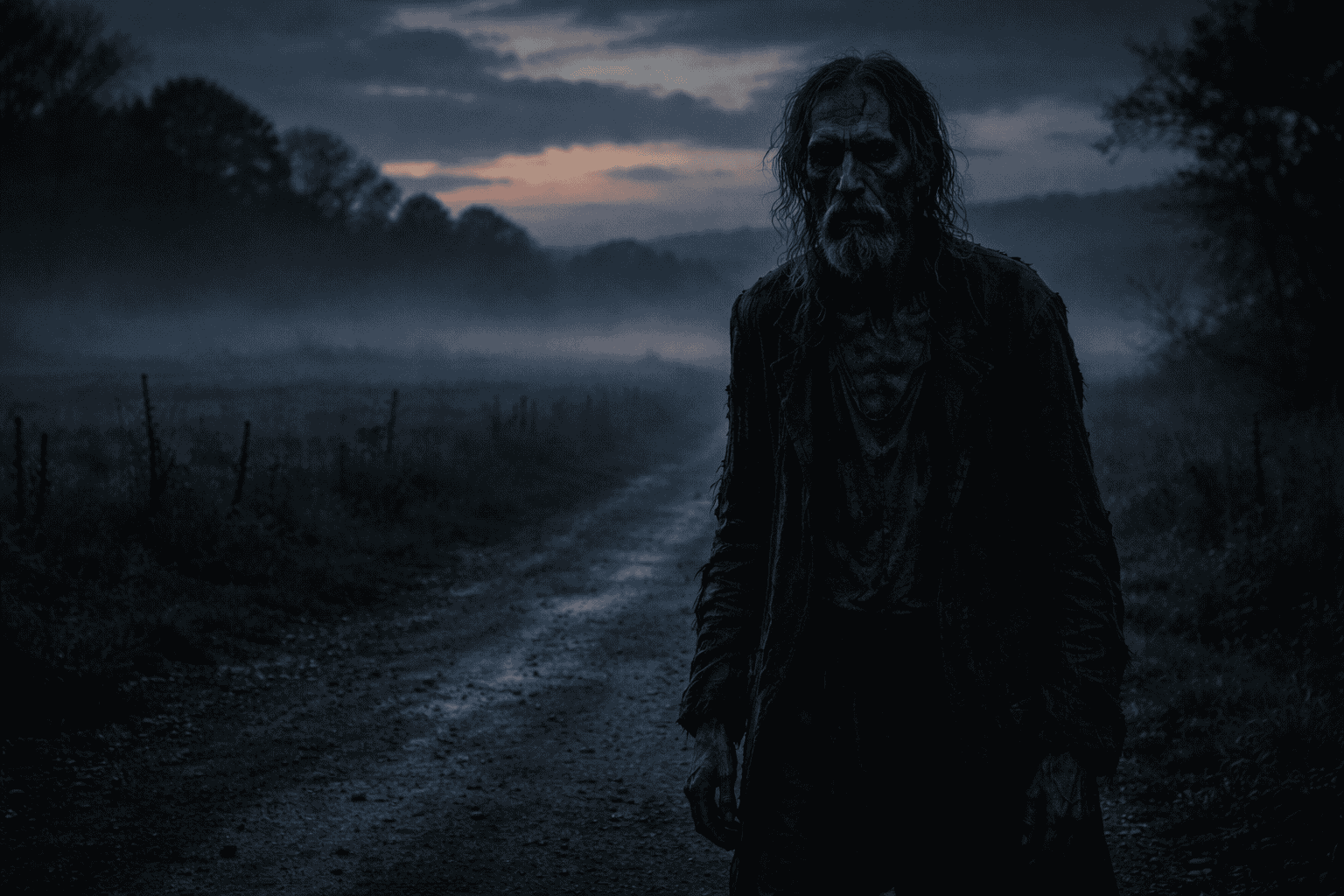
The fear gorta (pronounced roughly far GUR-tuh, “man of hunger”) is a phantom of Irish folklore: a thin, starving figure who wanders the roads in times of famine, begging for food. Those who give him something are rewarded with good luck, and in later retellings, those who refuse suffer for it. W. B. Yeats described him in 1888 as a phantom that goes through the land in famine time, begging alms and bringing good luck to the giver. He is closely linked to the féar gortach, or “hungry grass,” a patch of ground that strikes anyone who steps on it with a sudden, deadly hunger.
| Irish name | Fear gorta, “man of hunger”; also fear gortach |
|---|---|
| Pronunciation | Roughly far GUR-tuh |
| What he is | An emaciated phantom who begs for food |
| When he appears | In times of famine |
| If you feed him | Good luck |
| If you refuse | Misfortune, in later versions of the belief |
| Related belief | The hungry grass, féar gortach |
| Earliest description in English | W. B. Yeats, Fairy and Folk Tales of the Irish Peasantry, 1888 |
What Is the Fear Gorta?
A woman is at her half door in a bad year, when the potatoes have failed and every family is stretching what little it has. A stranger comes up the road: thin as a rake, in rags, so weak he can barely lift his hand. He asks for something to eat. She has almost nothing, but she gives him a cut of bread anyway. He thanks her and goes on his way, and afterward, whatever else happens to her neighbors, her own house never goes hungry again.
That is the fear gorta, the “man of hunger.” His name is plain Irish: fear, “man,” and gorta, “hunger” or “famine.” He belongs to the long tradition of supernatural strangers who test people’s hospitality, and he is one of the few figures in Irish folklore whose whole story is a single moral choice: will you share what you have?
The Earliest Accounts
The fear gorta enters written folklore in the late nineteenth century. In his 1888 collection, Fairy and Folk Tales of the Irish Peasantry, W. B. Yeats listed him among the solitary fairies, describing him as “an emaciated phantom that goes through the land in famine time, begging an alms and bringing good luck to the giver.” In Yeats’s description, the fear gorta is not a threat but an opportunity: a chance to be generous, and to be rewarded for it.
Later writers added more details and made him more frightening. Some describe him carrying a staff and a tin cup, rattling a coin in it to announce his coming, and say that households who failed to leave food out for him would suffer misfortune. Others describe him as a kind of starving ghost of the unburied dead. These details come from twentieth-century and modern books rather than from the older collections, and they should be read as later additions to a simpler belief.
The Fear Gorta and the Great Famine
It is easy to see why the fear gorta has become linked in modern minds with the Great Famine of 1845 to 1852, when about a million people died of starvation and disease and more than a million emigrated. The roads of Ireland in those years were full of starving people begging for food, and a family’s choice to share or not to share could decide who lived.
Whether the belief was born in the Famine or is older is hard to say. The idea of a supernatural beggar who rewards the generous is widespread in Irish and European folklore, including stories of Christ or a saint appearing as a poor traveler to test people’s charity. Ireland also suffered other famines before the 1840s. What seems clear is that the fear gorta carried special weight for the generations who remembered the Famine, and that his story made the old duty of hospitality impossible to forget.
The Hungry Grass
The fear gorta is closely tied to another Irish belief, the féar gortach, or “hungry grass.” This was a patch of ground, often looking no different from any other, where anyone who walked was suddenly struck by an overwhelming hunger and weakness, so severe that they could collapse or even die if they did not eat something at once.
Explanations varied. The antiquarian W. G. Wood-Martin, writing in 1902, recorded that hungry grass grew where someone had died of hunger. Others said it marked a place where a corpse had lain unblessed, or where food had been left out for the fairies. In County Leitrim, a folklorist writing in 1893 noted that the same name was used for a sudden, dangerous hunger that could seize travelers crossing the mountains. The practical advice was always the same: carry a crust of bread in your pocket, and if the hunger strikes, eat it at once.
Some later writers connected the two beliefs directly, saying that the fear gorta rose from a patch of hungry grass. Modern accounts often link the hungry grass to the unmarked famine graves scattered across the Irish countryside, which gives the belief a special sadness.
What the Fear Gorta Teaches
At its heart, the fear gorta is a lesson in hospitality. In traditional Ireland, turning away a hungry traveler was a serious wrong, and sharing food with a stranger, even in hard times, was a duty. The fear gorta story gives that duty a supernatural edge. The beggar at the door might be exactly what he seems, or he might be something more, and there is no way to know. The only safe course, and the only right one, is to be generous.
The Fear Gorta in Popular Culture
The fear gorta has become a popular figure in horror writing and games, where he is often turned into a zombie-like corpse risen from a famine grave. The novelist Richard Power took The Hungry Grass as the title of his 1969 novel, and the hungry grass remains one of the best-known Irish superstitions connected with the Famine.
Is the Fear Gorta Evil?
No, not in the older sources. In Yeats’s account, he brings good luck to those who give to him, and does no harm to anyone. The idea that he punishes people who refuse him appears in later versions, and the image of a rotting, zombie-like fear gorta is a modern invention. The traditional figure is better understood as a test of kindness than as a monster.
Sources and Further Reading
- W. B. Yeats, ed., Fairy and Folk Tales of the Irish Peasantry, Walter Scott (1888).
- W. G. Wood-Martin, Traces of the Elder Faiths of Ireland, vol. 2, Longmans, Green, and Co. (1902).
- Leland L. Duncan, “Folk-Lore Gleanings from County Leitrim,” Folklore 4 (1893).
- Cormac Ó Gráda, Black ’47 and Beyond: The Great Irish Famine in History, Economy, and Memory, Princeton University Press (1999).
- Dáithí Ó hÓgáin, Myth, Legend and Romance: An Encyclopaedia of the Irish Folk Tradition, Ryan Publishing (1990).