In Short
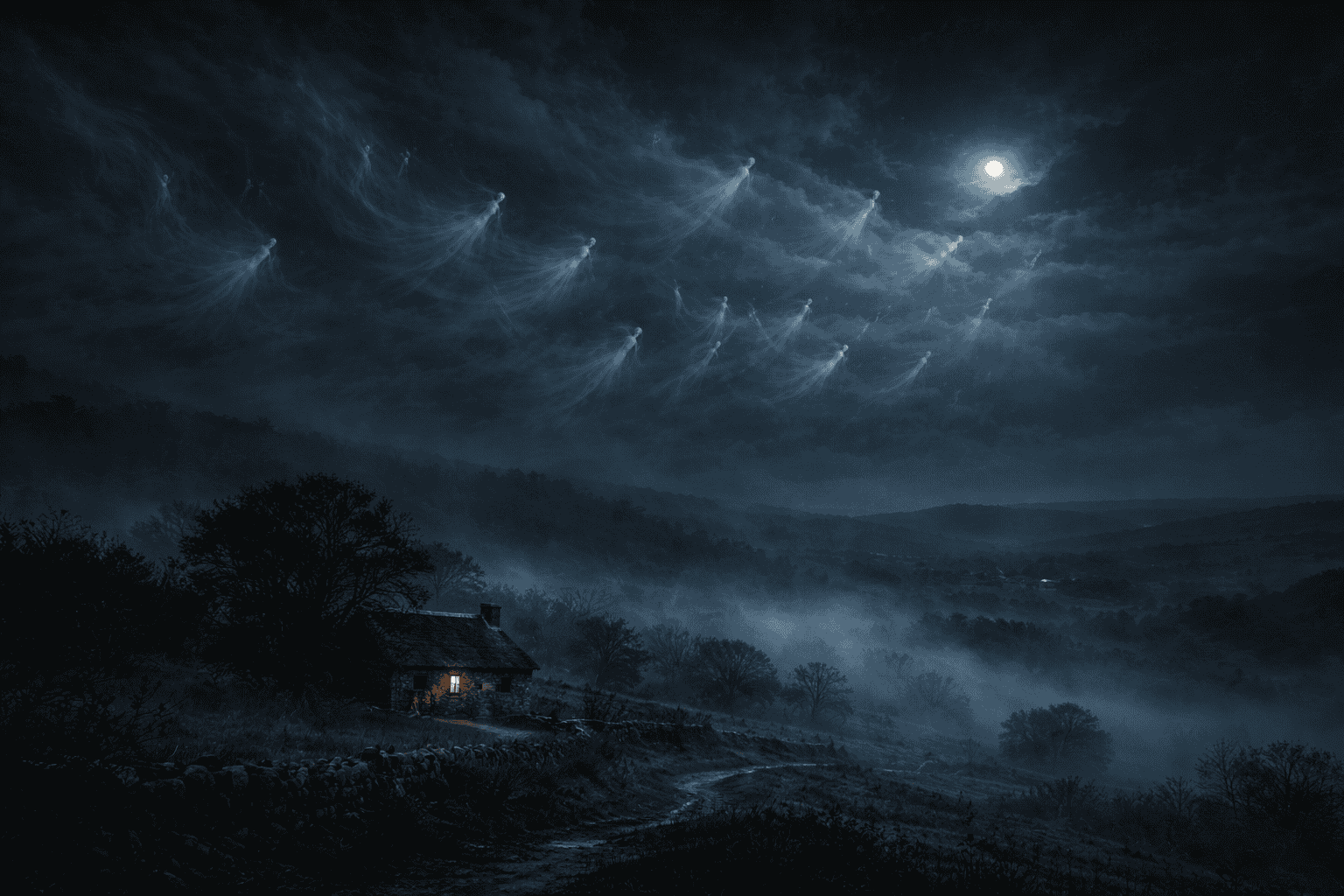
The sluagh (pronounced SLOO-uh, from the Old Irish slúag, “host” or “army”) is a host of spirits that flies through the night sky. In the Scottish Highlands and Islands, where the belief was strongest, it was the sluagh na marbh, “the host of the dead”: the souls of sinners, sweeping in from the west like a flock of starlings to snatch the souls of the dying and carry living people off through the air. In Ireland, the same word named the fairy host, the slua sí, which passed by in a sudden whirlwind and could carry mortals away.
| Name | Sluagh; Irish slua; Old Irish slúag, “host, army, crowd” |
|---|---|
| Pronunciation | SLOO-uh |
| Scottish form | Sluagh na marbh, “the host of the dead” |
| Irish form | Slua sí, “the fairy host” |
| What it looks like | A dark flock like starlings or crows, often in a crescent |
| Where it comes from | The west, at nightfall |
| What it does | Snatches the souls of the dying; lifts people into the air |
| Protection | Closing west-facing doors and windows when someone is dying |
| Main collectors | Alexander Carmichael; John Gregorson Campbell; Lewis Spence |
What Is the Sluagh?
An old woman lies dying in a cottage in the Hebrides. The family sits by her bed, and someone gets up to make sure the door and the window on the west side of the house are shut tight. It is not the cold they are worried about. Out there, in the dark, the sluagh may be gathering, a host of restless spirits sweeping in from the west, waiting for a chance to seize a soul as it leaves the body.
The sluagh is not a single creature but a crowd. Its name simply means “host” or “army,” and that is how it was imagined: a great swarm of spirits moving together through the night sky, sometimes seen as a dark cloud, sometimes heard as a rush of wind and voices, sometimes felt only as something passing overhead.
Scottish or Irish?
The sluagh as a host of the dead belongs above all to the folklore of the Scottish Highlands and Islands, and especially the Western Isles, where it was recorded in detail by collectors such as Alexander Carmichael and John Gregorson Campbell in the late nineteenth century. Many modern articles call it an Irish belief, but the dark, soul-snatching host of the dead is mainly Scottish.
The word itself is shared. Irish and Scottish Gaelic both come from Old Irish, where slúag meant a host or army. In Ireland, the same word named the fairy host, the slua sí, and Irish folklore has plenty to say about it. The two traditions are closely related, but they put the emphasis in different places.
The Host of the Dead in Scotland
In the Hebrides, the sluagh were the spirits of the dead, and specifically of those who had not been allowed to rest. Some said they were the souls of sinners, who flew about until their sins were purged. Others said they were fallen angels. Either way, they were feared.
They were said to come from the west at nightfall, flying in great clouds “like the starlings,” as one of Carmichael’s informants put it, and returning to the places of their earthly wrongdoing. They usually moved in a crescent, like a flight of birds, and they could swoop down and lift a person from the ground and carry them for miles through the air, sometimes from one island to another, before dropping them exhausted.
On the island of Barra, Carmichael was told that the hosts fought battles in the sky, and that the red lichen on the rocks was their blood, fuil nan sluagh, “the blood of the hosts.”
Guarding Against the Sluagh
Because the sluagh were believed to come from the west to seize the souls of the dying, families kept the doors and windows on the west side of the house closed when someone was near death. The custom made the dying person’s last hours a time of watchfulness as well as grief.
Some protections involved the dead as well. Carmichael recorded that at a mountain burial ground in Glencreran, in Appin, the bier used to carry a coffin was broken against a particular tree after the burial, so that the sluagh could not use it to carry away the dead on their journeys through the air.
The Fairy Host in Ireland
In Irish folklore, the slua sí, the fairy host, was the Aos Sí on the move. It traveled in a sudden whirlwind, a sí gaoithe, “fairy wind,” that sprang up on a still day, and people who felt one pass would bless themselves or throw dust after it. The host could carry off anything it wanted, including people. In Douglas Hyde’s tale “Guleesh na Guss Dhu,” published in 1890, a young man hears a great noise like many people running, talking, and laughing, sweeping past him like a whirl of wind, and he joins the fairy host on a night ride to France to steal a princess.
Irish tradition sometimes blurred the fairies and the dead, too. Some people believed that the recently dead could be found among the fairy host, and that the host was most active on Samhain, the night of the dead. But the Irish fairy host was usually imagined as the Good People themselves rather than as a swarm of damned souls.
How the Sluagh Relates to Other Death Spirits
Gaelic tradition had several figures linked to death, each with its own role.
- The banshee cries outside the house to warn of a coming death in an old family.
- The bean nighe is seen at a stream washing the clothes of those about to die.
- The dullahan rides out and calls the name of the one who will die.
- The sluagh is different from all three. It does not warn of death. It comes to take the dying soul, or to carry off the living.
The sluagh also resembles the Wild Hunt of northern European folklore, a ghostly troop that rides through the stormy sky and sweeps up anyone in its path.
The Sluagh in Popular Culture
In recent years, the sluagh has become a favorite of horror writers, game designers, and artists, usually as a flock of shadowy, bird-like wraiths or as a single terrifying creature. Most modern portrayals draw on the Scottish host of the dead, often calling it Irish, and add details like claws and beaks that the old accounts do not mention.
Why Did the Sluagh Come From the West?
In Gaelic tradition, the west was the direction of the setting sun, of the open ocean, and of the Otherworld islands and the lands of the dead. It was natural to imagine the host of the dead arriving from there at nightfall. Closing the west-facing window was a way of closing the door on that other world at the most dangerous moment.
Sources and Further Reading
- Alexander Carmichael, Carmina Gadelica, vol. 2, T. and A. Constable (1900).
- John Gregorson Campbell, Superstitions of the Highlands and Islands of Scotland, James MacLehose and Sons (1900).
- Lewis Spence, The Fairy Tradition in Britain, Rider (1948).
- Douglas Hyde, Beside the Fire: A Collection of Irish Gaelic Folk Stories, David Nutt (1890).
- James MacKillop, A Dictionary of Celtic Mythology, Oxford University Press (1998).