In Short
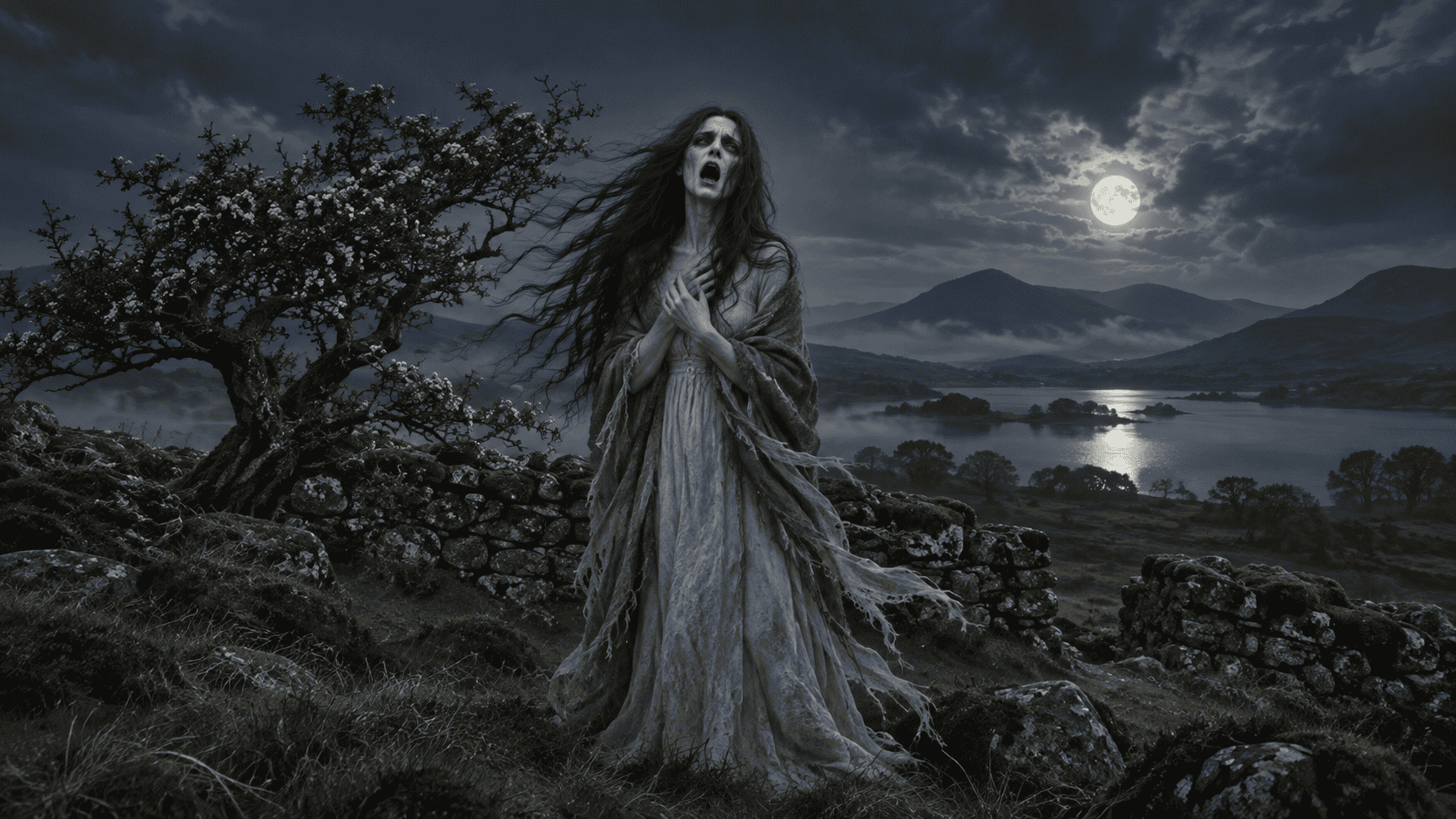
The banshee (pronounced BAN-shee, from Irish bean sí, “woman of the fairy mound”) is a supernatural woman in Irish folklore whose keening cry warns that someone in a family is about to die. She does not cause the death; she announces it. Tradition says she follows particular old families, and accounts of her were still being collected across Ireland in the twentieth century.
| Irish name | Bean sí, older bean sídhe |
|---|---|
| Pronunciation | BAN-shee |
| Meaning | Woman of the fairy mound, or Otherworld woman |
| Other names | The Bow or Badhbh in the south-east, the Bibe in Waterford, bean chaointe (keening woman) |
| Role | Foretells a death in the family by crying or keening |
| Appearance | A young woman or an old one, often combing long hair |
| Follows | Old families, traditionally those with Ó or Mac names |
| Earliest record | A fourteenth-century history of the O’Briens of Clare |
| Key study | Patricia Lysaght, The Banshee, 1986 |
What Is a Banshee?
Late at night, in a house where someone is ill, the family hears a sound outside. It rises and falls like a woman crying, but there is no woman on the road. It comes again, closer to the house, then fades. Nobody says what they are all thinking. In the morning, word comes that the sick man has died, or a message arrives from a relative far away.
That is the banshee as Irish people described her for generations: not a monster, not a ghost that haunts a house, but a messenger. Her Irish name, bean sí, means a woman of the síd, the fairy mounds that stand in fields all over Ireland, which makes her a being from the Otherworld. Her only work is to announce a death before it happens, and she does it with the sound Irish people most associated with grief: keening.
The Banshee and Keening
To understand the banshee, it helps to know about keening. For centuries, Irish wakes included the caoineadh, a sung lament for the dead, performed by women from the family or community and sometimes by professional keening women. It was loud, rhythmic, and full of raw grief, and it was an expected part of a proper send-off. The custom faded during the nineteenth and early twentieth centuries.
The banshee’s cry is described in exactly the same terms: wailing, crying, lamenting, keening. The folklorist Patricia Lysaght, whose 1986 book is still the standard study, saw her as a kind of supernatural counterpart to those human keening women. The difference is timing. The women at the wake keened after a death. The banshee keens before it.
What Does a Banshee Look Like?
Most people who told of the banshee only heard her. Those who saw her gave very different descriptions. Sometimes she is a young, beautiful woman in a white or grey cloak. Sometimes she is small and old, dressed in dark clothes, with a face worn by weeping. In many accounts, her hair is long and loose, white or red, and she is combing it.
The Banshee’s Comb
The comb is one of the most widespread details in banshee lore, and it came with a warning. If you found a comb lying by the road, you left it alone, because it might belong to the banshee, and she would come back for it. Stories tell of people who picked one up and were visited at night until they handed it back, sometimes through a window, and sometimes with painful results. Lysaght noticed that the comb stories are rare along the west coast, where legends of mermaids combing their hair are common, and suggested the two images may be related.
Other Names Around Ireland
Banshee is the name most people know, but it was not the only one. In parts of the south-east, including Wexford, Carlow, Kilkenny, and Tipperary, she was called the Bow or the Badhbh. In Waterford, she was the Bibe. Elsewhere she might simply be called the bean chaointe, the keening woman. The name Badhbh is especially interesting, because in early Irish literature Badb is a battle goddess, linked with the Morrígan, who appears as a crow and foretells slaughter.
Which Families Have a Banshee?
The banshee does not cry for everyone. According to tradition, she follows particular families, and the usual rule was that she attached herself only to old Gaelic families, those whose names begin with Ó or Mac. Folklore often names families such as the O’Briens, O’Neills, O’Gradys, and Kavanaghs. The rule was never strict, though. Lysaght found that the banshee was also said to follow some Anglo-Norman families who had lived in Ireland long enough to become thoroughly Irish, such as the Fitzgeralds, and nineteenth-century writers recorded her attending families of English origin too.
There is a certain pride in the belief. A family with a banshee was an old family, rooted in its place, and its deaths mattered enough to be mourned from the Otherworld.
The Oldest Banshee Stories
The earliest written accounts come from Caithréim Thoirdhealbhaigh, “The Triumphs of Turlough,” a history of the O’Brien wars in County Clare written in Irish around 1350 by Seán mac Ruaidhrí Mac Craith. Before a battle in 1317, an army marching through the Burren meets a hideous woman at a lake, washing human heads and limbs until the water runs red. She tells them her name is Bronach, that she is of the Tuatha Dé Danann, and that the heads she is washing are theirs. Their leader dismisses her, and by evening he and most of his kin are dead. A year later, the same chronicle has a similar figure appear to the Anglo-Norman lord Richard de Clare’s army at a river before his defeat and death at Dysert O’Dea.
That washer at the ford is a much older figure in Irish literature, and she is fierce rather than sorrowful. Over the following centuries, the grim prophetess of battle seems to have softened into the family mourner of later folklore, though scholars still debate exactly how the two are connected.
Lady Fanshawe’s Visitor
The most famous early eyewitness account comes from Ann, Lady Fanshawe, an Englishwoman who traveled in Ireland with her husband in the mid-seventeenth century. In her memoirs, written in the 1670s and first published in 1829, she describes staying with Lady Honora O’Brien, a daughter of the Earl of Thomond. In the night, she was woken by a voice and saw a woman in white at the window, with red hair and a pale, ghastly face, who called out three times and then vanished like a cloud. In the morning, her hostess told her that a relative had died in the house during the night, and that the apparition was the spirit of a woman murdered there long ago, who was said to appear when one of the family was about to die.
The Banshee and the Bean Nighe
Scotland has a close relative: the bean nighe, or washerwoman, who is seen at a stream washing the clothes of those about to die. She is essentially the washer at the ford of Irish literature, kept alive in Highland folklore. In Ireland, the washing image faded, and the crying and keening banshee became the familiar form. The two figures share the same job, foretelling death, but by the time folklore collectors reached them, they had grown into distinct traditions.
The Banshee in Popular Culture
The banshee is one of the best-known figures of Irish folklore worldwide, largely thanks to the screen. Walt Disney’s 1959 film Darby O’Gill and the Little People features a shrieking banshee and the death coach. Marvel Comics introduced Banshee, an Irish mutant named Sean Cassidy with a sonic scream, in X-Men #28 in 1967. More recently, Martin McDonagh’s 2022 film The Banshees of Inisherin used her name for its title, playing on her role as a harbinger of loss.
Most modern versions turn her into a screaming ghost or a horror monster. The traditional banshee is quieter and stranger than that. She mourns, she warns, and she belongs to the family she cries for.
Does the Banshee Cause Death?
No. This is the most common misunderstanding about her. In Irish tradition, the banshee never harms anyone and never brings death about. Her cry is a warning that a death is already coming, a sign rather than a cause. The only people she troubles are those who take her comb. To many families, hearing the banshee was even a kind of honor, a sign that their line was old and that their dead would be properly mourned.
Sources and Further Reading
- Patricia Lysaght, The Banshee: The Irish Supernatural Death-Messenger, Glendale Press (1986).
- Standish Hayes O’Grady, ed. and trans., Caithréim Thoirdhealbhaigh: The Triumphs of Turlough, Irish Texts Society (1929).
- The Memoirs of Ann, Lady Fanshawe, first published 1829.
- Thomas J. Westropp, “A Folklore Survey of County Clare,” Folk-Lore (1910 to 1913).
- W. B. Yeats, ed., Fairy and Folk Tales of the Irish Peasantry, Walter Scott (1888).