QUICK SUMMARY
The Abhartach is one of the oldest and most unsettling figures in Irish folklore: a tyrant who died, rose again, and demanded blood from the living. Often described as a precursor to the modern vampire, he is not romantic, not tragic, and not misunderstood. He is simply something that refuses to stay buried.
Who Was the Abhartach?
The Abhartach is said to have been a cruel chieftain in ancient Ireland, most commonly linked to the north, particularly around present-day County Derry. Unlike later vampire figures shaped by literature, the Abhartach feels rooted in something older and more local.
In many versions of the story, he is described as small in stature but powerful in influence. Some traditions suggest he was a sorcerer or dark ruler who controlled his people through fear. His name is often interpreted as “dwarf” or “little tyrant,” though the stories themselves focus far more on his cruelty than his appearance.
Death Was Not the End
The Abhartach was eventually killed, usually by a rival or local hero. That should have ended the story.
It did not.
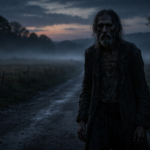
He rose from his grave and returned to the living world. Not as a ghost or spirit, but physically. Once returned, he demanded blood from his people. In some versions, villagers are forced to fill a bowl with their blood. In others, he feeds directly from them.
Death did not weaken him. It removed the only limit he had.
The Curse of Return
One of the most disturbing aspects of the Abhartach legend is that killing him once is not enough.
He is killed.
He is buried.
He returns.
This cycle repeats, turning the story into something far more oppressive than a single haunting. The problem cannot be solved through force alone. Each failure reinforces the idea that something deeper is at work, something that requires understanding rather than strength.
How the Abhartach Was Finally Stopped
Eventually, the hero seeks guidance, often from a druid or wise figure. Only then does the solution become clear.
The instructions are precise:
- Kill him again
- Bury him upside down
- Place a heavy stone over the grave
- In some versions, use a sword made of yew wood
Once these steps are followed correctly, the Abhartach no longer rises.
There is something almost ritualistic in this resolution. The story is not just describing an event. It is preserving a method, as though it expects the problem might return.
Is the Abhartach a Vampire?
The Abhartach is often described as an early form of the vampire, and the comparison is difficult to ignore.
He rises from the grave.
He feeds on blood.
He returns repeatedly unless properly contained.
These traits closely resemble later vampire traditions. Some have even drawn connections between the Abhartach and the literary figure of Count Dracula.
The difference is tone. The Abhartach is not elegant or seductive. There is no charm, no romance, and no attempt to humanize him. He is closer to something raw and ancient: a body that will not remain in the ground and a presence that feeds on the living.
The Landscape of Fear
The Abhartach legend is often tied to a specific place in Northern Ireland, sometimes identified as Slaghtaverty Dolmen. Whether or not the story reflects a real historical figure, this connection matters.
Irish folklore rarely places its stories in distant or abstract settings. It anchors them in real landscapes. Fields, stones, burial mounds, and quiet rural spaces become part of the narrative.
This grounding makes the story feel immediate. The Abhartach is not somewhere else. He is tied to a place that can be pointed to, visited, and remembered.
Symbolism of the Abhartach
The Abhartach represents several overlapping fears.
He embodies the idea of improper burial and restless dead. In Irish tradition, death is not just an ending. It is a boundary. When that boundary is broken, something unnatural follows.
He also represents power that continues beyond death. Even after the tyrant is gone, his influence lingers. Fear remains. Control persists. The living are still shaped by what should have ended.
At a deeper level, the Abhartach reflects one of the oldest human fears: that the dead may return, not as memory or spirit, but as something physical and demanding.
The Abhartach in Irish Folklore
Compared to other figures in Irish folklore, the Abhartach is unusually direct. There is little ambiguity in his nature. He is not a trickster, not a wandering spirit, and not a distant god. He is a presence that rises from the earth and refuses to stay there.
That simplicity gives the story its weight. There is no need for elaborate explanation. The horror comes from repetition and inevitability, from the sense that something is wrong and cannot be ignored.
Why the Abhartach Still Matters
The Abhartach still matters because the fear behind the story has not disappeared.
It speaks to the idea that some things do not end cleanly. That what is buried can return. That force alone is not always enough to resolve what has gone wrong.
Modern vampires have been reshaped into everything from romantic figures to action characters. The Abhartach remains unchanged. He is not meant to be admired or understood. He is meant to be remembered as a warning.
And, in a quiet way, the story offers a lesson that feels almost practical: if something comes back the first time, doing the same thing again probably will not fix it.