In Short
The Abhartach (pronounced OW-er-tukh, with the final sound as in “loch”) is a cruel magician and tyrant from a legend of Slaghtaverty, in County Derry, who was killed and buried but rose from his grave again and again, until a druid told the chieftain who fought him how to lay him to rest for good. The story was first printed by P. W. Joyce in the 1870s. Modern retellings have made the Abhartach a blood-drinking “Irish vampire” and even the model for Dracula, but those details are later additions, not part of the oldest recorded version.
| Name | Abhartach; anglicized Avartagh or Averty |
|---|---|
| Pronunciation | OW-er-tukh |
| What he is | A tyrant and magician who will not stay dead |
| Where | Slaghtaverty, near Garvagh, in the parish of Errigal, County Derry |
| His enemy | A neighboring chieftain, in some versions Fionn mac Cumhaill |
| How he was stopped | Killed a third time and buried head downward |
| First in print | P. W. Joyce, The Origin and History of Irish Names of Places, 1870s |
| Later additions | Blood-drinking, a sword of yew, the Dracula connection |
Who Was the Abhartach?
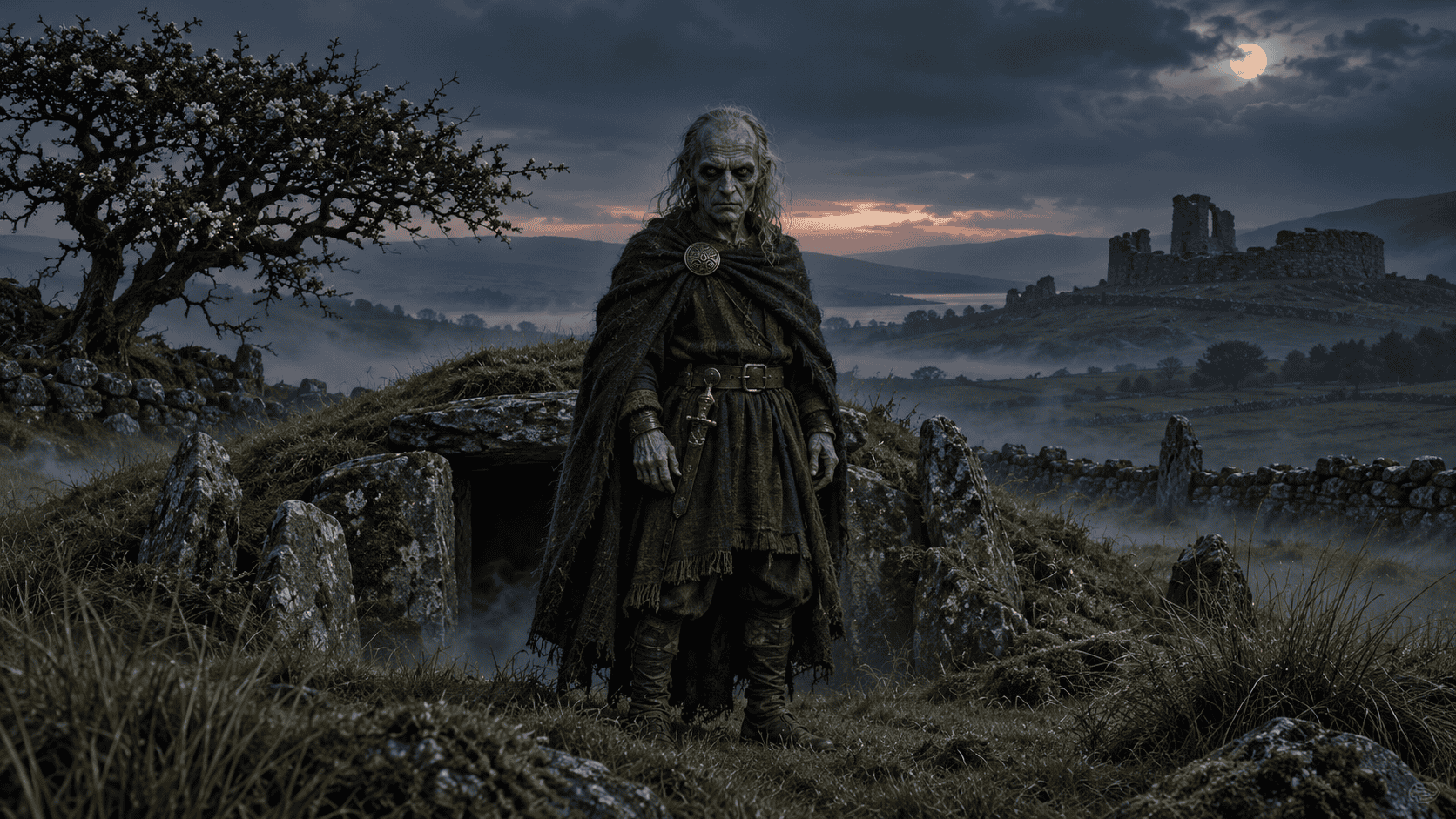
In a field at Slaghtaverty, a quiet townland near Garvagh in County Derry, there is an old stone grave with a thorn tree growing beside it. Local people have long called it the Dwarf’s Grave. The man said to be buried there, head downward, is the Abhartach, and the story of how he got there is one of the eeriest legends in Irish folklore.
He was, the story goes, a dwarf, a magician, and a tyrant who ruled the district through fear and cruelty. His neighbors could bear it no longer, and a chieftain from the next territory set out to kill him. In some tellings, that chieftain was Fionn mac Cumhaill himself.
The Legend as Joyce Recorded It
The earliest printed version comes from the scholar Patrick Weston Joyce, in his study of Irish place names, The Origin and History of Irish Names of Places. Joyce explained that Slaghtaverty ought really to be Laghtaverty, meaning the burial monument of the Abhartach, and then told the local legend behind the name.
The chieftain kills the Abhartach and buries him standing upright. The very next day, the Abhartach is back in his old haunts, crueler and stronger than before. The chieftain kills him a second time and buries him the same way, and again he escapes the grave and terrorizes the whole country. At last, the chieftain asks a druid for advice. Following the druid’s directions, he kills the Abhartach a third time and buries him in the same spot, but this time head downward. That breaks his magic, and he never rises again. The stone monument raised over him, Joyce added, was still there, and local people could still tell the story in detail.
Notice what Joyce’s version does not contain. The Abhartach returns from the grave, but there is no mention of him drinking blood.
How the Story Grew
A brief version of the legend was already noted in the 1830s by the scholars of the Ordnance Survey, who recorded a tyrant and enchanter named Averty slain by Fionn mac Cumhaill. Over the following century and more, the story picked up extra details as it was retold. Later versions say the Abhartach could only be killed with a sword made of yew wood, and that his grave was covered with a great stone and surrounded by thorns or rowan twigs to keep him in. Some modern versions give the hero the name Cathán, borrowing the name of the ancestor of the O’Kanes, the leading family of the area.
The biggest addition came in the twentieth century. Popular books on vampires began to describe the Abhartach demanding a bowl of blood from his subjects each day. The best-known of these, by the writer Bob Curran, presented him as Ireland’s vampire. That image is now the one most people know, but it cannot be traced back to the nineteenth-century accounts.
Is the Abhartach a Vampire?
In the oldest version, he is better described as a revenant, a dead man who will not stay in his grave. That idea is very old and widespread in European folklore, and so are the ways of dealing with it. Burying a dangerous corpse face down or head downward, weighing the grave with a heavy stone, or piercing the body were all ways of keeping the dead from walking. In that sense, the Abhartach belongs to the same world of beliefs that later fed into the vampire legends of Eastern Europe.
What makes him a “vampire” in the modern sense, the thirst for blood, is the part added most recently. He is a fascinating example of how an old local legend can be reshaped to fit a newer, more famous kind of monster.
Did the Abhartach Inspire Dracula?
It is often claimed that Bram Stoker, who was born in Dublin, based Dracula on the Abhartach. The idea was put forward by Bob Curran in the magazine History Ireland in 2000, and it has been repeated widely since. There is no direct evidence for it. Stoker’s surviving notes for the novel show that he took the name Dracula from a book about Wallachia by William Wilkinson, published in 1820, which mentioned the Romanian ruler Vlad III and said that “Dracula” meant “devil.” The claim that the name comes from the Irish droch fhola, “bad blood,” has no support in Stoker’s notes either.
That said, Stoker grew up in Ireland and knew Irish folklore well, and the Irish tradition of the restless dead was part of the world he came from. The Abhartach is best seen not as the source of Dracula, but as a cousin.
The Dwarf’s Grave at Slaghtaverty
The grave itself is a prehistoric stone monument in a field in the townland of Slaghtaverty, near Garvagh, known locally as the Dwarf’s Grave or the Giant’s Grave. A lone hawthorn grows beside it, and like many fairy trees, it has been left untouched. The site stands on private farmland, so anyone hoping to visit should ask permission first.
The Abhartach in Popular Culture
Over the past few decades, the Abhartach has become a favorite of Halloween articles, podcasts, and books on vampires, almost always as “the Irish Dracula.” He appears in horror fiction and games as a blood-drinking undead king, and the claim that he inspired Stoker is repeated so often that many people now take it as fact. For readers who want the older story, Joyce’s short account remains the place to start.
Was the Abhartach a Real Person?
There is no historical record of him. The legend is attached to a real place and a real prehistoric monument, and its purpose, like many place-name legends, was to explain an old stone and an unusual name in the landscape. Whether it preserves a distant memory of a hated local ruler is impossible to know. What is certain is that the story is much older than its modern vampire costume.
Sources and Further Reading
- P. W. Joyce, The Origin and History of Irish Names of Places, second series, McGlashan and Gill (1875).
- Bob Curran, Vampires: A Field Guide to the Creatures That Stalk the Night, New Page Books (2005).
- Elizabeth Miller, Dracula: Sense and Nonsense, Desert Island Books (2000).
- William Wilkinson, An Account of the Principalities of Wallachia and Moldavia, Longman (1820).
- Northern Ireland Community Archive, “Slaghtaverty,” niarchive.org.