QUICK SUMMARY
The Far Darrig, or “Red Man,” is one of the darker figures in Irish folklore: a solitary fairy known for cruel pranks, grotesque humor, and a fondness for human fear. Unlike the more elegant members of the fairy world, the Far Darrig is unsettling, unpredictable, and often malicious. His stories are not about wonder. They are about discomfort, humiliation, and the uneasy sense that something is laughing at you in the dark.
What Is the Far Darrig?
The Far Darrig (Irish: Fear Dearg, meaning “red man”) is a type of fairy, though that word does not quite capture what he is. He belongs to the broader world of the Aos Sí, but stands apart from the more refined or mystical beings often associated with that realm.
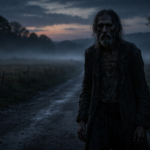
He is usually described as short, wrinkled, and deeply unpleasant to look at, dressed entirely in red from head to toe. His face is often said to be lined, sharp, and expressive in a way that feels exaggerated, almost theatrical. Everything about him suggests distortion rather than beauty.
If most fairies are strange but alluring, the Far Darrig is deliberately off-putting.
A Creature of Cruel Humor
The Far Darrig is best known for his sense of humor, which, unfortunately for everyone else, is built entirely around fear and suffering.
He delights in practical jokes, but these are not harmless tricks. They are elaborate, unsettling, and often humiliating for the victim. His goal is not simply to surprise, but to disturb.
He may lead travelers astray, place them in strange or degrading situations, or manipulate events so that the ordinary becomes grotesque. In many stories, the victim only realizes what has happened after the fact, which somehow makes it worse.
Laughter, in the Far Darrig’s world, is not shared. It is directed.
The Changeling and the Cradle
One of the most disturbing roles attributed to the Far Darrig involves changelings.
In some traditions, he is said to replace healthy human babies with grotesque substitutes, creatures that look similar but behave strangely or appear unnatural upon closer inspection. These changelings are often described as thin, wrinkled, or unnervingly alert.
The idea reflects a deep anxiety in older societies, where illness or developmental differences in children were poorly understood. Folklore gave those fears a form, and the Far Darrig became one of the figures associated with that explanation.
It is not a comforting part of the tradition. It is a harsh one.
“May the Far Darrig Not Trouble You”
The Far Darrig’s reputation was so unpleasant that people invoked him in warnings and blessings. One phrase that appears in Irish tradition translates roughly to:
“May the Far Darrig not trouble you.”
That is not a casual expression. It reflects a genuine unease about attracting his attention. In folklore, attention itself can be dangerous. To be noticed by certain beings is to invite misfortune.
And the Far Darrig, more than most, is the kind of presence people preferred to avoid entirely.
The Far Darrig and the Fairy World
Although he is part of the fairy realm, the Far Darrig does not behave like the more familiar members of that world.
He is not associated with beauty, music, or enchantment in the usual sense. Instead, he represents a darker side of fairy folklore: one rooted in discomfort, mockery, and the unpredictable nature of the supernatural.
This reflects a broader truth about Irish folklore. The fairy world is not divided neatly into good and evil. It is complex, often indifferent, and sometimes openly hostile.
The Far Darrig sits firmly in that harsher category.
Symbolism of the Far Darrig
The Far Darrig can be understood as a personification of fear, particularly the fear of being made powerless or ridiculous.
His stories often place ordinary people in situations where control is stripped away. They become the subject of someone else’s amusement, unable to respond or escape until the moment has already passed.
There is also an element of social anxiety in these tales. The fear of embarrassment, of being exposed, of being laughed at, all appear in exaggerated form through the Far Darrig’s actions.
At the same time, he represents the unpredictable nature of the world itself. Things do not always behave as expected. Order can collapse without warning. The familiar can become strange in an instant.
A Folklore of Discomfort
Unlike many other figures in Irish folklore, the Far Darrig offers little comfort or redemption. There is no clear lesson that guarantees safety, no reliable method to avoid him beyond the vague hope of not attracting attention.
That uncertainty is part of what makes him effective. He does not operate according to clear rules. He appears, disrupts, and disappears, leaving confusion behind.
In that sense, the Far Darrig reflects a particular kind of fear: not danger that can be fought, but discomfort that cannot be controlled.
Why the Far Darrig Still Matters
The Far Darrig endures because he taps into something deeply familiar.
People still fear being embarrassed, manipulated, or placed in situations they do not understand. People still recognize the discomfort of being the subject of someone else’s amusement. And people still sense that not all forces in the world are fair, logical, or kind.
The Far Darrig gives those feelings a face.
Not a pleasant one, unfortunately.
He is a reminder that folklore is not always about wonder or beauty. Sometimes, it is about unease, about laughter that is not shared, and about the lingering suspicion that something unseen might be enjoying the moment far more than you are.