In Short
A changeling, in Irish folklore, is a fairy left in the place of a person the fairies have stolen, most often a baby or young child, sometimes a young wife or new mother. The substitute looks like the missing person but sickens, wastes away, or behaves strangely. The belief offered an explanation for illness and disability that families could not otherwise understand, but it also led to real deaths, most famously that of Bridget Cleary in County Tipperary in 1895.
| What it is | A fairy, or a bewitched log, left in place of a stolen human |
|---|---|
| Usually taken | Babies and young children; also brides and new mothers |
| Taken by | The Aos Sí, the fairy people of the mounds |
| Signs | Failure to thrive, constant crying, a wizened face, a huge appetite |
| Famous tale | “The Brewery of Egg-Shells,” Thomas Crofton Croker, 1825 |
| “Cures” | Fire, cold water, foxglove, threats, often deadly |
| Real deaths | Michael Leahy, County Kerry, 1826; Bridget Cleary, County Tipperary, 1895 |
| Key study | Angela Bourke, The Burning of Bridget Cleary, 1999 |
What Is a Changeling?
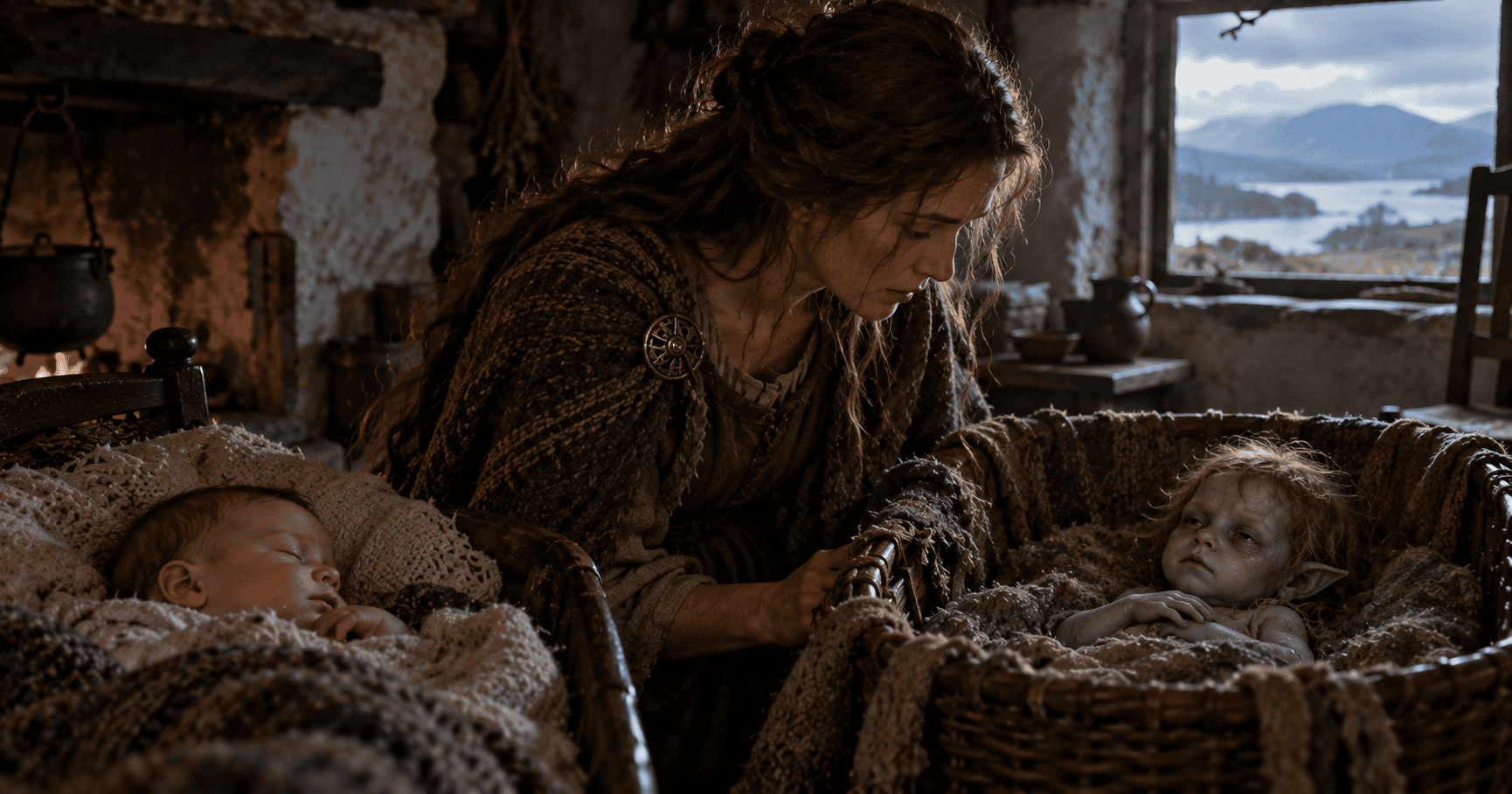
A mother leans over the cradle and something is wrong. The baby who fed well and laughed a week ago now cries day and night, eats everything and grows no bigger, and looks up at her with a face that seems suddenly old. Her neighbors have a word for what has happened. The fairies have taken her child, and left one of their own in its place.
That is a changeling. In Irish folklore, the Aos Sí, the fairy people of the mounds, were believed to steal humans away into their world and leave a substitute behind. Sometimes the substitute was a sickly fairy child. Sometimes it was an old fairy, worn out and ready to be rid of. Sometimes it was a mere log of wood, bewitched to look like the missing person and left to pine away, die, and be buried in their place.
It is one of the darkest beliefs in Irish tradition, because it was not only a story. People acted on it, and some of them killed.
Who the Fairies Took
Children were the most common target, especially healthy, handsome babies. Admiring a child too openly was thought to be dangerous. In the lore that W. B. Yeats gathered in 1888, a child who had been “overlooked,” gazed on with envy, was left open to the fairies.
Adults could be taken too. Many accounts single out young brides and women who had just given birth, who were thought to be carried off to nurse fairy children or to live in the fairy world. In their place, the family would find a wife or mother who seemed ill, cold, or not quite herself.
How People Said You Could Tell
The signs of a changeling, as the stories describe them, are strikingly consistent. The child stops growing or wastes away. It cries constantly, or makes strange noises. It eats far more than any child should, yet never thrives. Its face looks old and wizened. It may seem oddly knowing, as if far older than its years, or it may be unable to walk long after it should.
Read today, many of these signs are recognizable as illness, disability, or developmental conditions that nobody at the time could explain. That connection is at the heart of how scholars now understand the belief.
The Brewery of Egg-Shells
The best-known changeling story in Irish folklore appears in Thomas Crofton Croker’s Fairy Legends and Traditions of the South of Ireland, published in 1825, and was reprinted by Yeats in 1888. A mother, convinced that her child has been swapped, is told by a wise woman how to find out for sure. She is to boil water in a set of eggshells, as if she were brewing for a whole crowd of harvesters.
She does it, and the child in the cradle can’t contain itself. It sits up and declares that in all its long life, hundreds of years of it, it has never seen a brewery of eggshells before. The changeling has given itself away. In the end, it vanishes, and the mother finds her own child back in the cradle.
In the story, the trick works without harm. Many of the real “cures” did not.
When the Belief Turned Deadly
Folk tradition held that a changeling could be driven out by making the fairy world want it back, and the methods for doing that were harsh. Yeats recorded a formula passed on by Lady Wilde: a suspected changeling could be laid on the fire with the words “Burn, burn, burn, if of the devil, burn; but if of God and the saints, be safe from harm,” in the belief that a fairy would fly up the chimney. Other methods included bathing the child in cold water, leaving it out overnight, or dosing it with foxglove, which is poisonous.
These were not only stories. In 1826, in County Kerry, a four-year-old boy named Michael Leahy, who could neither stand nor speak, was bathed in the River Flesk on three mornings on the advice of an elderly woman named Ann Roche, who claimed healing powers. On the third morning, he was held under too long and drowned. Roche was tried for his death at Tralee, where her defense was that she had been trying to drive the fairy out of him, and the jury acquitted her.
The Death of Bridget Cleary
The most famous case came almost seventy years later. Bridget Cleary was a 26-year-old dressmaker who lived with her husband, Michael, a cooper, in a cottage at Ballyvadlea, in County Tipperary. In March 1895, she fell ill, possibly with bronchitis or tuberculosis. Her family sent for a doctor and a priest, and also consulted a local “fairy doctor.”
Over the following days, Michael became convinced that his wife had been taken by the fairies and that the sick woman in the bed was a changeling. With relatives and neighbors present, he and others forced herbal mixtures on her and held her near the fire, demanding that she say whether she was Bridget Cleary. On the night of 15 March, he killed her, and her body was burned. It was found a week later, on 22 March.
The case caused a sensation in Ireland and Britain. Michael Cleary was convicted of manslaughter at Clonmel in July 1895 and sentenced to twenty years. He served fifteen, was released in 1910, and emigrated to Montreal. Several of Bridget’s relatives and neighbors received shorter sentences. For years afterward, children in Tipperary chanted a grim rhyme: “Are you a witch, or are you a fairy, or are you the wife of Michael Cleary?”
In her study The Burning of Bridget Cleary, the scholar Angela Bourke showed that the killing was about much more than fairy belief. It also involved a strained marriage, an independent young woman in a changing rural society, and the way an old story could give cover to violence. Fairy belief did not simply cause her death. It gave the people around her a language in which to justify it.
What the Changeling Belief Was Really About
Most scholars now read the changeling belief as a way of explaining what could not otherwise be explained. The folklorist Susan Schoon Eberly, in a 1988 study, argued that many of the “signs” of a changeling closely match the symptoms of conditions such as failure to thrive and various congenital disorders. A family watching a child sicken, or a wife change after childbirth, could tell themselves that this was not really their loved one at all.
That story may have offered some comfort. It allowed families to grieve for a healthy child they believed was still alive somewhere in the fairy world. But it also made the sick person a stranger, and in the worst cases, something that could be harmed. The changeling tradition is a reminder that folklore is not always gentle, and that the stories people tell about illness can shape how the ill are treated.
The Changeling in Popular Culture
The changeling has haunted Irish writing ever since. W. B. Yeats’s poem “The Stolen Child,” published in 1886, is told in the voices of fairies luring a human child away, with its refrain, “Come away, O human child!” The Australian novelist Hannah Kent based her 2016 novel The Good People on the death of Michael Leahy. Bridget Cleary’s story has been retold in books, plays, podcasts, and songs, and Angela Bourke’s study of the case remains the essential account.
Were Changelings Real?
No. There is no evidence that anyone was ever taken by fairies or replaced by one. What was real was the suffering: children and adults with illnesses and disabilities that their communities could not understand, and a belief that sometimes turned their families against them. The changeling stories are best read today as a window into how people once tried to make sense of illness and loss, and as a warning about what can happen when a story is taken as fact.
Sources and Further Reading
- Thomas Crofton Croker, Fairy Legends and Traditions of the South of Ireland, John Murray (1825).
- W. B. Yeats, ed., Fairy and Folk Tales of the Irish Peasantry, Walter Scott (1888).
- Lady Wilde, Ancient Legends, Mystic Charms, and Superstitions of Ireland, Ward and Downey (1887).
- Susan Schoon Eberly, “Fairies and the Folklore of Disability: Changelings, Hybrids and the Solitary Fairy,” Folklore 99 (1988).
- Angela Bourke, The Burning of Bridget Cleary: A True Story, Pimlico (1999).