In Short
Irish superstitions are the everyday rules of luck, protection, and warning passed down through generations. Many grew out of the belief that the fairies lived alongside people and could take a child, a cow’s milk, or a household’s luck if given the chance. Others came from Christian custom, the farming year, or life on the sea. Well-known examples include never cutting a fairy tree, never giving anything away on May Day, stopping the clocks when someone dies, saluting a lone magpie, and saying “God bless it” when praising a baby. In Irish, a superstition or charm is a piseog.
| Irish word | Piseog (pronounced roughly PISH-ohg), anglicized pishogue |
|---|---|
| Main source of fear | The fairies, and the loss of luck, health, or life |
| Most dangerous days | May Eve and May Day; Samhain, at the start of November |
| Common protections | Iron, salt, holy water, St. Brigid’s crosses, a blessing spoken aloud |
| Best-known taboo | Never damage a fairy fort or cut a fairy tree |
| Best-known omens | The banshee’s cry; a lone magpie; a bird in the house |
What Are Irish Superstitions?
An Irish grandmother praises a neighbor’s new baby, and quickly adds “God bless it.” A farmer ploughs a crooked furrow around a hawthorn in the middle of his field. A woman at a wake crosses the room to stop the clock and cover the mirror. None of them would necessarily call what they are doing superstition. It is just the right way to do things.
That is how most Irish superstitions have survived: not as a formal belief system, but as habits, sayings, and small precautions woven into daily life. In Irish, a superstitious practice or charm is a piseog, and the word could also mean a spell cast to harm a neighbor. Many piseoga go back to the belief that the fairies lived all around, and that they could steal a household’s luck, its butter, its cattle, or even its children. Others come from Christian custom, the turning of the farming year, or the dangers of life on the sea.
Below are the superstitions that were most widely known in Ireland, grouped by the part of life they protected.
Superstitions About the Fairies
A great many Irish superstitions were rules for living peacefully beside the fairies, the Good People, who were thought to be easily offended and quick to take revenge.
Never Disturb Their Places
The most famous rule of all: never damage a fairy fort, never cut a fairy tree, usually a lone hawthorn, and never build a house across a fairy path. Our article on why you should never disturb a fairy fort explains what people believed would happen to those who did. Stepping into a fairy ring was also avoided.
Warn Them Before Throwing Out Water
Before throwing a basin of water out the door at night, people called out a warning, often a phrase meaning “mind the water.” Night was when the fairies were abroad, and one of them might be passing the door unseen. Drenching a fairy was an insult, and an insulted fairy could take revenge on the household.
Leave Something for Them
On certain nights, especially Samhain, food or a drop of milk was left out for the fairies, and the fire was left burning. Samhain was the night the Otherworld opened and the fairies moved about freely, so a little hospitality was a way of keeping them friendly. The dead were also thought to return to their old homes that night, and some left the food for them. After Samhain, children were warned never to eat blackberries, because the púca had spoiled them. There was sense in the warning, too: by November, the berries left on the bush are usually watery and moldy.
Protect the Children
The fairies were believed to steal healthy babies and leave a sickly changeling in their place, and boys were thought to be at greater risk, perhaps because sons were so valued on a farm. In some places, little boys were dressed in petticoats like girls, so that the fairies would pass them over. A pair of iron tongs laid across the cradle, or a piece of iron sewn into a baby’s clothes, gave extra protection, because iron was the one thing the fairies were believed to be unable to bear. Nobody knows for certain why. Some Victorian writers suggested that the belief was a memory of an older people, using bronze and stone, who feared the iron weapons of newcomers, but that theory is now largely set aside.
Superstitions About the Home
The home and the farm were where most piseoga were practiced, because the household’s luck, food, and livestock were what the fairies, and envious neighbors, were most likely to steal.
Never Give Anything Away on May Day
On May Day, the feast of Bealtaine, nothing was to leave the house: no fire, no salt, no milk, and no butter, not even as a loan. May Day was the start of summer and the start of the dairy season, and people believed that whoever took something from a house that morning took the house’s luck for the whole year with it. Anyone asking for fire or milk that day might be a fairy, or a neighbor practicing a piseog to steal the household’s butter. Some people also scattered yellow flowers, such as primroses and marsh marigolds, on the doorstep and windowsills on May Eve to protect the house and its butter.
Beware the Rotten Eggs
One of the most feared piseoga was the rotten egg hidden in a field or hayrick. An egg is a symbol of new life, and a rotten one of life gone bad, so hiding one on a neighbor’s land was believed to rot the crops there and carry the land’s fertility away to the farm of the person who did it. Reports of eggs hidden in fields turned up in rural Ireland well into the twentieth century, and the discovery could cause bitter feuds between neighbors.
Say “God Bless It”
Praising a baby, a calf, or a fine crop without adding “God bless it” was thought to invite bad luck. The reasoning was that praise draws attention, and attention was dangerous: the fairies, hearing a child admired, might decide to take it for themselves. The same fear lay behind the evil eye, the belief that envy alone, even unintended, could cause harm. Adding a blessing turned the praise into a prayer and put what was admired under God’s protection.
Protect the Doors
A horseshoe was nailed over the door, because it was made of iron, which kept the fairies out, and because it came from the horse, an animal of strength and good fortune. A St. Brigid’s cross, woven from rushes at Imbolc on the first of February, was hung above the door or in the rafters to put the house under the saint’s protection from fire and harm through the year. Hawthorn blossom was never brought indoors. The hawthorn belonged to the fairies, so bringing its flowers inside was like carrying their property into the house. There may also be a natural reason: the blossom contains trimethylamine, a chemical that is also produced by decaying flesh, and many people have noticed that the flowers smell of death.
Superstitions About Death
Irish tradition gave great attention to death, and many superstitions cluster around it: omens that it was coming, and customs for the hours after it arrived.
Death Omens
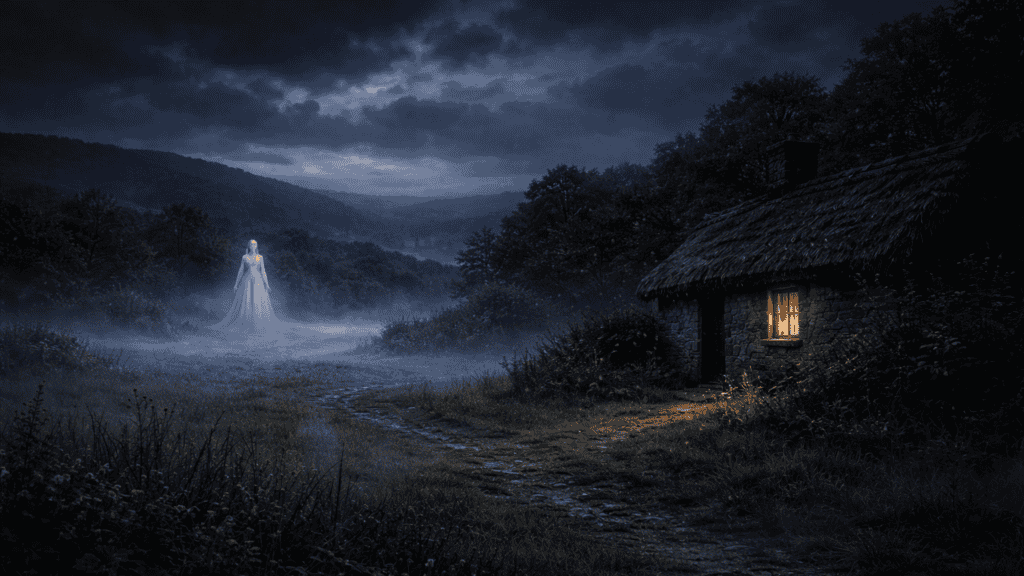
The best known is the cry of the banshee, heard outside the house of an old family before a death. Other signs were feared too: a bird flying into the house or tapping at the window, a picture falling from the wall for no reason, or a dog howling in the night. Birds were widely thought to carry messages between this world and the next, so a bird trying to get into the house was a messenger coming for someone. Dogs were believed to sense spirits and death before people could, which is why their howling at night was taken as a warning.
Customs at a Death
When someone died, the household followed a set of customs, and each one had a reason.
- Opening the window. A window was opened so that the soul could leave the house freely on its journey. It was closed again after an hour or two, so that the soul could not come back in, and people took care not to stand in the way between the bed and the window.
- Stopping the clocks. The clocks were stopped at the hour of death. It marked the moment the person died, and showed that ordinary time had stopped for the household during the days of mourning. Some said it also helped the soul leave without being held back by the life of the house.
- Covering the mirrors. Mirrors were covered because the soul, or the spirit of the dead, might be caught in the glass and unable to leave. Some also believed that the next person to see their own reflection in the room would be the next to die. Covering them also removed a sign of vanity from a house in mourning.
- Never leaving the body alone. The body was watched day and night until the burial. The main reason was protection: the soul was believed to be at its most vulnerable in the time between death and burial, and evil spirits or the fairies might try to take it, or even carry off the body. Keeping company with the dead was also a mark of respect and love, so that the person would not be alone on their last nights at home. There were practical reasons too, in houses where cats and rats could get in, and in an age when people were sometimes wrongly thought dead.
- The wake. That is why neighbors sat up through the night at the wake, praying, telling stories, and keeping the dead person company. The wake was also a farewell, a gathering of the community, and, in many places, a lively social occasion with food, drink, and games.
Superstitions About Animals and Birds
Animals were watched closely for signs of luck and warning.
- Magpies. A single magpie was unlucky, and many people still greet one to ward off the bad luck. Magpies usually travel in pairs, so a lone bird was thought to have lost its mate, a sign of sorrow. Christian legend also gave the magpie a bad name, saying it was the only bird that would not mourn at the Crucifixion. Greeting it politely was a way of showing respect and turning the bad luck aside. The old counting rhyme begins “One for sorrow, two for joy.”
- Robins. It was very unlucky to kill a robin or disturb its nest. According to a Christian legend, the robin got its red breast from the blood of Christ when it tried to pull a thorn from his crown, which made it a holy bird.
- Wrens. The wren had the opposite fate. Irish legend blamed it for betrayals: in one story, its chattering gave away the hiding place of Saint Stephen, and in another, it woke a sleeping enemy army by pecking on a drum. On St. Stephen’s Day, the Wren Boys hunted it and paraded it from house to house, in a custom that still survives in parts of Ireland, though today no real wren is harmed.
- Hares. A hare crossing your path was unlucky, and a hare seen near the cows on May morning might be a witch come to steal the milk. Stories told of hares that were shot or wounded, and of an old woman found the next day with the same wound.
Superstitions of the Sea
Fishing communities had some of the strictest superstitions of all, because life at sea was so dangerous and so much depended on luck. Fishermen were wary of meeting a red-haired woman on the way to the boat, though nobody has ever explained the belief convincingly. Whistling at sea was forbidden because it was thought to call up the wind, and a whistled breeze could become a storm. Certain words, such as the names of the priest or of some animals, were never said aboard, and fishermen used other names for them, because naming a thing was thought to invite its power. Seeing a merrow was taken as a warning of storms. Along the west coast, killing a seal could be unlucky, since some seals were believed to be selkies, people living under enchantment.
Everyday Signs of Luck
Many small superstitions are still repeated today, often half in jest.
- An itchy palm. Money is coming, if it is the right hand, or going, if it is the left.
- A luck penny. At a cattle fair, the seller gave a little money back to the buyer after the deal, for luck. It showed good faith, so that the buyer went home satisfied and the animal would thrive with its new owner.
- Turning back. It was unlucky to turn back after setting out on a journey, because it suggested that the journey had begun badly. If someone had to go back for something they had forgotten, they would sit down for a moment before setting out again, to start the journey fresh.
- New Year’s Eve. Some households banged a loaf of bread against the door to drive out bad luck and hunger for the year ahead. The bread stood for plenty, and striking it on the door was meant to chase want out of the house and keep food on the table all year.
- The ring in the barmbrack. At Halloween, the one who found the ring baked into the barmbrack would marry within the year.
Why Irish Superstitions Lasted
Irish superstitions survived for several reasons. Many were attached to real dangers: illness, the loss of cattle, the death of children, drowning at sea. A precaution that cost nothing, like saying a blessing or saluting a magpie, seemed worth keeping just in case. Many were also reinforced by the Church’s own blessings and sacramentals, like holy water and Brigid’s crosses, which blended easily with older beliefs. And they were passed on at the fireside, as part of the stories every child grew up with.
In the 1930s, the Irish Folklore Commission asked schoolchildren across Ireland to collect the beliefs and customs of their own districts. The result, known as the Schools’ Collection, preserves a vast record of local superstitions in the words of the people who practiced them.
Are Irish People Still Superstitious?
Many still keep a few old habits, often without calling them superstitions. People still salute magpies, avoid cutting lone hawthorns, and hang St. Brigid’s crosses. Road projects in Ireland have been changed to spare fairy trees, and politicians have raised fairy forts in national debate. Belief has faded, but the caution often remains.
Sources and Further Reading
- Seán Ó Súilleabháin, A Handbook of Irish Folklore, Educational Company of Ireland (1942).
- W. G. Wood-Martin, Traces of the Elder Faiths of Ireland, Longmans, Green, and Co. (1902).
- Lady Wilde, Ancient Legends, Mystic Charms, and Superstitions of Ireland, Ward and Downey (1887).
- Kevin Danaher, The Year in Ireland: Irish Calendar Customs, Mercier Press (1972).
- The Schools’ Collection, National Folklore Collection, University College Dublin (1937 to 1939), on dúchas.ie.