In Short
A fairy fort is the Irish name for a ringfort, a circular earthen bank or stone wall that once enclosed an early medieval farmstead. There are around 45,000 of them across Ireland, making them the most common ancient monument in the country. Long after their builders were forgotten, folklore made them the homes of the Aos Sí, the fairy people, and held that anyone who damaged one would suffer for it. That belief protected thousands of forts from the plough, and it still shapes how many Irish people treat them today.
| What it is | A ringfort: a circular enclosure of earth or stone around an early farmstead |
|---|---|
| Irish names | Ráth and lios (earthen), caiseal and cathair (stone), dún (a stronghold) |
| How many | About 45,000 recorded in Ireland |
| Built | Mostly about AD 500 to 1000 |
| Size | Usually 20 to 60 meters across |
| In folklore | Homes and gathering places of the Aos Sí |
| The rule | Never damage a fort, cut its trees, or move its stones |
| Legal protection | Recorded monuments are protected by law in the Republic of Ireland |
What Is a Fairy Fort?
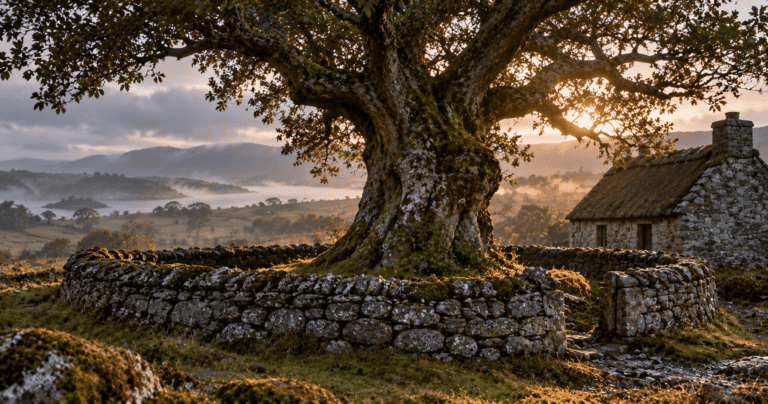
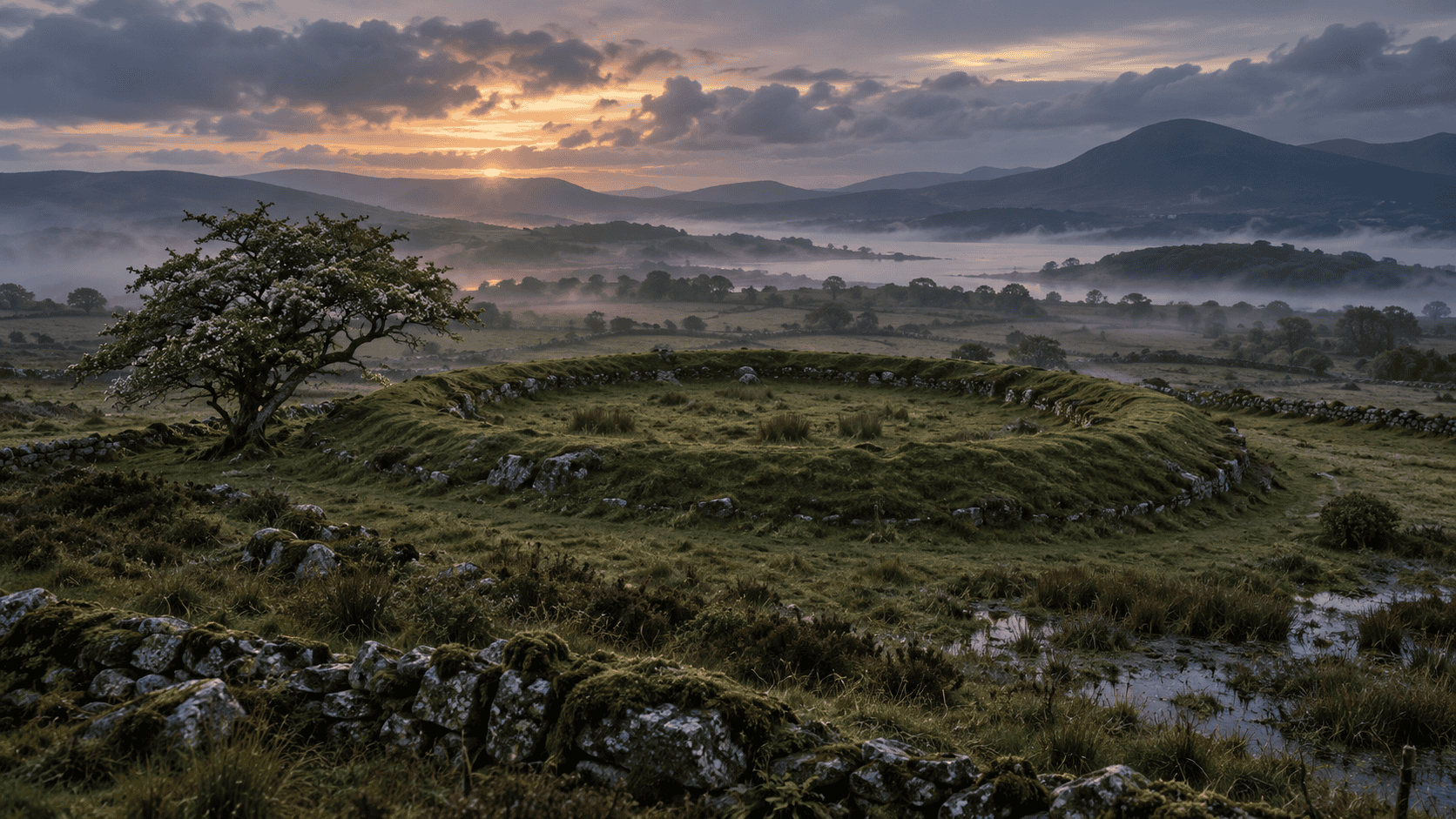
Look across almost any stretch of Irish farmland and sooner or later you will spot one: a low, round bank in the middle of a field, often ringed with hawthorn and ash, sometimes so overgrown that it looks like a small circular wood. The fields around it have been cleared, drained, and ploughed for generations. The circle itself has been left alone.
That is a fairy fort. To an archaeologist, it is a ringfort, the remains of a farmstead more than a thousand years old. To generations of Irish country people, it was something else as well: a place that belonged to the fairies, where their music could be heard at night, and where no sensible person would cut a bush or move a stone.
What Ringforts Really Were
Ringforts were not forts in the military sense. Most were the homes of prosperous farming families in early medieval Ireland, built mainly between about AD 500 and 1000. A bank of earth, thrown up from a ditch dug outside it, enclosed a circular yard, usually 20 to 60 meters across, and was often topped with a wooden fence. Inside stood one or more houses, workshops, and pens for cattle, which were the main measure of wealth in early Ireland. Many ringforts also had a souterrain, an underground passage used for storage or as a place to hide.
Irish has several words for them. A ráth or lios usually had earthen banks, while a caiseal or cathair was built of stone. A dún was a stronghold of some importance, whatever its shape. Those words survive in hundreds of place names across Ireland, from Rathmines and Rathcoole to Lismore, Listowel, Cashel, Cahersiveen, and Dundalk. A larger ringfort, with two or three rings of banks and ditches, probably belonged to someone of high status.
About 45,000 ringforts have been recorded in Ireland, and there were once many more. They are so common that, on average, there is roughly one for every two square kilometers of the island.
How Ringforts Became Fairy Forts
By the later Middle Ages, people had stopped building and living in ringforts. The houses rotted away, and the banks grassed over and grew up with thorn and briar. To later generations, who had no idea who had built them or why, the silent green circles in their fields were a mystery.
Folklore filled the gap. Irish tradition already told of the Aos Sí, the fairy people descended from the Tuatha Dé Danann, who lived hidden inside the hills and ancient mounds. The ringforts, which looked like smaller versions of those mounds, became their homes too. The word lios, which had once simply meant the yard of a farmstead, came to mean a fairy dwelling. The forts were not abandoned at all, people said. Their owners had simply become invisible.
What People Said Happened There
The folklore of fairy forts is full of quiet, unsettling detail. People told of hearing music coming from a fort at night, or seeing lights moving on its banks. The fairy host was said to travel between neighboring forts along invisible paths, and a house built across one of those paths could expect trouble until a corner was knocked off or the door was moved. People who fell asleep inside a fort, or wandered into one at the wrong hour, might be taken into the fairy world, or come home changed.
Some forts were thought to be especially powerful meeting places, where the fairies of one district gathered before battling those of another. Accounts like these turn up in every county in the folklore collected by schoolchildren for the Schools’ Collection in the 1930s, now online at dúchas.ie.
Never Disturb a Fairy Fort
Above all, the folklore agreed on one rule: leave the fort alone. That meant not digging into its banks, not ploughing through it, not removing its stones, and above all not cutting the fairy thorns that grew on it. People who broke the rule were said to suffer illness, the death of their cattle, crop failure, injury, or a death in the family. The stories are many and varied, and the lesson was always the same. Our article on why you should never disturb a fairy fort gathers more of the warnings.
That fear had a remarkable side effect. Because farmers would not touch the forts, tens of thousands of early medieval sites survived into the modern age, largely undamaged, in the middle of intensively farmed land. Archaeologists owe a real debt to the fairies. Even so, many ringforts have been lost to farming and development over the past two centuries, as the old belief has weakened.
Fairy Forts in Modern Ireland
The belief has not disappeared. Many farmers still plough around a fort rather than through it, and builders have been known to change their plans rather than disturb one. In Killarney, a factory was reportedly built around a ringfort rather than on top of it.
The subject even reached national news in 2017, when Danny Healy-Rae, a member of the Dáil from County Kerry, suggested that a dip which kept reappearing in the N22 road near Killarney might be linked to the many fairy forts in the area. He said that anyone who had tampered with them over the years had paid a high price, and that he would starve before he would knock one himself. Road engineers had put the problem down to the ground beneath the road. The remark caused plenty of amusement, but it also started a national conversation, and many people admitted they would never touch a fort either.
Are Fairy Forts Protected by Law?
Many are. In the Republic of Ireland, most known ringforts are listed in the Record of Monuments and Places, which is protected under the National Monuments Acts. Under section 12 of the 1994 amendment to those Acts, anyone planning work at or near a recorded monument must give the relevant government minister two months’ written notice before starting, except in an emergency. Some of the most important forts are also State-owned National Monuments. So, in practice, the fairies now have the law on their side as well.
Fairy Forts You Can Visit
Most ringforts stand on private farmland, but some of the finest are open to visitors:
- Grianán of Aileach, County Donegal. A massive stone ringfort on a hilltop, built on the site of a much older hillfort, with wide views over Lough Swilly and Lough Foyle.
- Caherconnell, County Clare. A well-preserved stone fort in the Burren, near Poulnabrone dolmen, with a visitor center.
- Cahergall, County Kerry. A large stone fort near Cahersiveen, on the Ring of Kerry.
- Rathrar, County Roscommon. A large and well-preserved earthen ringfort, with its banks and ditches still clearly visible.
For a fort on farmland, always ask the landowner’s permission before visiting, and leave everything exactly as you found it.
Is It Bad Luck to Visit a Fairy Fort?
Not according to most tradition. The folklore warns against damaging a fort, not against walking into one, although many people would avoid being inside one at night. Visiting respectfully, without taking anything or disturbing the banks, stones, or trees, is fine by the old rules and by the law. The fairies, it seems, object to vandals, not visitors.
Sources and Further Reading
- Matthew Stout, The Irish Ringfort, Four Courts Press (1997).
- Dáithí Ó hÓgáin, Myth, Legend and Romance: An Encyclopaedia of the Irish Folk Tradition, Ryan Publishing (1990).
- Eddie Lenihan and Carolyn Eve Green, Meeting the Other Crowd: The Fairy Stories of Hidden Ireland, Tarcher (2004).
- The Schools’ Collection, National Folklore Collection, University College Dublin (1937 to 1939), on dúchas.ie.
- National Monuments Service, Historic Environment Viewer and Record of Monuments and Places.