In Short
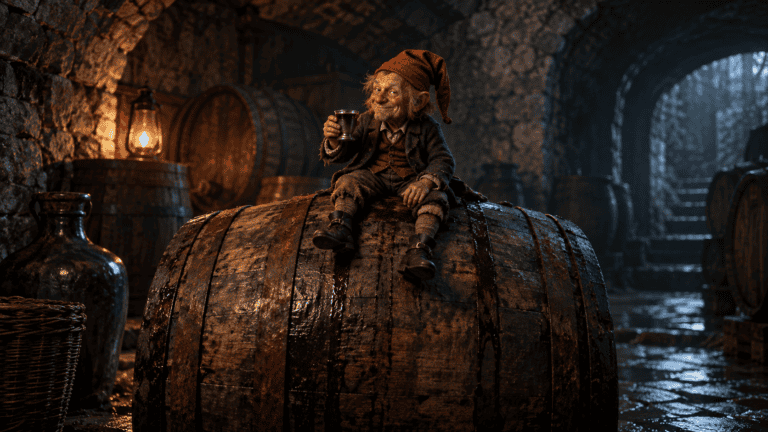
The Aos Sí (pronounced ees shee) are the fairy folk of Irish tradition, the people of the sídhe or mounds. In the oldest account, they are the Tuatha Dé Danann, the defeated gods, who withdrew underground when the Gaels took Ireland. They were rarely named directly, and the rules for living alongside them were followed in rural Ireland well into the twentieth century.
| Irish name | Aos sí, older áes síde, the people of the mounds |
|---|---|
| Usual names for them | The good people, the gentry, the neighbors, themselves |
| Who they are | The Tuatha Dé Danann after their defeat by the Gaels |
| Where they live | Ringforts, passage tombs, lone hawthorns, lakes and hills |
| Two groups | The trooping host and the solitary spirits |
| Active at | May Eve, November Eve, midday and midnight |
| Protections | Iron, salt, fire, not thanking them, not naming them |
| Still visible in | Untouched forts in working fields, rerouted roads |
What the Name Means
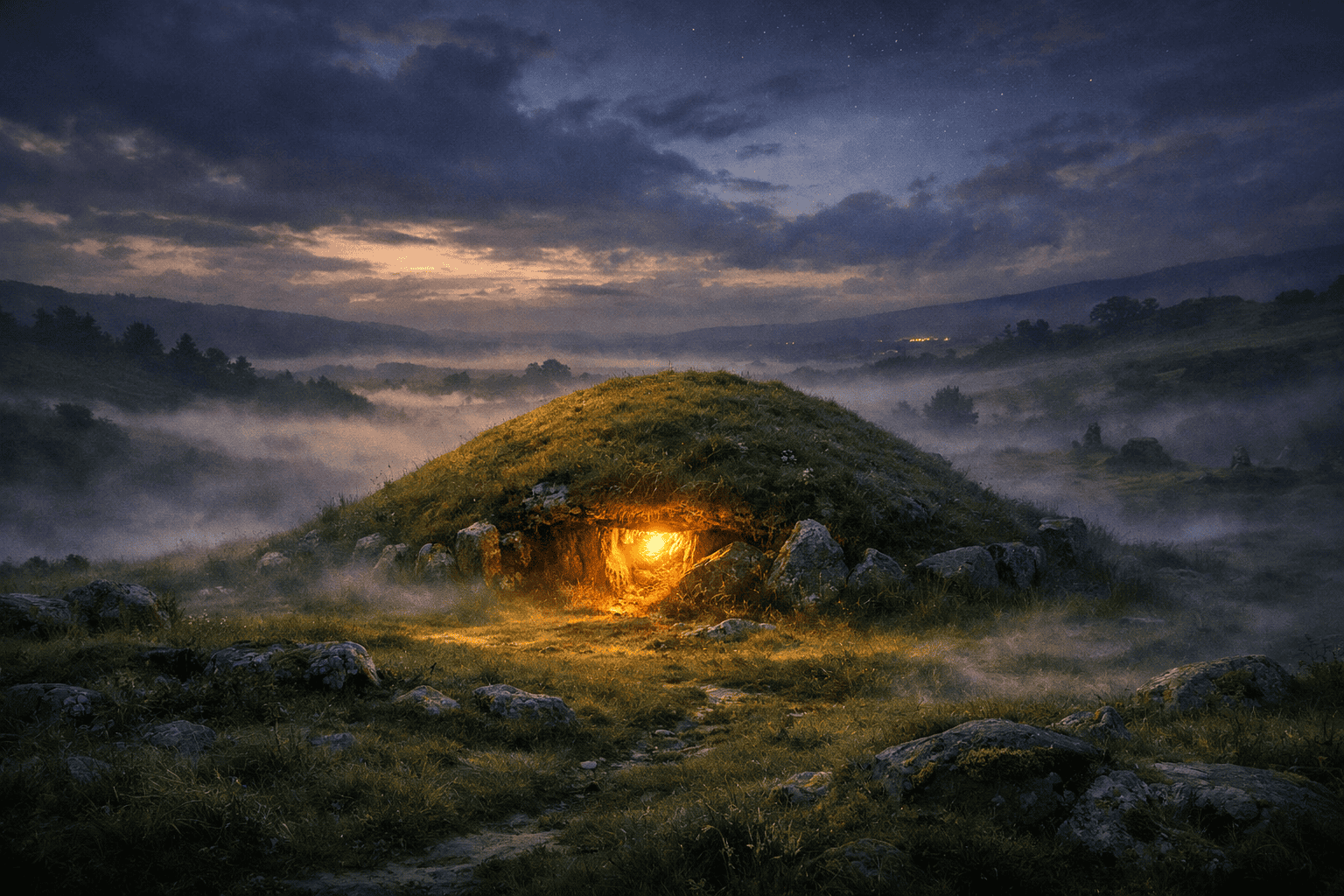
Sí, older sídh, means a mound. The aos sí are therefore the people of the mounds, and the mounds are real: the ringforts, raths and passage tombs that sit in fields all over Ireland, tens of thousands of them, most built between the Iron Age and the early medieval period.
The word does something else too. Sí also came to mean the Otherworld itself, so the same syllable covers the dwelling, the people and the place they live. That collapse of categories is the whole belief in miniature. You cannot separate these beings from the ground they are in.
What almost nobody did was call them fairies, or call them anything at all if it could be avoided. They were the good people, the gentry, the neighbors, the folk, or simply themselves. Naming a thing draws its attention.
Who They Were
Irish tradition gives three answers to where the Aos Sí came from, and all three were held at once, often by the same people.
The first is the mythological account. The Tuatha Dé Danann lost Ireland to the Milesians and the country was divided: the Gaels took what lies above ground, and the old gods took everything below it. In this reading the Aos Sí are the gods of pre-Christian Ireland, still resident, still owed their due.
The second is the Christian account, recorded again and again by collectors. The fairies are angels who fell with Lucifer but were not wicked enough for hell, and were left suspended between, in the air, the water and the hills. Whether they will be saved at the last day is a question people asked seriously.
The third is that they are the dead, or some of the dead, which is why the same house might fear a fairy fort and an unquiet grave in roughly the same way.
What They Looked Like
Not small. The Victorian fairy, winged and thumb-sized, is an English invention that reached Ireland through books rather than tradition.
The collected descriptions are consistent and quite different. The Aos Sí are the height of people or taller, finely dressed, often on horseback, and frequently described as the gentry precisely because they carried themselves like landed aristocracy. Witnesses in the accounts gathered by W. Y. Evans-Wentz around 1910 describe them as a noble people, beautiful and cold, who take offense easily.
The types of Irish fairies divide broadly into the trooping host, seen moving in numbers between forts, and the solitary beings who work alone, such as the banshee and the púca.
The Rules
Belief in the Aos Sí was not a matter of opinion. It was a set of things people did and did not do, and the rules were specific.
Do Not Disturb Their Ground
Ringforts were left standing in the middle of tilled fields, with the plow going around them for centuries. Lone hawthorns in open ground were not cut. Digging into a fairy fort carried a real expectation of consequence, and the stories about what followed are among the most commonly collected in Ireland.
Do Not Block Their Path
The fairies were believed to travel in straight lines between forts. A house built across such a line would suffer: illness, noise, cattle that would not thrive. The usual remedy was to leave the front and back doors aligned so the host could pass through, or to take a corner off the building.
Do Not Thank Them, and Do Not Name Them
Direct thanks acknowledged a debt and invited a claim. The safe formula was indirect: a blessing said aloud, or nothing at all. When a sudden whirlwind crossed a field, the sí gaoithe, people said a short blessing rather than commenting on it.
Give Them Their Share
The first of the milk spilled on the ground. A portion of food left out. Crumbs from the churn. These were not offerings in a devotional sense. They were closer to tribute, or to the courtesy you show a neighbor whose goodwill you need.
You did not believe in the good people the way you believe a fact. You conducted yourself as though they were there.
The attitude running through the Schools’ Collection accounts
What They Were Said to Do
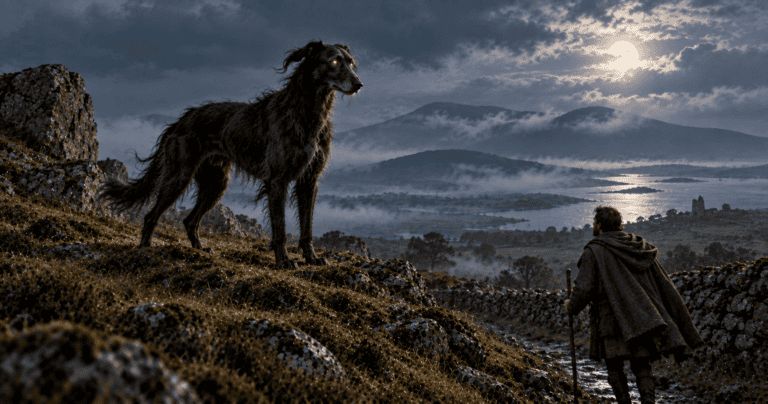
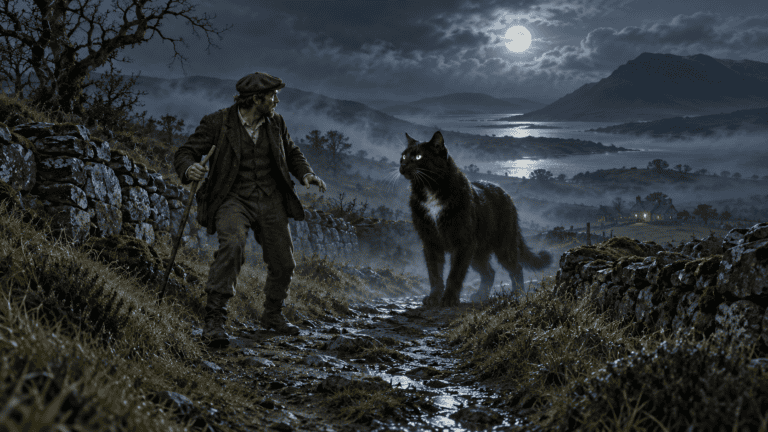
The Aos Sí took things: butter from the churn, the goodness out of milk, the strength from a crop. They led travelers astray, so that a man who knew every field of his own townland walked all night without reaching home.
They took people too. Someone abducted was said to be away, and might be returned years later, or seen among the riders by a relative who could do nothing. A sudden paralysis or stroke was a poc sí, a fairy blow. A child who failed to thrive might be declared a changeling, a fairy substitute left in place of the real one, and that belief did real and sometimes fatal harm.
They also gave. Musicians got their tunes from the fairies. Healers got their cures. A person who treated them correctly might find a run of luck that lasted years.
When They Were Abroad
The Aos Sí were more active at the turning points of the year. May Eve and November Eve were the two great ones, when they were said to move house between forts and when nobody wanted to be out on a road at night.
The same logic applied to the day: midday and midnight, and the edges of things generally. A boundary between two fields, the threshold of a house, the shore between land and sea, the moment between one season and the next. Irish tradition locates danger at edges.
The Belief Has Not Entirely Gone
This is the part most accounts treat as quaint, and it should not be.
In 1999 a planned bypass in County Clare was rerouted around a lone hawthorn after the folklorist Eddie Lenihan argued publicly that it was a meeting place for the fairies of Munster and Connacht. The road was moved. Farmers still leave forts standing. Contractors still find themselves unable to get local men to take a digger to certain ground.
What is at work is not usually literal belief. It is closer to the reasoning behind not walking on a grave: the cost of respecting it is nothing, and the cost of being wrong is unbounded.
Where to Read Next
For the broader picture, the Irish fairies and whether they are good or evil. For the world they withdrew into, the Otherworld. For the ground itself, fairy forts and fairy rings. And for the individual beings, the guide to Irish creatures.
Sources and Further Reading
- The Schools’ Collection, National Folklore Collection, University College Dublin (1937 to 1939), on dúchas.ie.
- W. Y. Evans-Wentz, The Fairy-Faith in Celtic Countries (1911).
- Lady Wilde, Ancient Legends, Mystic Charms and Superstitions of Ireland (1887).
- Angela Bourke, The Burning of Bridget Cleary: A True Story, Pimlico (1999).
- Eddie Lenihan and Carolyn Eve Green, Meeting the Other Crowd: The Fairy Stories of Hidden Ireland, Tarcher (2004).