In Short
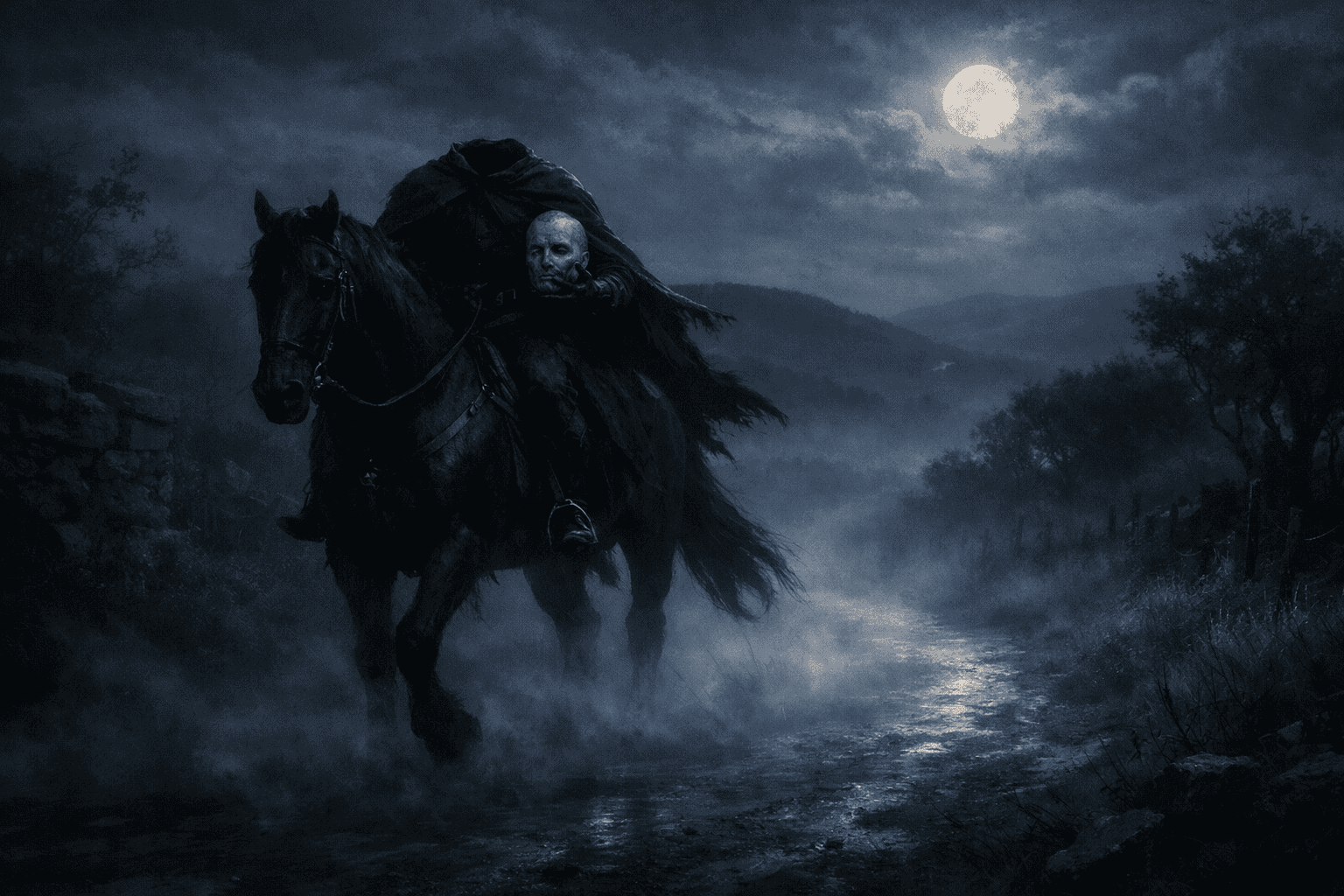
The Dullahan (pronounced DULL-uh-han) is the headless rider of Irish folklore, a death omen who travels the roads at night on a black horse, carrying his own head. When he stops and calls out a name, that person dies. He was recorded in County Cork in the 1820s by the collector Thomas Crofton Croker, and he often rides with the cóiste bodhar, a silent death coach drawn by headless horses.
| Name | Dullahan, from Irish dúlachán |
|---|---|
| Other name | Gan Ceann, “without a head” |
| Pronunciation | DULL-uh-han |
| Type | Solitary spirit and death omen |
| Appearance | A headless rider on a black horse, holding his own head |
| Companion | The cóiste bodhar, or death coach |
| What he does | Stops, calls a name, and the person named dies |
| Key early source | Thomas Crofton Croker, 1828 |
| Said to fear | Gold, in modern retellings |
What Is the Dullahan?
You hear him before you see him. Hooves on a dark road, coming fast, with no lantern and no rider’s voice. Then the horse comes around the bend, and the man on its back has no head on his shoulders. He is holding it. And if he pulls up outside your house and says your name, it does not matter how fast you run.
That is the Dullahan, the headless rider of Irish folklore and one of the grimmest figures the tradition produced. Plenty of Irish spirits are unpredictable. The púca might throw you in a ditch or clean your kitchen, depending on its mood. The Dullahan has no moods. He has one errand, and it is always the same.
Where the Name Comes From
Dullahan is an English spelling of the Irish dúlachán. The word is often explained as meaning something like “dark one,” from the Irish dubh, meaning dark or black, but the etymology is not certain, and dictionaries do not agree on it. The rider also went by a far more literal name: Gan Ceann, which means simply “without a head.” Irish folklore was not always subtle.
The figure reached print through Thomas Crofton Croker, a Cork-born collector who published Fairy Legends and Traditions of the South of Ireland in the 1820s. The second part of that collection, published in 1828, grouped several Munster tales of headless riders and phantom coaches under the heading “The Dullahan.” Most later writing about the Dullahan, including much of what appears online today, traces back to those stories.
Croker’s books were a sensation in their day. The first volume came out anonymously in 1825, and within a year the Brothers Grimm had translated it into German as Irische Elfenmärchen, “Irish Fairy Tales.” That meant a Cork collector’s headless riders and fairy mounds were being read in Germany almost as soon as they were being read in London. It also means the Dullahan most people know today is, at root, a Munster figure, first written down among the storytellers of Croker’s own province.
A Rider Who Carries His Own Head
The missing head is the part everyone remembers, but the tellers were careful to say it was not missing at all. The Dullahan carries it with him, usually under one arm or held up in his hand. He can see with it. In the most common descriptions it is pale and corpse-like, with a wide, fixed grin and eyes that dart about in their sockets, searching the dark.
His horse is black and runs at a speed no living horse could match. Put the two together and the picture is simple and very hard to forget: a dead man on a fast horse, looking for someone, and looking with eyes that are not where eyes should be.
The Death Coach
Sometimes the Dullahan does not ride at all. He drives. The cóiste bodhar, pronounced roughly KOSH-tyuh BOW-er, is the death coach of Irish folklore. The name means “the deaf coach” or “the silent coach,” and it is usually described as a black carriage drawn by headless horses, with the Dullahan at the reins. Croker included it among his Dullahan material, and it turns up across Munster tradition as a sign that someone in the house it passes will soon die.
When the Dullahan Stops
The Dullahan’s whole purpose comes down to one moment. He rides until he reaches the home of the person whose time has come. There he stops, and he calls out that person’s name. Death follows, often on the spot.
That is what separates him from most other death omens in Ireland. The accounts gathered for the Schools’ Collection in the 1930s are full of them: a picture falling from the wall, a strange knock, a banshee keening in the night. All of these are warnings. They tell a family that a death is coming. The Dullahan is not a warning. By the time he stops, the matter is already settled.
Can the Dullahan Be Stopped?
According to almost every modern account, yes, and the answer is surprisingly small. The Dullahan is said to fear gold. A gold coin, a gold pin or even a sliver of the metal is supposed to be enough to drive him off, and some versions say he will not come near a house where gold is kept.
It is a satisfying rule, and it appears in nearly every book and website that mentions him. What is harder to find is its source. We have not been able to trace the gold rule to a named nineteenth-century collector, and it does not appear in Croker’s stories. It may well be a genuine piece of local belief that simply went unrecorded. It may also be a later addition. Either way, it is safer to treat it as part of the modern Dullahan rather than the one Croker wrote down.
What the Modern Books Add
The gold rule is not the only detail with a thin paper trail. Popular books from the twentieth century onward gave the Dullahan a whole kit of extra horrors. His whip is made from a human spine. No lock or gate can keep him out, because every gate swings open as he approaches. Anyone foolish enough to watch him pass gets a basin of blood thrown in the face, or an eye lashed out by that whip. The death coach grows wheels with thigh bones for spokes and candles burning in skulls.
These images are vivid, and they have been repeated so often that they now feel traditional. But they are hard to trace to any early collector, and readers should enjoy them with that in mind. The same goes for a popular theory that the Dullahan was once Crom Dubh, a pre-Christian god supposedly worshipped with human sacrifice. There is no early evidence linking the two. The idea is a modern guess that has hardened into a “fact” through repetition.
The Dullahan and the Banshee
The two are often mentioned together, and for good reason, since both are tied to death. But they could hardly be more different in character. The banshee grieves. She keens for particular old families, and her cry is an act of mourning, sometimes even of loyalty. The folklorist Patricia Lysaght, who studied hundreds of banshee accounts, showed how closely she was bound to the families she followed.
The Dullahan has no such bond. He does not mourn and he does not belong to anyone. If the banshee is the family member weeping at the bedside, the Dullahan is the knock at the door.
From Cork to Sleepy Hollow and Beyond
People who hear about the Dullahan often assume he inspired the headless horseman in Washington Irving’s “The Legend of Sleepy Hollow,” published in 1820. It is a natural guess, but there is no evidence for it. Irving’s horseman is the ghost of a Hessian soldier who lost his head to a cannonball, and his story draws on European and American ghost lore rather than anything Irish. Headless riders appear in folklore across Europe, and the two figures are best seen as cousins, not parent and child.
The Dullahan has had a busy modern life all the same. He has turned up in fantasy novels, role-playing games and horror films, and in the Japanese anime series Durarara!!, where a dullahan named Celty rides the streets of Tokyo on a black motorcycle in search of her lost head. Most of these versions are far friendlier than the original. In the stories told in Cork two centuries ago, nobody wanted to meet him, and nobody wanted to hear the hooves slow down outside their door.
Sources and Further Reading
- Thomas Crofton Croker, Fairy Legends and Traditions of the South of Ireland, Part II, John Murray (1828).
- Washington Irving, “The Legend of Sleepy Hollow,” in The Sketch Book of Geoffrey Crayon, Gent. (1820).
- Katharine Briggs, An Encyclopedia of Fairies, Pantheon Books (1976).
- Patricia Lysaght, The Banshee: The Irish Supernatural Death-Messenger, Glendale Press (1986).
- The Schools’ Collection, National Folklore Collection, University College Dublin (1937 to 1939), on dúchas.ie.