In Short
The Púca (pronounced POO-kuh, often spelled pooka) is a shapeshifting spirit of Irish folklore, most often seen as a sleek black horse that carries unlucky riders on a wild night ride. It can also appear as a goat, a bull, an eagle, or a man, and it is neither wholly good nor wholly evil. Rural tradition tied it to the end of the harvest, which is why children were warned never to eat blackberries after Samhain.
| Irish name | Púca, plural púcaí |
|---|---|
| Pronunciation | POO-kuh |
| English spellings | Pooka, phooka, phouka |
| Type | Solitary shapeshifting spirit |
| Usual forms | Black horse, goat, bull, eagle, donkey, a small dark man |
| Season | Samhain and the start of November |
| Known for | Terrifying rides, spoiled blackberries, occasional good turns |
| Place names | Poulaphouca in Wicklow, Carrigaphooca in Cork |
| Relatives | English Puck, Welsh pwca |
What Is the Púca?
Picture a man walking home from a fair, well after dark, with more drink in him than sense. A black horse is standing by the road, with no saddle and no owner in sight, watching him. A man who knows the old stories keeps walking. The one who climbs on is about to meet the púca.
The púca is one of the solitary beings of Irish folklore. It does not ride with the fairy host or dance in the forts. It works alone, it changes shape at will, and it has a talent for turning an ordinary night into one a person talks about for the rest of his life.
It is also hard to pin down, and not only because of the shapeshifting. The banshee has one job, and everyone knows what it is. The púca has no job at all. In one story, it throws a traveler into a ditch. In the next, it scrubs a kitchen floor until dawn. Nineteenth-century collectors found it frightening in one parish, mischievous in the next, and helpful in a third, and they wrote down all three without trying to make them agree.
Púca or Pooka: Which Spelling Is Right?
Both, depending on the language you are writing in. Púca is the Irish spelling, and it is the one this site uses. Pooka is the English phonetic version, which spread through nineteenth-century story collections and Revival writing along with older forms such as phooka and phouka. If you need more than one, the Irish plural is púcaí.
The name has relatives across the water. English folklore has Puck, the household sprite who turns up as Robin Goodfellow in Shakespeare’s A Midsummer Night’s Dream. Wales has the pwca. The three words are clearly related, but nobody has settled which language lent the word to the others. The folklorist Dáithí Ó hÓgáin thought the Irish word probably arrived from Norse or English speakers in the Middle Ages. If he was right, the name is younger than many of the hills and waterfalls it now haunts.
A Creature of Many Shapes
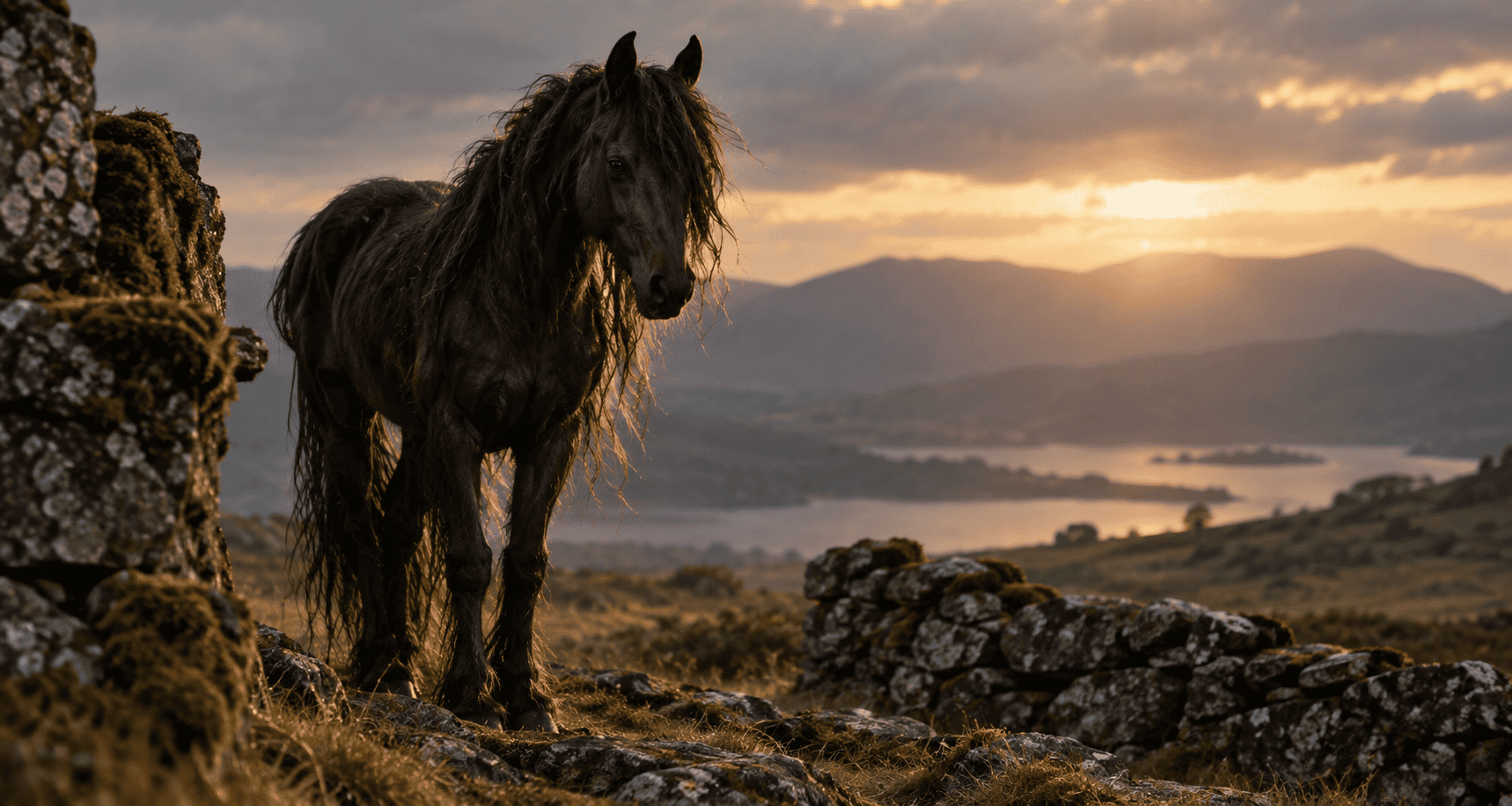
The horse is the classic form, and for good reason. Irish accounts describe a dark, powerful animal with a flowing mane and eyes that burn in the dark, standing by the roadside as though it has been waiting for you. Most of the famous púca stories use this shape, and most modern illustrations do too.
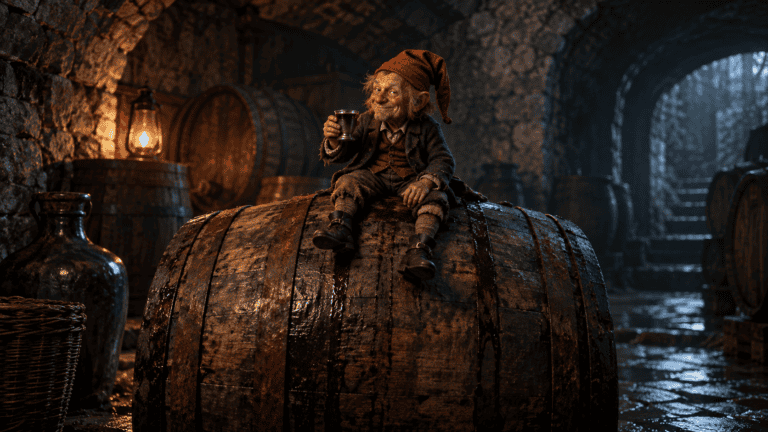
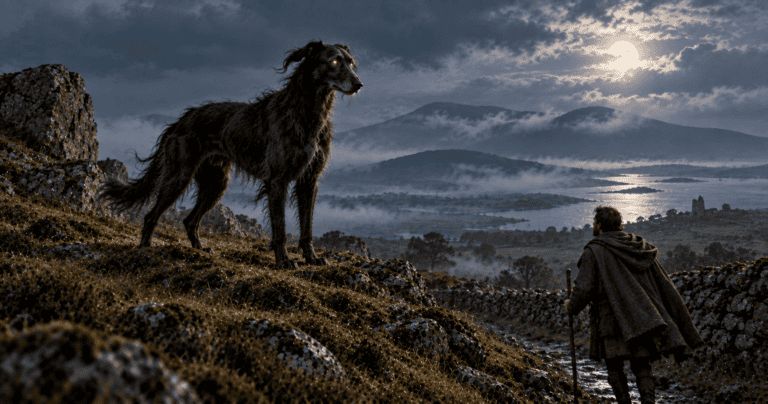
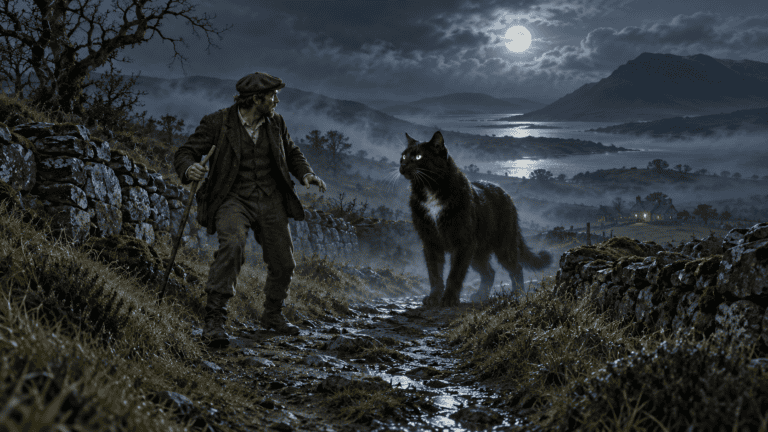
But the horse was only the favorite. When W. B. Yeats gathered Irish stories for his 1888 anthology Fairy and Folk Tales of the Irish Peasantry, he described the púca as an animal spirit that could come as a horse, a donkey, a bull, a goat, or an eagle. Other accounts give it a human shape, usually a small, wizened man. In some districts, it was a shaggy goat with curling horns.
The shape depended on who was telling the story and where. One thing never changed. The animal in front of you was not really an animal, and by the time you found that out, it was usually too late.
The Púca’s Ride
The ride is the púca’s signature trick, and the stories follow a familiar pattern. A traveler is heading home late, often from a fair or a wake, often with drink taken. He finds a horse where no horse should be. Sometimes he is foolish enough to climb on. Sometimes he is given no choice, because the púca slips between his legs and hoists him onto its back.
Then it runs. It crosses bogs and ditches, clears hedges, skirts cliff edges, and, in some tellings, leaves the ground altogether. The rider can do nothing but hold on. At dawn, when the púca has had its fun, it tips him into a ditch or a stream and vanishes. He is almost always unhurt. He is also soaked, bruised in his pride, and, for once, completely sober, with a long walk home and a story that nobody is going to believe.
The Piper and the Púca
The best-known version is “The Piper and the Púca,” which Douglas Hyde translated from Irish and Yeats printed in his 1888 anthology. Its hero is a drunken piper with a limited repertoire. He can play exactly one tune, “The Black Rogue,” and he plays it whether people ask him to or not.
One night a púca with long horns scoops him up and carries him at full speed across the country. The piper clings to the horns for dear life. He ends the night playing for a gathering of banshees, which is not an audience any piper would choose, before he is returned home, shaken and changed. The story shows the púca at its most typical. It is not out to kill anyone. It takes an ordinary man far out of his depth and then sends him back to tell the tale.
A Púca That Worked for Its Keep
Not every púca is out to terrify. In 1866, the Wexford collector Patrick Kennedy published Legendary Fictions of the Irish Celts, which includes a story he called “The Kildare Pooka.” It is set in a big house in County Kildare, where something strange is happening in the kitchen. Every night, after the family goes to bed, the dishes get washed, the kitchen gets cleaned, and the floor gets swept. Nobody in the house is doing it.
A scullery boy decides to stay up and see who is. What he finds is a púca in the shape of a donkey, hard at work. It tells him that it was once a servant in this same house, and a lazy one, and that it is now working off its idleness as a penance. When the household offers it a new coat in thanks, it leaves and is never seen again.
Readers who know Scottish or English folklore will recognize the pattern. The brownie and the hob are household spirits that also work in secret and also leave when someone rewards them with clothing. The Kildare story shows that the púca could sit on either side of the line between menace and help.
The Púca and the Blackberries
If you grew up in rural Ireland, you may have been told this one yourself. After Samhain, the festival at the start of November that closed the harvest and opened the winter, the blackberries belong to the púca. On November Eve, it was said to spit on them, or to foul them outright, so that any fruit left on the brambles was spoiled. The belief turns up again and again in the accounts gathered for the Schools’ Collection between 1937 and 1939.
Like a lot of good folklore, it has a practical side. By November, blackberries left on the bush are usually watery, moldy, or full of insects, so a rule that kept children away from them did real good. But the belief also placed the púca right at the turning of the year. That was the same night when the fairy host was said to move between forts and the dead were thought to walk abroad.
The Púca in the Irish Landscape
One of the surest signs that a belief ran deep is that it ends up on the map, and the púca did. Poulaphouca, from Poll an Phúca, “the púca’s hole,” is a waterfall and gorge on the River Liffey in County Wicklow. The reservoir built above it in the 1940s took the same name. Carrigaphooca, from Carraig an Phúca, “the púca’s rock,” is a MacCarthy tower house on a rock outcrop near Macroom in County Cork.
Smaller place names across the country mark púca holes, púca rocks, and púca fields. They tend to cluster at waterfalls, cave mouths, and sudden drops. Those are exactly the places where a runaway horse might throw its rider, which may be the whole point.
Is the Púca Good or Evil?
Neither, in any simple sense. Like the Aos Sí more broadly, the púca lives outside human ideas of right and wrong. It frightens people far more often than it harms them, and the harm it does is usually to their pride. The riders in the stories survive. The piper gets home. The kitchen in Kildare gets cleaned.
That makes the púca more of a trickster than a monster. Its favorite targets are the careless, the drunk, and the overconfident, the sort of man who sets off down a dark road alone and assumes he will be fine. The rare person who treats it with respect may come out ahead. The safest plan, as with most of the good people, was never to meet it at all.
The Púca in Popular Culture
The púca has had a surprisingly busy career in print. In Flann O’Brien’s 1939 comic novel At Swim-Two-Birds, the Pooka MacPhellimey appears as a gentlemanly devil who argues philosophy with a Good Fairy while the two travel to a birth. In the United States, Mary Chase’s play Harvey won the Pulitzer Prize for Drama in 1945. Its title character is a six-foot invisible rabbit, and the play calls him a pooka. The 1950 film, starring James Stewart, made him famous.
Harvey is where the idea of the púca as a rabbit comes from, and it is also behind the gentle, whimsical púca found in a lot of recent fantasy. Neither has any root in Irish tradition. The rabbit is an American invention of the 1940s. The cuddly trickster leaves out the one thing that made the púca worth warning children about. In the old stories, the horse by the road is not your friend, and it is not waiting to give you a pleasant ride home.
Sources and Further Reading
- Patrick Kennedy, Legendary Fictions of the Irish Celts, Macmillan (1866).
- W. B. Yeats, ed., Fairy and Folk Tales of the Irish Peasantry, Walter Scott (1888).
- The Schools’ Collection, National Folklore Collection, University College Dublin (1937 to 1939), on dúchas.ie.
- Katharine Briggs, An Encyclopedia of Fairies, Pantheon Books (1976).
- Dáithí Ó hÓgáin, Myth, Legend and Romance: An Encyclopaedia of the Irish Folk Tradition, Ryan Publishing (1990).