In Short
The Otherworld is the supernatural realm of Irish mythology: a land of eternal youth, feasting, and music, where sickness and death are unknown and time runs differently. It has many names, including Tír na nÓg, Mag Mell, and Tír Tairngire, and it lies in many places at once: inside the ancient mounds, beneath lakes and the sea, and on islands far out in the western ocean. The Tuatha Dé Danann withdrew there when the ancestors of the Irish took the land, and the medieval voyage and adventure tales are full of mortals who were invited in, and who found it hard, or impossible, to come home.
| Main names | Tír na nÓg, Mag Mell, Tír Tairngire, Emain Ablach, Tír fo Thuinn |
|---|---|
| Where it lies | Inside the síd mounds, beneath lakes and sea, on western islands |
| Who lives there | The Tuatha Dé Danann, the Aos Sí, Manannán mac Lir |
| What it is like | Eternal youth, endless food and music, no sickness or death |
| Time | Moves differently; a year there may be centuries here |
| When it opens | Especially at Samhain and Bealtaine |
| Key tales | Echtra Condla, Immram Brain, Echtrae Cormaic, the story of Oisín |
| Land of the dead | Tech Duinn, “the House of Donn,” off the south-west coast |
What Is the Otherworld?
A young prince is standing with his father on a hill when a woman in strange clothes appears beside him. Only he can see her. She tells him of a land where there is no death and no sin, where people feast forever without serving, and where she will love him. She throws him an apple, and for a month he eats nothing else, yet the apple never shrinks. At the end of the month, she comes again in a boat of glass, and he steps in and sails away with her. He is never seen again.
That is the story of Connla, one of the oldest Irish tales of the Otherworld, and it contains almost everything that makes the Irish Otherworld distinctive. It is a real place, close by, reached by an invitation. It is beautiful and generous beyond anything in the human world. And the mortals who go there rarely come back.
Scholars use the word Otherworld as a catch-all for these supernatural realms. The medieval Irish storytellers had many names for them, and they did not always agree on where they lay.
The Many Names of the Otherworld
Irish literature gives the Otherworld a whole range of names, each with its own flavor. Some seem to name different places, and some are simply different ways of describing the same happy land.
Tír na nÓg
Tír na nÓg (pronounced teer nuh NOHG), “the Land of the Young,” is the best-known name today, thanks above all to the story of Oisín, who rode there with the fairy woman Niamh and stayed three hundred years that felt like three.
Mag Mell
Mag Mell, “the Plain of Delight,” is a land of pleasure and plenty where the Otherworld people live without care. It appears in the story of Connla and in Serglige Con Culainn, “The Sickbed of Cú Chulainn,” in which the hero is lured there by the Otherworld woman Fand.
Tír Tairngire
Tír Tairngire, “the Land of Promise,” is the realm of Manannán mac Lir, the sea god. In Echtrae Cormaic, “The Adventure of Cormac,” the king Cormac mac Airt visits it and is given a golden cup that breaks when three lies are spoken over it and is made whole by three truths.
Emain Ablach
Emain Ablach, “Emain of the Apples,” is an island paradise associated with Manannán. Apples, and branches of apple blossom, appear again and again in Otherworld stories as tokens from that land.
Tír fo Thuinn
Tír fo Thuinn, “the Land Under the Wave,” is the Otherworld beneath the sea, reached by diving into the water or following a mysterious guide beneath the waves.
Where the Otherworld Lies
One of the most striking things about the Irish Otherworld is that it has no single location. The stories place it in at least three kinds of place, often side by side.
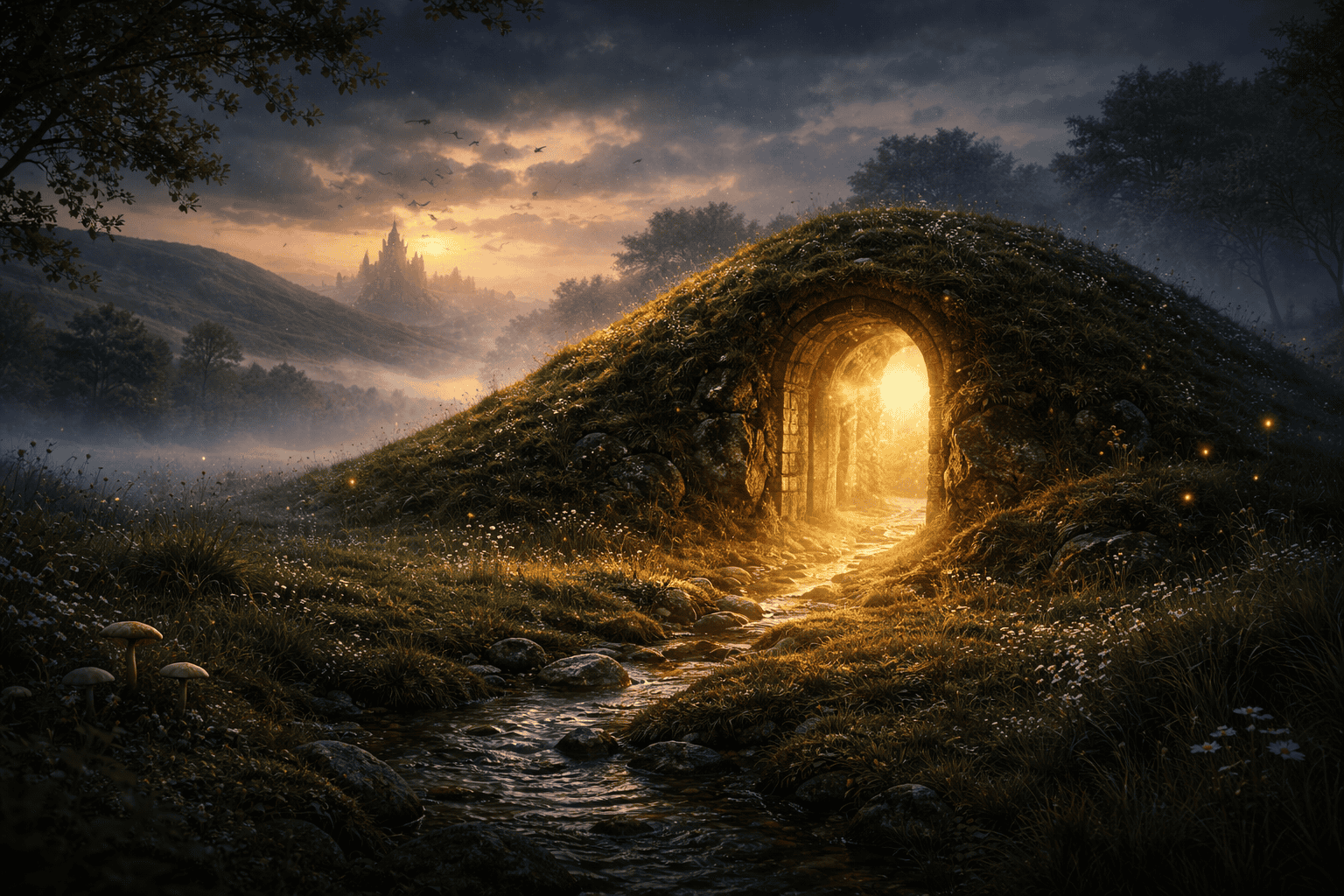
Inside the mounds. The Tuatha Dé Danann, according to tradition, withdrew into the hills and ancient mounds when the sons of Míl took Ireland, and each of their leaders took a síd, or fairy mound, as a home. The great passage tomb of Newgrange, Brú na Bóinne, was said to belong first to the Dagda and later to the young god Óengus. These mounds, and the thousands of fairy forts across the countryside, became the homes of the Aos Sí.
Beneath the water. Lakes and the sea could hide whole kingdoms. Travelers in the stories dive into lakes or follow a stranger into the waves and find themselves in a land of light below.
Across the western sea. In the voyage tales, the Otherworld lies on islands far out in the Atlantic, beyond the setting sun. That idea proved so powerful that phantom islands like Hy-Brasil appeared on European maps for centuries.
What the Otherworld Is Like
The descriptions are remarkably consistent. The Otherworld is a land of perpetual summer, where trees bear fruit and blossom at the same time. There is no sickness, old age, or death. Food and drink never run out: there are pigs that are eaten each night and alive again in the morning, and vats of ale that never empty. Music is everywhere, often from birds or from a silver branch that lulls listeners to sleep. Its people are beautiful, richly dressed, and forever young.
Unlike the heaven and hell of Christian belief, the Otherworld is not a reward or a punishment. It is not where good people go when they die. It is simply another country, older and happier than this one, whose people can visit ours when they choose.
Voyages and Adventures
Medieval Irish storytellers developed whole genres of Otherworld tales. The echtrae, “adventures,” tell of a hero invited or lured into the Otherworld, and the immrama, “voyages,” tell of sea journeys past strange and wonderful islands.
The most famous voyage is Immram Brain, “The Voyage of Bran,” probably first written in the seventh or eighth century. A woman brings Bran a silver branch from the Otherworld and sings to him of its islands. He sets out with his companions, meets the sea god Manannán riding across the waves in a chariot, and reaches the Land of Women, where he stays for what seems a year. When one of his men grows homesick, they sail back to Ireland, but the people on the shore know Bran only as a figure from ancient stories. The homesick man leaps ashore and at once turns to a heap of ashes, as though he had been dead for centuries. Bran tells his story from the boat, then sails away and is never seen again.
Time in the Otherworld
That twist, the discovery that far more time has passed at home than the traveler realized, is one of the great themes of the Otherworld. Bran thinks he has been away a year, and it has been centuries. Oisín thinks he has been in Tír na nÓg for three years, but three hundred have passed, and when he touches Irish soil, he becomes an old man. The Otherworld’s people are untouched by time, and mortals who return from it pay the price all at once.
The Doors Between the Worlds
The boundary between this world and the Otherworld was thought to open at certain times. Samhain, at the start of November, and Bealtaine, at the start of May, were the great turning points of the year, when the mounds opened and the Otherworld people moved about freely. Many of the old stories are set on those nights. Invitations also came through Otherworld messengers, usually beautiful women, bearing a branch, an apple, or a song, and through places where the worlds met, like lakes, caves, and the mounds themselves.
The House of Donn
The Irish Otherworld is mostly a land of the living, not of the dead, but Irish tradition also had a place for the dead. Tech Duinn, “the House of Donn,” was said to lie on a rocky island off the south-west coast, often identified with the Bull Rock off the Beara Peninsula. Donn, a shadowy ancestor figure, was said to have drowned during the arrival of the sons of Míl, and the dead were believed to gather at his house.
The Otherworld in Folk Belief
Long after the medieval tales were written, the Otherworld lived on in everyday belief. Country people across Ireland believed that the Good People lived in the forts and hills, that music heard on a lonely road came from inside the mounds, and that someone who fell asleep on a fairy fort might wake up in the fairy world, or never wake up at all. The fear of being “taken,” and replaced by a changeling, was the dark side of the same belief.
Is the Otherworld the Same as Tír na nÓg?
Tír na nÓg is one name for the Otherworld, and today the best known. But the Irish Otherworld has many names and many locations, and medieval writers used Mag Mell, Tír Tairngire, Emain Ablach, and others as well. It is best to think of Tír na nÓg as one face of a larger, older idea: a land beside our own, just out of reach, where nobody grows old.
Sources and Further Reading
- Kuno Meyer, ed. and trans., The Voyage of Bran Son of Febal to the Land of the Living, David Nutt (1895).
- Tom Peete Cross and Clark Harris Slover, eds., Ancient Irish Tales, Henry Holt (1936).
- John Carey, “The Location of the Otherworld in Irish Tradition,” Éigse 19 (1982).
- Proinsias Mac Cana, Celtic Mythology, Hamlyn (1970).
- Dáithí Ó hÓgáin, Myth, Legend and Romance: An Encyclopaedia of the Irish Folk Tradition, Ryan Publishing (1990).