In Short
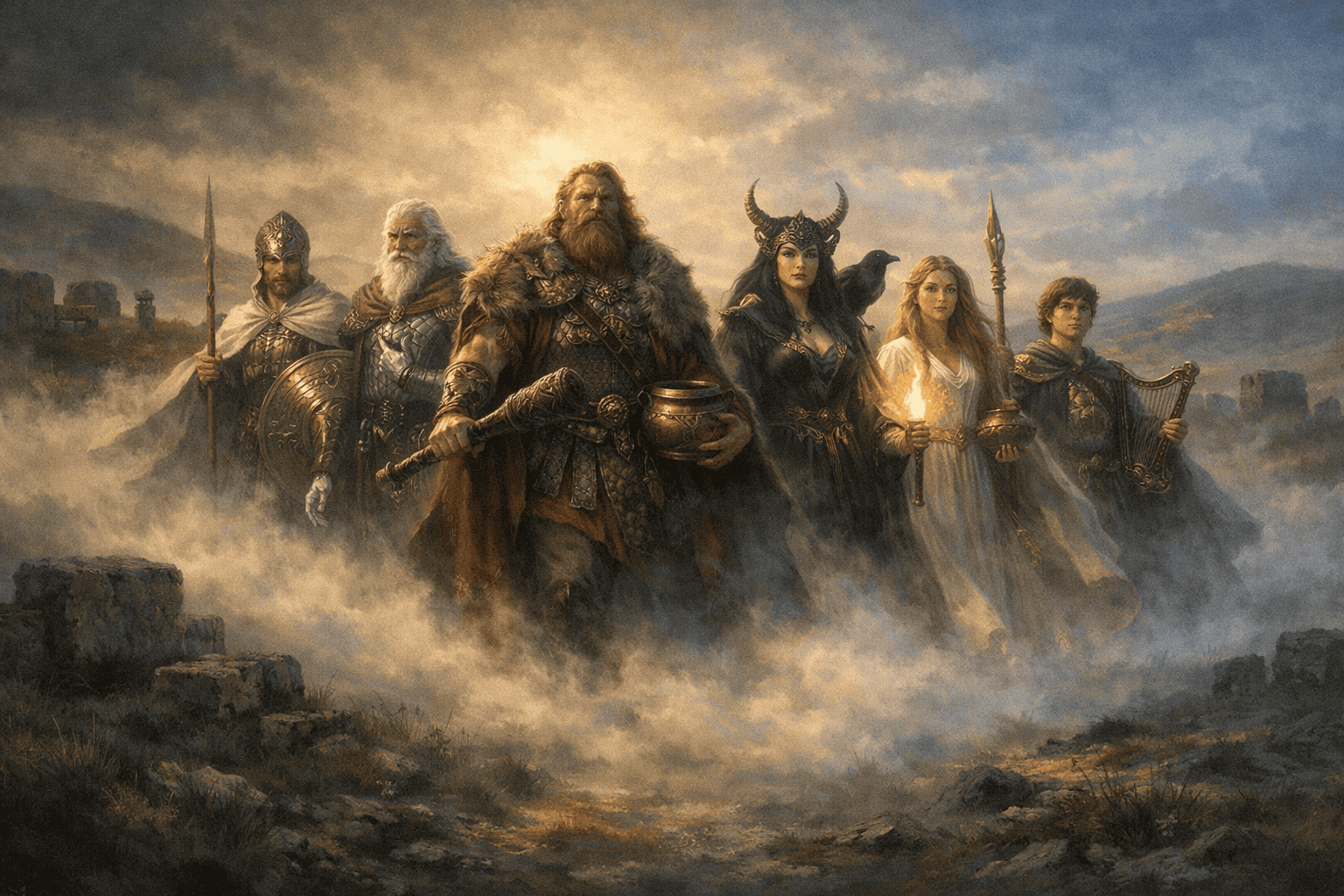
The Tuatha Dé Danann (pronounced TOO-ah-ha day DAN-an) are the old gods of Ireland, recorded in medieval manuscripts as a people skilled in magic who took the island from the Fir Bolg, defeated the Fomorians, and were themselves defeated by the Gaels. Rather than leaving, they withdrew into the mounds and became the fairy folk.
| Name | Tuath Dé in the oldest texts, meaning the tribe of the gods |
|---|---|
| Came from | Four cities in the northern islands of the world |
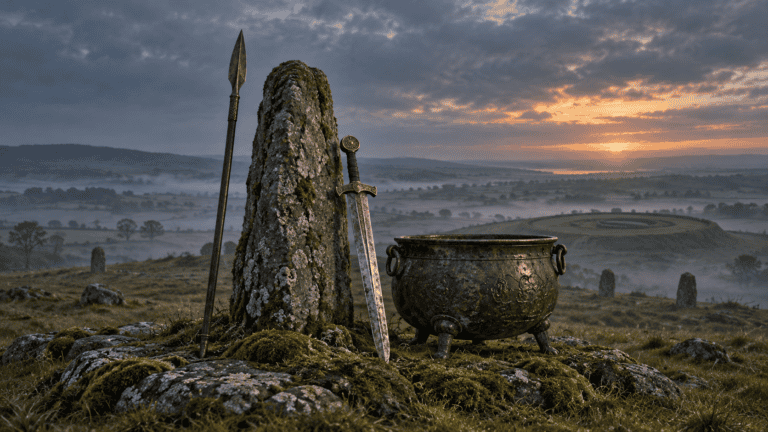
| Brought with them | The Lia Fáil, the spear of Lugh, the sword of Nuada, the cauldron of the Dagda |
| Took Ireland from | The Fir Bolg, at the first battle of Mag Tuired |
| Defeated | The Fomorians, at the second battle of Mag Tuired |
| Lost Ireland to | The Milesians, the sons of Míl, ancestors of the Gaels |
| Where they went | Into the sídhe, the mounds, becoming the Aos Sí |
| Main sources | Lebor Gabála Érenn and Cath Maige Tuired |
Who the Tuatha Dé Danann Were
The Tuatha Dé Danann are the gods of pre-Christian Ireland as medieval Irish writers chose to present them: not as objects of worship, which would have been unthinkable for a monastic scribe, but as an earlier people who held the island before the Gaels and were unusually good at everything.
That framing is not a detail. It shapes every text we have. The scribes recorded genealogies for them, gave them dates, fitted them into a sequence of invasions, and kept their supernatural abilities while withholding the word god wherever they could. The result is a body of stories where the divine keeps showing through a historical surface, and where the same figure can be a king on one page and a power on the next.
In the oldest material they are called simply Tuath Dé, the tribe of the gods. The longer form appears later, and one reason for it is practical: medieval Irish biblical writing used Tuath Dé for the Israelites, so a distinguishing word was useful. Whether Danann refers to a goddess named Danu is less certain than most retellings suggest. She is barely present in the texts, and the related figure Anu is the one Cormac’s Glossary actually names as the mother of the Irish gods.
The Four Cities
The Tuatha Dé Danann are said to have come from four cities in the northern islands of the world, where they learned poetry, magic and craft. Each city gave them a teacher and an object.
From Falias came the Lia Fáil, the stone of destiny, which cried out beneath the rightful king. From Gorias came the spear of Lugh, which guaranteed that its bearer would not be defeated. From Findias came the sword of Nuada, from which no one escaped once it was drawn. From Murias came the cauldron of the Dagda, from which no company went away unsatisfied.
Read together, the four treasures are a description of legitimate kingship rather than a collection of weapons: the right to rule, the power to defend, the power to strike, and the ability to feed those who follow you. A king who lacked any of the four was not a king in the Irish sense.
The Arrival
They came to Ireland in dark clouds, landing on a mountain in what is now County Leitrim and blotting out the sun for three days. Some versions explain the darkness plainly: they burned their ships behind them, and the smoke was what covered the sky.
The detail matters because of what it rules out. There was to be no going back. Every people in the Irish invasion sequence arrives from somewhere, but the Tuatha Dé Danann arrive having destroyed the means of return.
The First Battle of Mag Tuired
The Fir Bolg held Ireland when the Tuatha Dé Danann landed. Negotiation failed, the two sides met at Mag Tuired, and the Tuatha Dé Danann won.
The victory came at a cost that drives everything after it. Nuada, their king, lost his arm in the fighting. Irish kingship required physical wholeness, so a maimed man could not rule, and Nuada had to step down.
His replacement was Bres, chosen partly because he was beautiful and partly because his father was a Fomorian, which looked like a route to peace. It was not. Bres proved miserly, the one failing an Irish king could not survive. Under his rule the great men of the Tuatha Dé Danann were set to menial work, and no guest left his hall with grease on his knife. When the poet Cairbre composed a satire against him, the first satire in Ireland, Bres broke out in blotches and lost the kingship on the same rule of blemish that had cost Nuada his.
Meanwhile Dian Cécht the healer had fitted Nuada with a working arm of silver, and Dian Cécht’s son Miach went further and restored flesh and feeling to it. His father, unable to bear being outdone, killed him. Nuada returned to the kingship, and Bres went to the Fomorians for an army.
A king who could not give was no king. The satire that ended Bres was about hospitality, not war.
The logic of kingship in Cath Maige Tuired
Lugh and the Second Battle
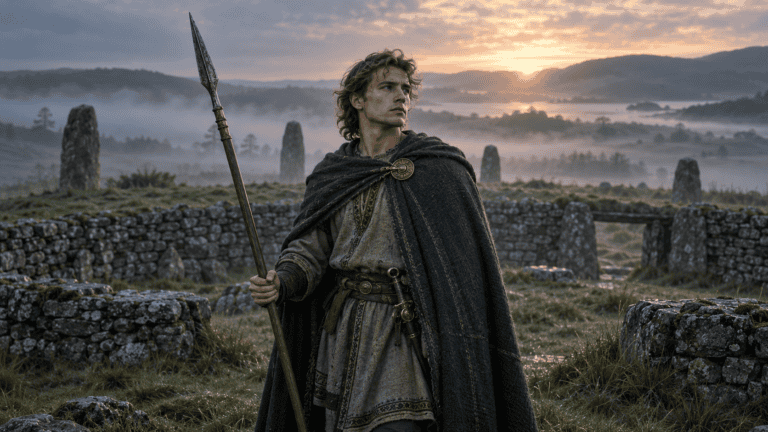
Before the Fomorian war, a young man came to the gate at Tara and asked to be let in. The doorkeeper told him that no one entered without a skill the court did not already have. He offered wright, smith, champion, harper, poet, historian, sorcerer, physician, cupbearer, brazier. Each time he was told that the court already had such a man. Then he asked whether any one man there had all of them together, and the gate was opened.
This is Lugh, called Samildánach, skilled in many arts together. He takes command for the second battle of Mag Tuired, against the Fomorians led by Balor, whose single eye destroyed whatever it looked upon and took four men to lift its lid.
Balor was Lugh’s grandfather. The Tuatha Dé Danann and the Fomorians had intermarried repeatedly, and the war was not a clash of good against evil so much as a fight over tribute and rule. When the eye opened, Lugh put a sling stone through it, driving it back through Balor’s skull so that it destroyed the Fomorian host behind him.
Nuada was killed in that battle. The Dagda recovered his harp from the Fomorians, calling it out of the wall where it hung. And Bres, captured, bought his life with the knowledge of when to plow, sow and reap.
How They Lost Ireland
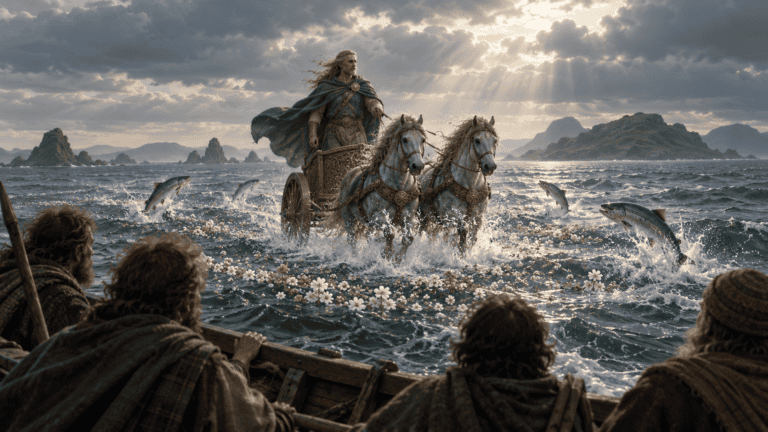
The Milesians, the sons of Míl and the ancestors of the Gaels, arrived last. As they approached, the Tuatha Dé Danann raised a druidic mist and hid the island, and the invaders were driven back out to sea.
What follows is the strangest and most consequential passage in the tradition. The Milesian poet Amergin required that they withdraw beyond nine waves and return, so that the land could be taken lawfully rather than by surprise. When they came back and landed, they won.
Three queens of the Tuatha Dé Danann met them first: Banba, Fódla and Ériu, each asking that the island be named for her. Amergin promised each in turn. Ériu’s name is the one that lasted, and Éire is hers.
The settlement that followed divided Ireland in two. The Gaels took what lies above ground. The Tuatha Dé Danann took what lies below it, and in most accounts it is Manannán mac Lir who allots the mounds among them, raises the féth fíada that hides them from mortal sight, and provides the feast that keeps them from aging.
What They Became
After the division, the Tuatha Dé Danann are no longer a people who rule. They are the powers resident in specific places. Aengus holds Brú na Bóinne, the passage tomb at Newgrange. Finvarra holds Knockma in Galway. Each mound has its occupant, and each occupant has a temper.
This is the moment mythology turns into folklore. The Aos Sí, the fairy folk of later Irish belief, are these same beings under a name that avoids saying who they are. The instruction not to disturb a fairy fort is a term of the treaty, still being observed by farmers in the twentieth century who could not have told you where it came from.
What Modern Accounts Get Wrong
Three things circulate widely and do not hold up.
The first is the pantheon. Arranging the Tuatha Dé Danann into a Greek-style set of departments, a god of this and a goddess of that, imposes a structure the texts never had. Their functions overlap and their roles change between tellings.
The second is Danu. She is inferred from the name rather than described, and the confident family trees found online are modern constructions.
The third is the idea that they were gentle nature spirits driven out by Christianity. They were neither gentle nor driven out. In the tradition they negotiated, took the better half of a divided country by some readings, and stayed.
Where to Read Next
For the individual figures, see the Irish gods and goddesses. For where these stories sit among the rest, the four cycles. For the world they withdrew into, the Otherworld. And for what they became, the Aos Sí.
Sources and Further Reading
- Cath Maige Tuired: The Second Battle of Mag Tuired, edited by Elizabeth A. Gray, Irish Texts Society (1982).
- Lebor Gabála Érenn, edited and translated by R. A. S. Macalister, Irish Texts Society (1938 to 1956).
- Sanas Cormaic (Cormac’s Glossary), ninth or tenth century.
- Mark Williams, Ireland’s Immortals: A History of the Gods of Irish Myth, Princeton University Press (2016).
- John Carey, The Irish National Origin-Legend: Synthetic Pseudohistory, University of Cambridge (1994).