QUICK SUMMARY
Púca stories in Irish folklore often describe strange encounters on lonely roads, sudden misdirection, and unsettling rides with shapeshifting spirits. These encounters rarely end in clear harm, but they leave a lasting sense of confusion, fear, and the realization that the world is not as predictable as it seems.
Why Púca Stories Matter
Púca stories are not long, complex myths with structured beginnings and endings. They are usually brief, personal, and unsettling in a quiet way. Someone sees something they should not have seen, follows something they should not have trusted, or ends up somewhere they never intended to go.
That simplicity is part of their power. These are not heroic tales. They are warnings disguised as experiences, told in a way that makes them feel almost plausible.
The púca does not need an elaborate narrative. It only needs a moment where reality shifts slightly out of place.
The Lonely Road Encounter
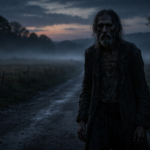
One of the most common púca stories begins with a familiar setting: a person walking alone at night on a quiet Irish road. The path is known, the distance is manageable, and there is no immediate sense of danger.
Then something appears.
It might be a horse standing silently in the road, or a shape just visible at the edge of sight. At first, it seems ordinary. But something about it feels wrong. The stillness is too complete, the presence too deliberate.
In some versions of the story, the traveler ignores the feeling and continues. In others, curiosity wins.
That is usually the mistake.
The Ride That Goes Wrong
Perhaps the most well-known púca encounter involves the rider.
A traveler comes across what appears to be a normal horse. It stands calmly, almost inviting interaction. There is no immediate threat, no reason to suspect anything unusual.
The moment the person mounts it, everything changes.
The horse bolts with unnatural speed, ignoring roads, walls, and boundaries. It runs through fields, across uneven ground, and into places the rider does not recognize. The experience is not just frightening. It is disorienting. Direction disappears. Time becomes unclear.
Eventually, the ride ends as abruptly as it began. The rider is thrown off or left in an unfamiliar place, shaken but alive.
The message is not subtle. What seemed safe was not.
Being Led Astray
Not all púca encounters are dramatic. Some are quieter, and in many ways, more unsettling.
A person walking a familiar path suddenly finds themselves lost. Landmarks no longer match. The road seems longer than it should be, or it turns in ways it never has before. There is no clear moment when things changed, only the growing awareness that something is wrong.
In these stories, the púca is not seen directly. Its presence is inferred from the effect.
The experience ends when the person finally returns to a known place, often with no clear explanation of how they became lost in the first place.
This kind of encounter reflects a different kind of fear. Not sudden danger, but the slow realization that control has quietly slipped away.
The Talking Púca
In some accounts, the púca takes a more direct role.
It appears in a form that can speak, sometimes offering advice, sometimes mocking, and sometimes delivering statements that feel important but are difficult to interpret. These interactions are rarely comfortable. There is always a sense that the púca understands more than it is revealing.
The conversation may seem harmless at first, but it often leads to confusion or unexpected consequences. The púca does not guide in a straightforward way. Even when it appears helpful, there is usually a cost.
That uncertainty reinforces its role as a trickster. It does not simply deceive. It complicates.
Encounters Near Fields and Harvest Time
Some púca stories are tied to the land itself, particularly during harvest season.
In certain traditions, it was believed that the púca could influence crops, especially in the final stages of harvest. Fields left unattended too long might be “claimed” in some way, or touched by the púca’s presence. This belief sometimes led to practices where part of the crop was left unharvested, an acknowledgment of forces that should not be ignored.
Encounters in these settings are less about sudden fear and more about quiet respect. The púca is not always visible, but its presence is assumed.
These stories blur the line between superstition and tradition, showing how belief can shape behavior over time.
Why Most Encounters End Without Harm
One of the more interesting aspects of púca stories is that they rarely end in death or permanent injury. The fear is real, the confusion is genuine, but the outcome is often survival.
This is not because the púca is harmless. It is because its purpose is different.
The púca disrupts, unsettles, and reminds. It creates experiences that linger in memory, not because of physical damage, but because of what they reveal. It shows that certainty can fail, that control can be lost, and that the world is not entirely predictable.
That is often enough.
The Pattern Behind the Stories
Although púca stories vary in detail, they share a recognizable pattern.
- A person is alone or slightly removed from safety
- Something familiar appears, but feels wrong
- A decision is made, often based on curiosity or assumption
- Reality shifts in a way that removes control
- The person returns, changed or unsettled
This structure is simple, but effective. It reflects a basic human experience: the moment when something ordinary becomes unfamiliar, and understanding fails.
The púca is the force that causes that shift.
Why These Stories Endure
Púca stories continue to be told because they tap into a type of fear that does not depend on time or place. The fear of getting lost, of making the wrong choice, of trusting something that turns out to be false, these are not historical concerns. They are constant.
The púca gives those fears a shape.
It allows people to talk about uncertainty in a way that feels concrete. Instead of abstract anxiety, there is a figure, a presence, a story that explains how things can go wrong without warning.
That is why these encounters remain memorable. They do not need to be proven. They only need to feel possible.
Final Thoughts
Púca stories are not about dramatic battles or clear victories. They are about moments when the world stops behaving as expected, and when a person is forced to confront that change without preparation.
The púca itself is rarely seen clearly, and even when it is, it does not stay the same for long. That instability is the point. It is what gives the stories their tension and their meaning.
To encounter the púca is not to face a monster, but to experience a break in certainty. And once that break has been felt, it is difficult to fully trust the world in quite the same way again.