In Short
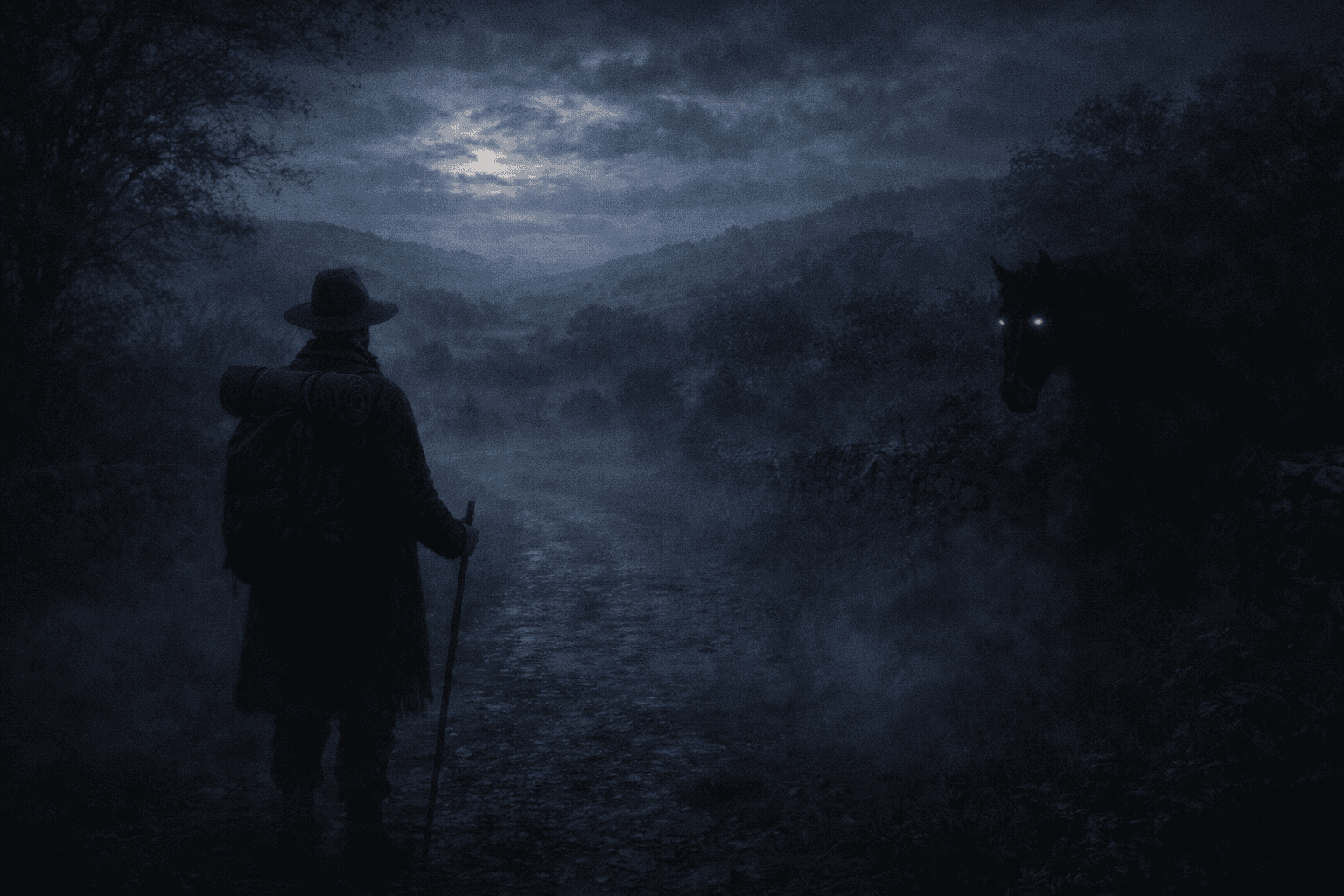
The best-known púca stories follow a simple pattern: a traveler, usually alone, at night, and often with drink taken, meets a strange animal, and ends up on a wild journey he never meant to take. In Douglas Hyde’s “The Piper and the Púca,” a horned púca carries a drunken piper to a feast of banshees on Croagh Patrick. In Thomas Crofton Croker’s “Daniel O’Rourke,” a man who falls asleep under the walls of the púca’s tower is carried to the moon by an eagle. In “The Kildare Pooka,” a púca in the shape of a donkey cleans a kitchen every night. Almost always, the victim survives, shaken, humbled, and with a story to tell.
| Best-known tales | “The Piper and the Púca”; “Daniel O’Rourke”; “The Kildare Pooka” |
|---|---|
| Usual victim | A man alone at night, often on his way home from a dance or party |
| Usual form | A horse or horned beast; also a donkey and an eagle |
| Season | Especially around Samhain and November |
| Usual ending | The victim is thrown off or wakes up, unhurt but changed |
| Main collectors | Thomas Crofton Croker (1825), Patrick Kennedy (1866), Douglas Hyde and W. B. Yeats (1888) |
What a Púca Story Is Like
Most púca stories are short, funny, and a little frightening. They are not epic myths about gods and heroes. They are the kind of tale told at the fireside about someone’s grandfather, or a man from the next parish, who set out for home one night and did not get there the way he expected. The storyteller usually knows exactly where it happened: a bridge, a ford, the walls of a ruined castle.
The púca itself is a shapeshifter, most often a horse, and the stories turn on the moment when an ordinary-looking animal turns out to be something else. Below are the most famous of them, retold from the nineteenth-century collections.
The Piper and the Púca
This is the classic púca tale. Douglas Hyde translated it from an Irish-language storybook and W. B. Yeats published it in his 1888 collection, Fairy and Folk Tales of the Irish Peasantry.
In Dunmore, County Galway, there lived a simple-minded piper who loved music but could play only one tune, “The Black Rogue.” One night, coming home half drunk from a dance, he stopped at a little bridge near his mother’s house and struck up his one tune. The púca came up behind him and flung him onto its back. It had long horns, and the piper grabbed them and held on for his life, protesting that he had ten pence in his pocket to buy his mother snuff.
The púca ordered him to play “The Shan Van Vocht.” The piper said he did not know it. “Play up,” said the púca, “and I’ll make you know.” He did, and played such music that he astonished himself. The púca then told him they were going to a feast in the house of the banshee, on top of Croagh Patrick. The piper was delighted: the priest had given him a pilgrimage to Croagh Patrick as a penance for stealing his white gander.
At the summit, the púca struck the ground three times, a door opened, and they entered a hall with a golden table surrounded by hundreds of old women, who welcomed the “Púca of November.” A door opened in the wall, and in walked the very gander the piper had stolen and eaten. It cleared the table. The piper played, the old women danced until they were tired, and each paid him a gold piece. As he left, the gander gave him a new set of pipes.
The púca dropped him back at the bridge, telling him he now had two things he never had before: sense and music. But at home, the new pipes made only a noise like all the geese and ganders in Ireland screeching together, and in the morning, the gold had turned to leaves. When he put on his old pipes, though, he played beautifully, and from that day until his death, there was no better piper in County Galway.
The story shows the púca at its most typical. It frightens the piper, takes him far out of his depth, and leaves him with nothing to show but a story. Yet it also gives him a real gift. The fairy gold was worthless, but the music was real.
Daniel O’Rourke
Thomas Crofton Croker published this story in 1825, claiming he heard it from Daniel O’Rourke himself, an old man living at the foot of Hungry Hill, near Bantry in County Cork. The cause of all Daniel’s troubles, Croker explained, was that he had fallen asleep under the walls of the púca’s tower.
Daniel had been at a grand party at the big house and had taken a good deal to drink. On his way home, crossing the stepping stones of a ford, he slipped into the water and found himself stranded on a little island in a bog. Down swooped an eagle, which spoke to him in a human voice and offered to carry him home. Instead, it flew him up to the moon, and left him clinging to the reaping hook sticking out of its side. The man in the moon came out and ordered him off, and Daniel fell. A flock of wild geese caught him, then dropped him into the sea, where a whale came up beside him. Just as he thought he would drown, he woke up. His wife was standing over him, throwing a bucket of water in his face, and scolding him for falling asleep under the walls of the púca’s tower.
The whole adventure is a púca-sent nightmare. Croker never says what the eagle was, but the eagle is one of the púca’s recorded forms, and many readers take it for the púca itself. It is also one of the funniest stories in Irish folklore.
The Kildare Pooka
Not every púca terrifies. In “The Kildare Pooka,” published by the Wexford folklorist Patrick Kennedy in 1866, a púca in the form of a donkey secretly washes the dishes and cleans the kitchen of a big house every night. It explains to a kitchen boy that it was once a lazy servant in that house and is working off its idleness as a penance. When the family gives it a new coat in thanks, it leaves for good. It is a reminder that the púca could be helpful as well as menacing.
The Talking Steed of November
An older tradition, quoted by Yeats from a note by Douglas Hyde, describes a púca-like horse that rose out of a hill in Leinster every year around November Day. It came out as far as its middle, a sleek and terrible steed, and spoke in a human voice, answering the questions of anyone who asked about what would happen to them in the year ahead. People left gifts at the hill until the coming of Saint Patrick. The story links the púca to prophecy, and, like the piper’s “Púca of November,” to the season of Samhain, when the púca was believed to be most active.
The Pattern Behind the Stories
Put the stories side by side and a clear pattern appears.
- The victim is alone, at night, and off guard. Usually he is a man coming home from a dance, a fair, or a party, often with drink taken.
- The púca appears as an animal. A horse, a horned beast, an eagle, or a donkey, something that looks almost ordinary.
- The victim is carried off. He loses control completely, whether on a wild ride across bogs or a flight to the moon.
- He comes back unhurt but changed. He is thrown off at dawn, dropped at a bridge, or wakes up, soaked, sober, and humbled.
The stories were funny partly because the victims deserved it a little. A drunk man making his way home in the dark was both a figure of comedy and a man in real danger of falling into a ditch or a river. The púca stories gave that danger a face, and a warning: go home sober, and do not trust a strange horse on the road at night.
Why Most Púca Stories End Without Harm
Unlike the dullahan, whose appearance means certain death, the púca rarely kills anyone in the old stories. The reason lies in what kind of being it is. The púca is a trickster, not a monster. Its aim is to frighten, humble, and sometimes teach, not to destroy. Its victims are usually guilty of some small folly, like drunkenness, boasting, or carelessness, and the punishment fits: a wild night, a soaking, and a lasting embarrassment. The harm is mostly to pride. In the piper’s case, the púca even leaves him better off than before.
Are Púca Stories True?
They were told as true, and often about named people and real places, like Hungry Hill, Dunmore, and Croagh Patrick. That was part of the storyteller’s art. Whether anyone really met a púca is another matter. A night of drink, a fall into a stream, and a strange dream could easily become a púca story by morning, and Croker’s “Daniel O’Rourke” as good as admits it.
Sources and Further Reading
- Thomas Crofton Croker, Fairy Legends and Traditions of the South of Ireland, John Murray (1825).
- Patrick Kennedy, Legendary Fictions of the Irish Celts, Macmillan (1866).
- W. B. Yeats, ed., Fairy and Folk Tales of the Irish Peasantry, Walter Scott (1888), including Douglas Hyde, “The Piper and the Púca.”
- Katharine Briggs, An Encyclopedia of Fairies, Pantheon Books (1976).
- Dáithí Ó hÓgáin, Myth, Legend and Romance: An Encyclopaedia of the Irish Folk Tradition, Ryan Publishing (1990).