In Short
A fairy ring is a circle of mushrooms, or of darker or withered grass, that appears in a lawn, pasture, or woodland. In the folklore of Ireland and Britain, it marks the place where fairies danced in the night, and stepping inside was said to be dangerous: you might be drawn into the dance, lose track of time, or find that years had passed when you came out. Science explains the rings as the work of an underground fungus spreading outward from a single point, but the belief still makes many people step around them.
| What it is | A natural ring of mushrooms or darker grass |
|---|---|
| In folklore | The mark left by dancing fairies |
| The danger | Being drawn into the dance, losing time, or being taken |
| The rule | Never step inside, and never damage the ring |
| Where the belief is found | Ireland, Scotland, Wales, England, and much of Europe |
| Real cause | An underground fungus spreading outward in a circle |
| Best-known fungus | Marasmius oreades, the fairy ring champignon |
| Largest known | About 600 meters across, near Belfort, France, thought to be over 700 years old |
What Is a Fairy Ring?
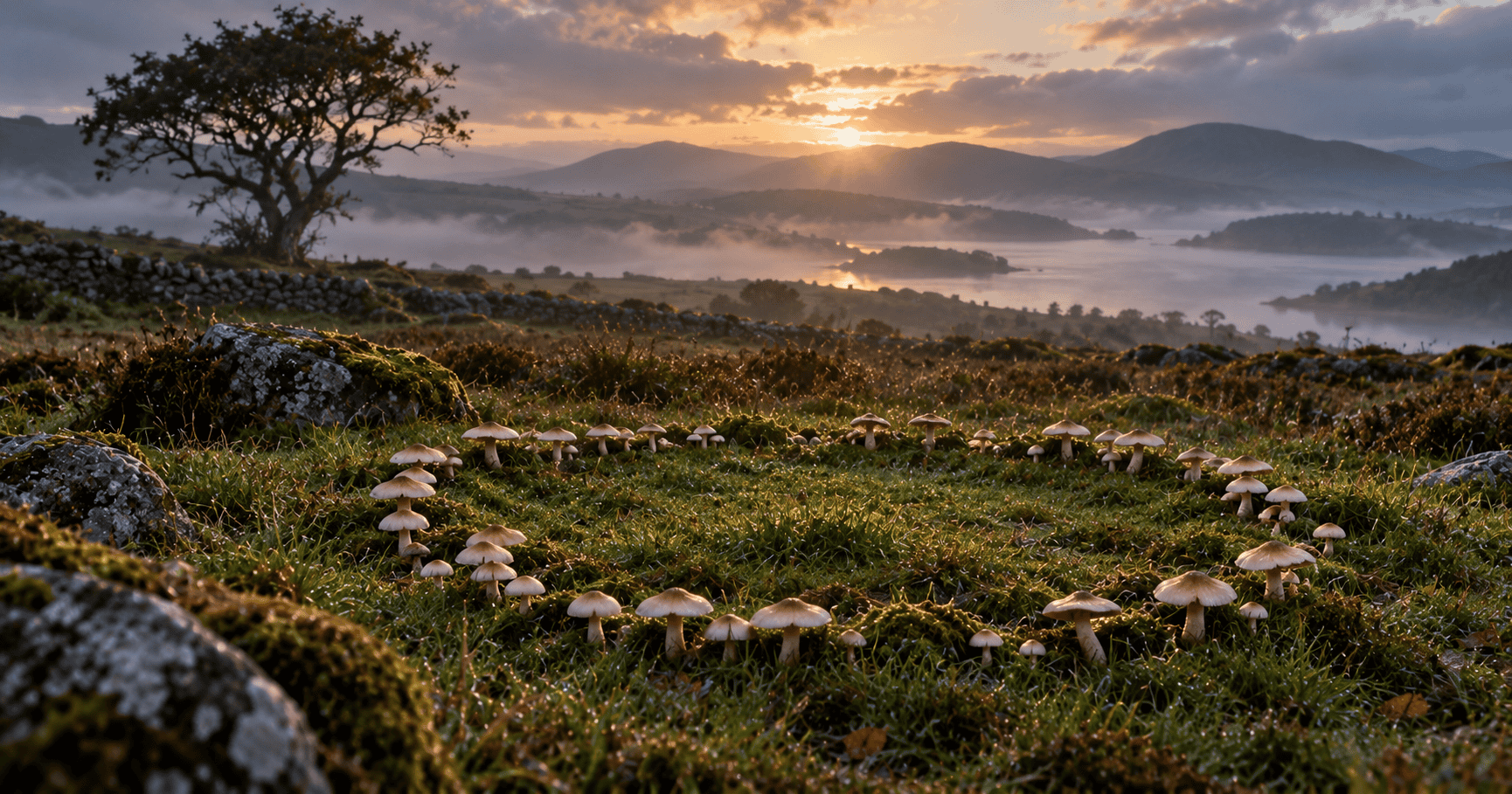
You find it on a damp morning in late summer: a perfect circle of small pale mushrooms in the grass, as if someone had marked it out with a compass. Sometimes there are no mushrooms at all, only a ring of grass that is greener and taller than the rest, or a ring where the grass has withered and died. Yesterday it was not there. Or perhaps it was, and you never noticed.
To country people across Ireland and Britain, the explanation was obvious. This was where the fairies had danced the night before, around and around in a ring, their feet wearing the pattern into the ground. The ring belonged to them, and a person who stepped into it was stepping onto fairy ground.
Where the Fairies Danced
The idea that fairies danced in rings is old and widespread. The folklorist James MacKillop, in his Dictionary of Celtic Mythology, describes the fairy ring simply as a circle in a lawn or pasture believed to have been caused by dancing fairies. The belief turns up in Ireland, Scotland, Wales, England, and across much of Europe, under names like elf rings, pixie rings, and fairy circles. It was well known in England by Shakespeare’s time. In The Tempest, Prospero speaks of the elves who make the “green sour ringlets” in the grass that sheep will not eat.
In Ireland, the word “ring” often meant something larger. The ringforts, the ancient circular earthworks that dot the Irish countryside, were known as fairy forts and fairy rings, and were thought to be the homes of the Aos Sí. The small mushroom ring in a field and the great earthen fairy fort on a hill were two versions of the same idea: a circle in the landscape that belonged to the fairy people, and should be left alone.
What Happens If You Step Inside?
The stories agree on one thing: nothing good. The most common warning is that a person who steps into a fairy ring, especially at night, will be caught up in the fairies’ dance and unable to stop. Some dance until they collapse from exhaustion. Others are pulled into the fairy world altogether.
Many stories add a twist in time, the same one found in the legend of Tír na nÓg. A dancer who seems to have joined the ring for only a few minutes steps out to find that a whole year has gone by, or much longer. The best-known version comes from Wales, recorded by the American writer Wirt Sikes in British Goblins in 1880. Two farm servants, Rhys and Llewelyn, are walking home when Rhys hears music and slips away to dance. Llewelyn cannot find him, and when a year passes without Rhys returning, Llewelyn is suspected of murdering him. At last, Llewelyn is brought back to the spot a year and a day later, sees Rhys dancing in the ring, and pulls him out by his coat. Rhys insists he has been dancing for only a few minutes.
Our article on stepping in a fairy ring gathers more of the warnings and the ways people were said to escape.
Rules for Living Beside a Fairy Ring
The belief was not only a matter of stories. It shaped how people treated the land.
- Don’t step inside, above all after dark or on the great festival nights, when the fairies were most active.
- Don’t damage it. Digging up a fairy ring, or ploughing through it, was thought to bring bad luck on the farm or the family.
- Don’t build on it. A house or barn built across a fairy ring, like one built across a fairy path, was believed to invite trouble.
- Treat it as someone else’s property. Like the fairy forts, the ring belonged to the fairies, whatever the deeds to the land said.
What Really Makes a Fairy Ring?
The real cause is hidden underground. A fairy ring begins with a single fungal spore that lands in the soil and starts to grow. The body of the fungus, a web of fine threads called the mycelium, spreads outward in every direction, feeding on dead organic matter as it goes. Over time, the mycelium at the center uses up the food there and dies back, leaving a living ring that keeps expanding, sometimes by up to 20 centimeters a year.
The mushrooms themselves are just the fruit of the fungus, pushed up at the outer edge where the mycelium is active. The fungus also changes the grass above it. At the leading edge, it can release nutrients that make the grass grow greener and taller. Just behind that, it can starve the grass or make the soil repel water, leaving a ring of dead, brown turf. That is why some fairy rings are marked by lush grass, some by bare earth, and some by both.
More than a hundred kinds of fungi can form fairy rings. The best known in lawns and pastures is Marasmius oreades, an edible mushroom known as the Scotch bonnet or fairy ring champignon. Rings can grow to a remarkable size and age. One near Belfort, in north-eastern France, is thought to be about 600 meters across and more than 700 years old.
Why the Belief Makes Sense
Seen from a farmer’s point of view, the old belief fits the evidence surprisingly well. The rings appear suddenly, often overnight after rain. They are strangely perfect in shape. They grow larger from year to year, as if something were still using them. Livestock may avoid the grass. And trying to get rid of one rarely works, because the fungus lies deep in the soil and the ring simply comes back. For people who did not know about underground fungi, dancing feet were a reasonable explanation.
Fairy Rings in Popular Culture
Fairy rings have been part of English literature for centuries. Besides Prospero’s “green sour ringlets,” Shakespeare’s A Midsummer Night’s Dream has a fairy who dews the “orbs” upon the green for the Fairy Queen. Victorian painters and illustrators loved the image of tiny fairies dancing in a ring of mushrooms, and it has been a fixture of fantasy art, children’s books, and garden ornaments ever since. In video games and fantasy fiction, fairy rings often appear as portals or teleportation points, a modern echo of the old idea that a ring could carry you into another world.
Is It Bad Luck to Step in a Fairy Ring?
Only according to folklore. There is no danger in stepping into a fairy ring, though some of the mushrooms that grow in them are poisonous and should never be eaten without expert identification. Still, many people in Ireland and Britain would rather walk around one than through it. It costs nothing to show a little respect, and the old stories have a way of lingering in the mind when you find a perfect circle in the grass at dusk.
Sources and Further Reading
- James MacKillop, A Dictionary of Celtic Mythology, Oxford University Press (1998).
- Wirt Sikes, British Goblins: Welsh Folk-Lore, Fairy Mythology, Legends and Traditions, Sampson Low (1880).
- Katharine Briggs, An Encyclopedia of Fairies, Pantheon Books (1976).
- W. B. Yeats, ed., Fairy and Folk Tales of the Irish Peasantry, Walter Scott (1888).
- Boel Olsson and others, “Spatial Structure and Growth Dynamics of Fairy Rings Formed by Marasmius oreades,” Royal Society Open Science 13 (2026).