In Short
Irish folklore is the traditional knowledge of ordinary people in Ireland, passed on mostly by word of mouth: stories and legends, beliefs about the fairies and the dead, seasonal customs, cures and charms, sayings, and the lore attached to places. It overlaps with Irish mythology, the medieval literature of gods and heroes, but it is broader and closer to everyday life. Much of it was written down in the nineteenth and twentieth centuries, above all by the Irish Folklore Commission, whose archive is now one of the largest collections of oral tradition in Europe.
| Irish word | Béaloideas, from béal, “mouth,” and oideas, “teaching” |
|---|---|
| What it includes | Tales, legends, fairy belief, customs, cures, sayings, place lore |
| How it was passed on | Mostly by word of mouth, in Irish and in English |
| Storytellers | The seanchaí and the scéalaí |
| Early collectors | Croker, Kennedy, Lady Wilde, Yeats, Hyde, Lady Gregory |
| Main archive | The National Folklore Collection, University College Dublin |
| Schools’ Collection | About 740,000 pages gathered by schoolchildren, 1937 to 1939 |
| Online | dúchas.ie |
What Is Irish Folklore?
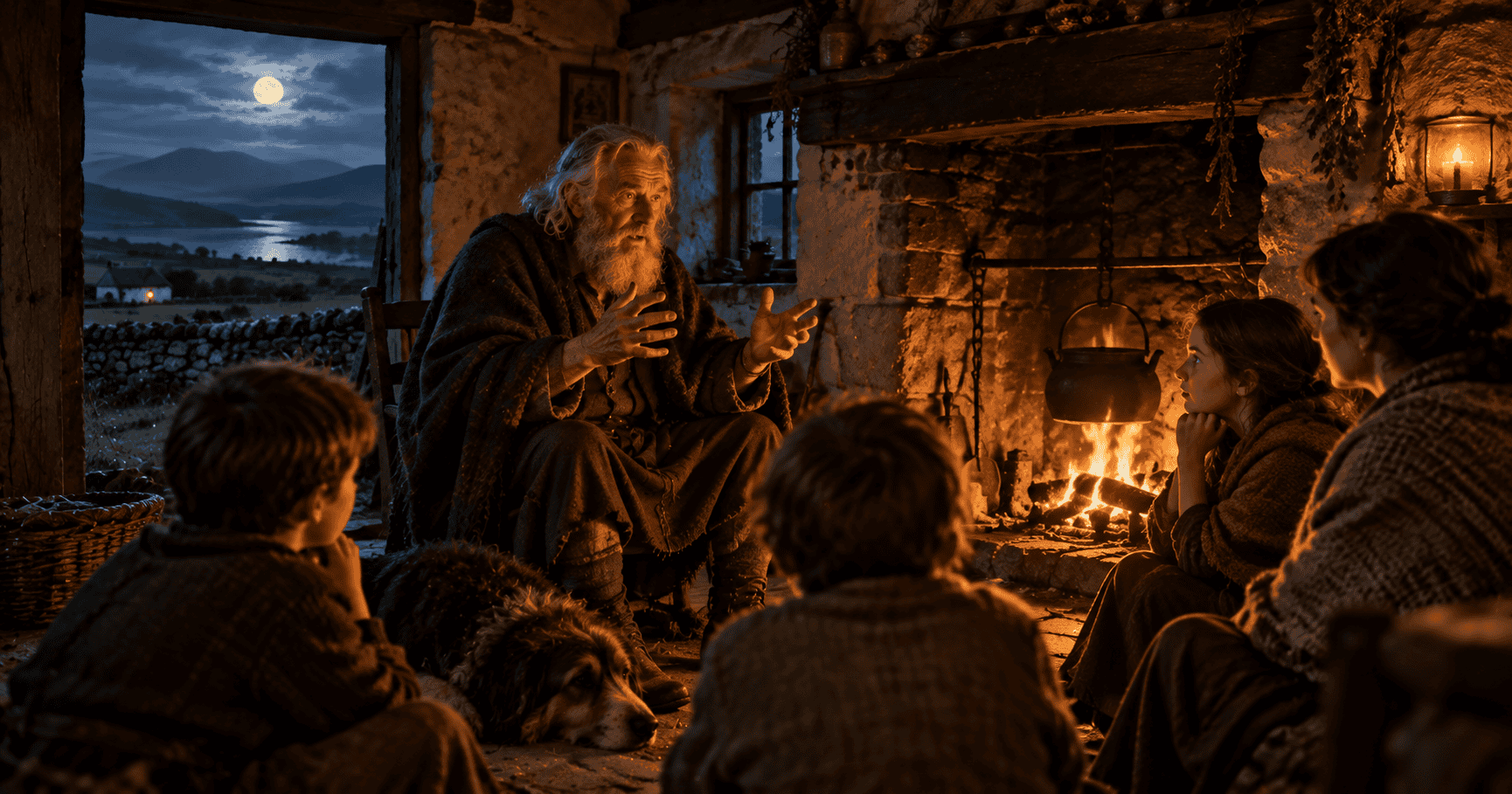
Picture a farmhouse kitchen on a winter night, a century ago. The work is done, the turf fire is lit, and the neighbors have come in. Someone asks the old man in the corner for a story, and he begins: a tale of a man who met the fairies on the road home from a fair, or of a hero who could leap across a river, or of the night the banshee cried outside a house down the valley. Between the stories come other things: a cure for a sprained ankle, a warning never to cut the lone thorn in the lower field, a saying about the weather.
That is Irish folklore. The Irish word for it, béaloideas, means something like “mouth-teaching,” and it captures the idea well. Folklore is the knowledge people learned from each other, by listening, rather than from books. It covers stories, but also beliefs, customs, cures, songs, games, prayers, proverbs, and the local knowledge of which field was unlucky and which well could heal.
Folklore and Mythology: What’s the Difference?
The two words are often used as if they meant the same thing, but they point to different traditions that overlap.
Irish mythology usually means the stories of gods, heroes, and ancient kings preserved in medieval Irish manuscripts, written by monks and learned poets from about the seventh century onward. Scholars group them into four cycles: the Mythological Cycle, about the Tuatha Dé Danann and other early peoples; the Ulster Cycle, about Cú Chulainn and the warriors of Ulster; the Fenian Cycle, about Fionn mac Cumhaill and the Fianna; and the Cycle of the Kings.
Irish folklore is the living tradition of ordinary people, most of it recorded in the nineteenth and twentieth centuries. It includes some of the same characters, since stories of Fionn and his men were still told around country firesides in the 1930s, but it also includes a great deal that never appears in the manuscripts: fairy lore, calendar customs, cures, charms, and local legends. Put simply, mythology is the literature of the old learned class, while folklore is the knowledge of everyone else, and the two have fed into each other for a thousand years.
The Main Kinds of Irish Folklore
Folklorists usually sort the tradition into a handful of broad areas. They overlap constantly, since a single story can involve a fairy, a festival, a cure, and a real place, but together they give a good map of what Irish folklore covers.
Fairy Belief
No part of Irish folklore is better known, or more misunderstood. The fairies of Irish tradition, the Aos Sí, were not tiny winged creatures but a powerful hidden people living inside the hills and ancient mounds. They were treated with wary respect, and much of the lore is about staying on their good side: leaving fairy forts and fairy trees untouched, not throwing water out at night without a warning, and guarding children against being taken and replaced by a changeling. Solitary beings like the banshee, the púca, and the leprechaun belong here too.
Legends and Hero Tales
Many of the great figures of the medieval literature lived on in oral storytelling. Tales of Fionn mac Cumhaill, like the Salmon of Knowledge, were told and retold, and every district had its local legends: of saints, outlaws, giants, and holy wells. Some tales, like the Children of Lir, passed back and forth between books and the fireside for centuries.
Folktales
Irish storytellers also told long wonder tales and comic tales, many of them versions of stories found across Europe and beyond: clever servants outwitting their masters, youngest sons winning kingdoms, poor men tricking the devil. Told in Irish or English, often at great length, they were among the most prized parts of a storyteller’s repertoire.
The Festival Year
The Irish year turned on four great festivals: Imbolc at the start of February, Bealtaine at the start of May, Lughnasadh at the start of August, and Samhain at the start of November. Each had its own customs, from making St. Brigid’s crosses to lighting bonfires and telling fortunes at Halloween, and many of them survived well into the twentieth century.
Cures, Charms, and Beliefs
Folklore was also practical. People relied on traditional cures, holy wells, charms, and prayers for illness and misfortune. They read signs in the weather, in animals, and in dreams, and they observed customs around birth, marriage, and death, from the wake to the keening of the dead.
Place Lore
In Ireland, almost every hill, river, rock, and ruin has a story. Medieval scholars collected this kind of lore in a body of texts called the Dindshenchas, “the lore of places,” and ordinary people carried on the habit. A name on a map often preserves the memory of a battle, a saint, a giant, or a fairy host.
The Storytellers
At the heart of Irish folklore were the people who carried it. The seanchaí was a keeper of lore: local history, genealogy, customs, and short anecdotes. The scéalaí was a teller of long tales, some of which could take a whole night, or several nights, to tell. The best of them were famous in their districts, and people traveled to hear them.
Some became famous far beyond. Seán Ó Conaill, a farmer from Cill Rialaig in County Kerry, told a great store of tales to the folklorist Séamus Ó Duilearga, who published them in 1948. Peig Sayers of the Great Blasket Island, one of the finest storytellers of her time, gave a great number of tales and songs to collectors, and her autobiography became one of the best-known books in the Irish language.
How Irish Folklore Was Collected
Serious collecting began in the nineteenth century. Thomas Crofton Croker published Fairy Legends and Traditions of the South of Ireland in 1825, Patrick Kennedy his Legendary Fictions of the Irish Celts in 1866, and Lady Wilde her Ancient Legends of Ireland in 1887. W. B. Yeats gathered many of these into Fairy and Folk Tales of the Irish Peasantry in 1888, and Douglas Hyde, later the first President of Ireland, published tales he had collected in Irish in Beside the Fire in 1890.
The great turning point came in the twentieth century. In 1927, Séamus Ó Duilearga founded the Folklore of Ireland Society and its journal, Béaloideas. In 1935, the Irish government set up the Irish Folklore Commission, with Ó Duilearga as director. Its full-time collectors traveled the country, above all the Irish-speaking districts, writing down and later recording everything they could before it disappeared. About two-thirds of the material they gathered is in Irish.
The Commission’s most remarkable project was the Schools’ Collection. Between 1937 and 1939, more than 50,000 children in about 5,000 primary schools collected folklore from their parents, grandparents, and neighbors, filling about 740,000 pages with stories, beliefs, cures, games, and local history. Today, the whole archive is held by the National Folklore Collection at University College Dublin, which in 2017 was added to UNESCO’s Memory of the World Register. Much of it, including the Schools’ Collection, can be read free online at dúchas.ie.
Why Irish Folklore Still Matters
Irish folklore is not only a record of the past. It is the reason many Irish people still step around a fairy fort, eat barmbrack at Halloween, or hang a Brigid’s cross in the kitchen. It shaped the writing of Yeats, Lady Gregory, and Seamus Heaney, and it lives on in music, film, and games around the world. It is also one of the richest records anywhere of how ordinary people understood their world: its dangers, its landscapes, its illnesses and deaths, and the invisible neighbors they believed shared it with them.
Where to Start
If you are new to Irish folklore, the best starting points on this site are the Aos Sí, who sit at the center of so much of it; the banshee and the púca, two of its most famous creatures; Samhain, the festival that gave the world Halloween; and Tír na nÓg, the land of eternal youth. Or browse our full guide to Irish mythological creatures.
Sources and Further Reading
- Seán Ó Súilleabháin, A Handbook of Irish Folklore, Educational Company of Ireland (1942).
- Dáithí Ó hÓgáin, Myth, Legend and Romance: An Encyclopaedia of the Irish Folk Tradition, Ryan Publishing (1990).
- Diarmuid Ó Giolláin, Locating Irish Folklore: Tradition, Modernity, Identity, Cork University Press (2000).
- Henry Glassie, ed., Irish Folk Tales, Pantheon Books (1985).
- National Folklore Collection, University College Dublin, dúchas.ie.