In Short
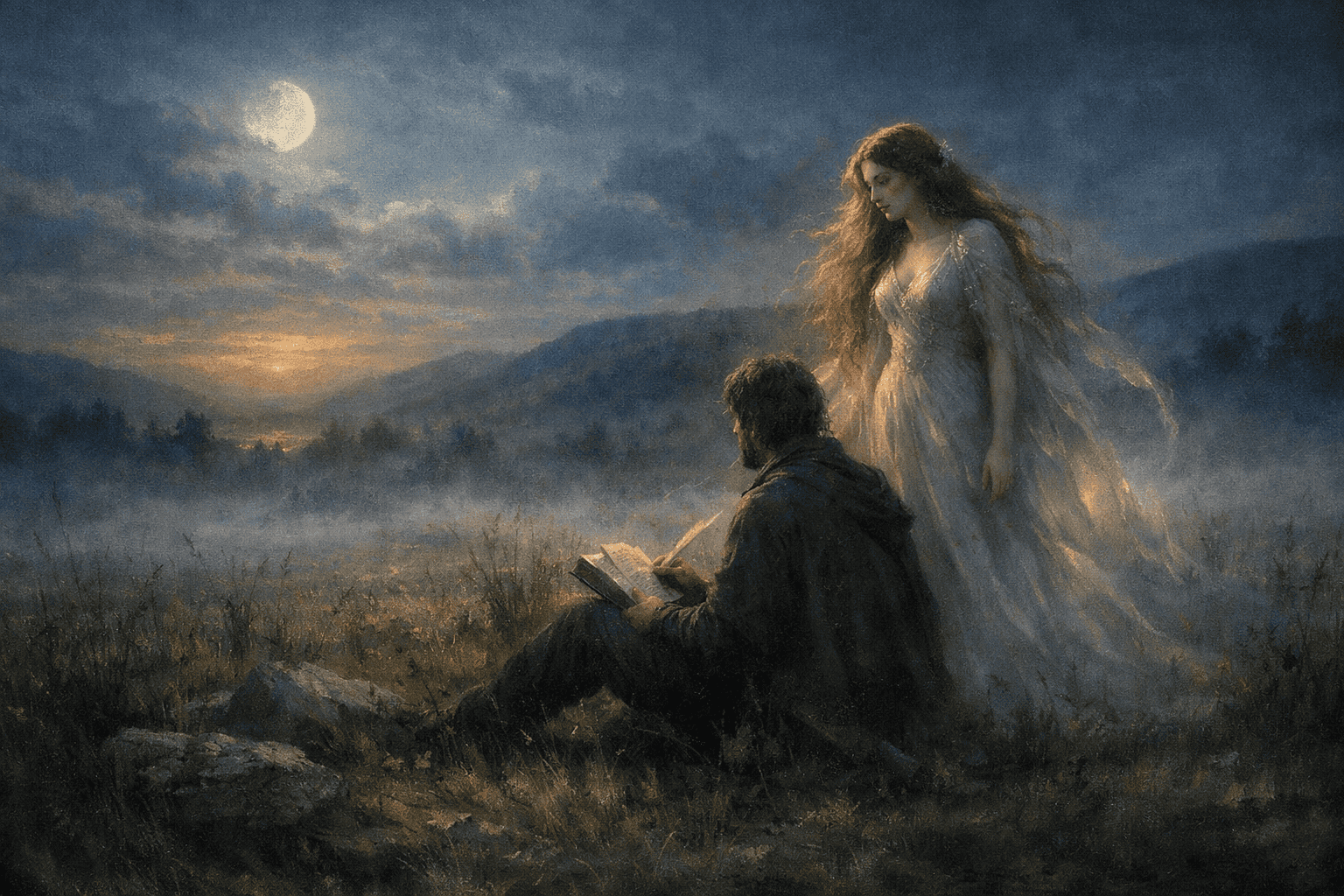
The leanán sídhe (pronounced LAN-awn shee, Irish for “fairy lover”) is a fairy woman of Irish folklore who takes a mortal lover, most famously a poet. She gives him extraordinary inspiration, but she feeds on his life, and he wastes away and dies young. That picture comes above all from W. B. Yeats, who called her “the Gaelic muse” in 1888. Behind it lies a much older and wider Gaelic belief in fairy lovers, found in Ireland, Scotland, and the Isle of Man, and some of the oldest stories in Irish literature, in which a woman of the Otherworld comes for a mortal man.
| Irish name | Leannán sídhe; modern spelling leannán sí |
|---|---|
| Meaning | “Fairy lover” or “fairy sweetheart” |
| Pronunciation | LAN-awn shee |
| Other forms | Scottish Gaelic leannan sìth; Manx lhiannan shee |
| Seeks out | Mortal men, especially poets |
| Gives | Inspiration |
| Takes | The lover’s life and strength |
| Escape | Only by finding someone to take your place, according to Yeats |
| Key source | W. B. Yeats, Fairy and Folk Tales of the Irish Peasantry, 1888 |
What Is the Leanán Sídhe?
A young poet has been struggling for years, writing verses nobody remembers. Then something changes. The words start to come as if someone were whispering them. His poems are sung in every house in the county. But his friends notice that he has grown thin and pale, that he sits up all night, and that he seems to be listening to someone who is not there. Within a few years, he is dead, and the old people nod and say he had a fairy lover.
That is the leanán sídhe, the fairy lover of Irish tradition. Her name joins leannán, “sweetheart” or “lover,” with sídhe, the older spelling of sí, the fairy people of the mounds. She is one of the Aos Sí, beautiful and irresistible, and she chooses a mortal man as her lover. What she gives him is inspiration. What she takes is his life.
Yeats and the “Gaelic Muse”
The version most people know comes from W. B. Yeats. In his 1888 collection Fairy and Folk Tales of the Irish Peasantry, he listed the “Leanhaun Shee,” his phonetic spelling, among the solitary fairies, and described her in a few unforgettable lines. She “seeks the love of mortals,” he wrote. If a man refuses her, she must be his slave. If he consents, he is hers, and he can only escape by finding someone else to take his place. “The fairy lives on their life, and they waste away. Death is no escape from her. She is the Gaelic muse, for she gives inspiration to those she persecutes.” The Gaelic poets, he added, die young, because she is restless and will not let them stay long on earth.
In a later book, Irish Fairy Tales, published in 1892, Yeats went further, claiming that most of the Gaelic poets, down to quite recent times, had had a leanán sídhe, and that when her lovers died, she carried them away to other worlds.
How Much Is Folklore, and How Much Is Yeats?
It is worth being clear about the evidence. The belief in fairy lovers is genuinely old and widespread across the Gaelic world. But the particular picture of a muse who trades genius for a short life owes a great deal to Yeats himself. Few, if any, of the older folk accounts describe her in quite those terms, and scholars have described his leanán sídhe as partly his own creation, shaped by his interest in poetry, magic, and the tragic artist. Some critics have suggested that his own long, unhappy love for Maud Gonne colored the idea.
Lady Wilde, writing a year before Yeats in 1887, also connected fairy spirits with poetic inspiration, but her account is gentler and says little about the fatal price. The dark, vampire-like muse is mostly Yeats’s contribution.
That does not make the leanán sídhe any less a part of Irish folklore. It means that the familiar version is a literary telling of an older belief, rather than a single ancient tale passed down unchanged.
The Older Fairy Lovers
Long before Yeats, Irish literature was full of Otherworld women who came for mortal men.
In one of the oldest Irish tales, Echtra Condla, “The Adventure of Connla,” a woman whom only the young prince can see calls him away to a land without death, and he sails off with her in a boat of glass, never to return. In “The Sickbed of Cú Chulainn,” the Otherworld woman Fand falls in love with the hero Cú Chulainn and nearly takes him from his wife and his world. And in the story of Tír na nÓg, Niamh of the Golden Hair carries Oisín away to the Land of Youth.
These women share much with the leanán sídhe. Each is beautiful, powerful, and in love with a mortal, and each draws him away from ordinary human life. The difference is that their lovers are heroes and princes, not poets.
Why Poets?
The link between fairy women and poets has deep roots. In early Ireland, the filí, the learned poets, were believed to draw their knowledge from the Otherworld, and poetic inspiration was thought of as something supernatural, given rather than learned. In the eighteenth century, Irish poets developed the aisling, or “vision poem,” in which the poet meets a beautiful woman from the Otherworld, often a symbol of Ireland herself. With traditions like these, it was a short step to imagine a fairy woman as the source of a poet’s gift.
The idea of the price is just as easy to understand. A spirit who gave a poet his genius and then claimed his life offered an explanation for two things people have always found mysterious: a sudden, dazzling gift, and an early death.
The Leannan Sìth and the Lhiannan Shee
The belief crossed the sea. In Scottish Gaelic, the fairy lover is the leannan sìth. On the Isle of Man, the lhiannan shee is darker still: a spirit who attaches herself to a young man, is invisible to everyone else, and slowly drains his life away, much like Yeats’s version. Some accounts also describe male fairy lovers who come for mortal women, a reminder that the belief was never only about female spirits.
Fairy Lover or Vampire?
The leanán sídhe is often called a vampire, and Yeats’s own words invite the comparison. But she is quite unlike the vampires of later fiction. She is not one of the dead, like the Abhartach of County Derry, and she does not drink blood. What she takes is strength, attention, and life, and she takes them from someone who goes on offering them willingly. She is closer to the other Irish stories of unequal bargains with the fairy world, in which a mortal accepts a gift and finds that it cannot be given back.
The Leanán Sídhe in Popular Culture
The fairy lover has had a busy modern life, usually as a beautiful and dangerous muse. In Jim Butcher’s Dresden Files novels, the Leanansidhe is the hero’s fairy godmother, and she appears in fantasy novels, games, songs, and the 2017 horror film Muse. She is a common reference point whenever writers talk about the artist who burns out young. Much of her appeal is that the old story needs almost no translation: it describes the pull of work that feels bigger than you, and the fear that giving everything to it might cost more than it returns.
Is the Leanán Sí the Same as the Leanán Sídhe?
Yes. Leanán sí and leanán sídhe are the same name in two spellings. Sí is the modern Irish spelling, and sídhe is the older one, which is still more common in English. The Yeats form, “Leanhaun Shee,” is simply his attempt to spell the Irish pronunciation.
Sources and Further Reading
- W. B. Yeats, ed., Fairy and Folk Tales of the Irish Peasantry, Walter Scott (1888).
- W. B. Yeats, ed., Irish Fairy Tales, T. Fisher Unwin (1892).
- Lady Wilde, Ancient Legends, Mystic Charms, and Superstitions of Ireland, Ward and Downey (1887).
- Katharine Briggs, An Encyclopedia of Fairies, Pantheon Books (1976).
- James MacKillop, A Dictionary of Celtic Mythology, Oxford University Press (1998).