In Short
No native Irish account of the creation of the world has survived. What Irish tradition has instead is the story of how Ireland was settled, told in the Lebor Gabála Érenn, “The Book of the Taking of Ireland,” compiled by Christian scholars in the eleventh century. It describes six waves of settlers: Cessair’s people, who drowned in the Flood; Partholón’s, who died of plague; Nemed’s, who were crushed by the Fomorians; the Fir Bolg; the godlike Tuatha Dé Danann; and finally the sons of Míl, the ancestors of the Irish, who drove the Tuatha Dé into the hills. That last division, the living above ground and the old gods below, is the closest thing Irish mythology has to the moment its world took shape.
| Native creation story | None survives |
|---|---|
| Main source | Lebor Gabála Érenn, compiled in the 11th century |
| Also called | The Book of Invasions |
| The six arrivals | Cessair, Partholón, Nemed, the Fir Bolg, the Tuatha Dé Danann, the sons of Míl |
| Great enemies | The Fomorians |
| Witnesses to it all | Fintan mac Bóchra and Tuan mac Cairill |
| Final outcome | The Milesians take the land above; the Tuatha Dé go beneath it |
| Ireland’s name | From the goddess Ériu, who asked the Milesians to name the land after her |
Is There an Irish Creation Myth?
Norse mythology begins with a yawning void and a giant made of ice. Greek mythology begins with Chaos, Earth, and the sky. Readers who come to Irish mythology looking for something similar are usually surprised: there is no Irish story of how the world was made. No creator god shapes the earth, and no first man and woman appear in a garden.
The likeliest reason is how Irish mythology came down to us. The druids of pre-Christian Ireland passed their learning on by word of mouth. By the time Irish myths were written down, the writers were Christian monks, working from the seventh century onward. They already had a creation story, the one in the Book of Genesis, and they had no reason to record a pagan rival. If the Irish once had their own account of the beginning of the world, it was either lost or deliberately left out.
What the monks did preserve, and greatly expand, was a different kind of origin story: the history of how Ireland was settled, from the time of the Flood to the arrival of the Irish people themselves.
Was the Irish Creation Myth Erased?
There is no evidence that it was. No record describes Irish monks destroying pagan texts, and there were probably none to destroy, since the druids did not write their teachings down. What happened was quieter. The monks chose what to record, and a pagan account of how the world began was the one kind of story that competed directly with the Bible. Stories of heroes, kings, and the Otherworld did not, and the monks preserved a remarkable amount of them, far more than survives from the pre-Christian religions of Britain or Gaul.
It is also possible that there was never a single Irish creation story to lose. Not every culture tells one, and the early Irish may have cared more about the origins of their land, their kings, and their families than about the origin of the world. Scholars still disagree about how much genuinely pagan material lies behind the medieval texts. Some see old myths reworked by Christian hands. Others argue that much of the literature was invented by the monks themselves. Either way, when the Irish did write about the creation of the world, in texts such as In Tenga Bithnua, “The Evernew Tongue,” from around the tenth century, the account was entirely Christian.
The Book of the Taking of Ireland
That history is told in the Lebor Gabála Érenn, usually translated as “The Book of the Taking of Ireland” and often called the Book of Invasions. It was compiled in the eleventh century from older poems and traditions, and it survives in several versions. It begins not in Ireland but with the Creation and the Flood as told in the Bible, and it traces the Irish people back to Noah.
Scholars today describe it as “synthetic history,” a learned attempt to fit Ireland’s native legends into the framework of biblical and classical history. That is why it reads as a strange blend of Genesis, Greek geography, and much older Irish myth. It is also why each wave of settlers is given a precise date, counted in years from the Flood.
The Six Takings of Ireland
The book tells of six “takings” of Ireland, each by a different people. The first four end in disaster, leaving the island empty again.
Cessair and the Flood
The first to reach Ireland was Cessair, described as a granddaughter of Noah, who sailed there before the Flood with fifty women and only three men. The Flood drowned them all except one man, Fintan mac Bóchra, who survived by changing shape, living on as a salmon, an eagle, and a hawk. He lived for thousands of years, long enough to witness every later invasion and tell their story. The medieval writers needed Fintan: without a survivor of the Flood, nobody could have known what happened before it.
Partholón
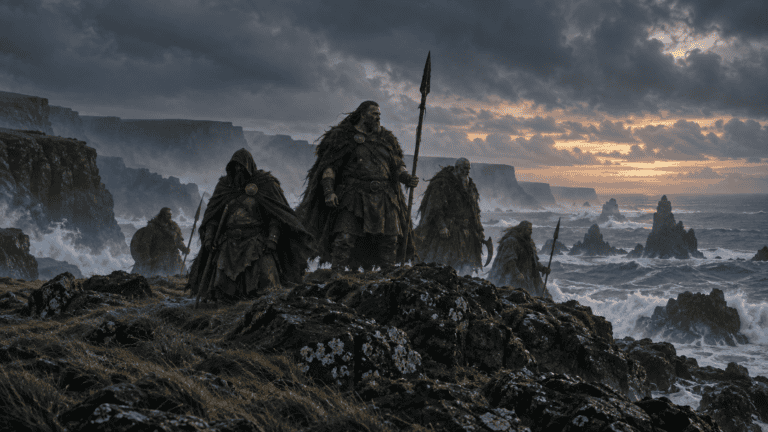
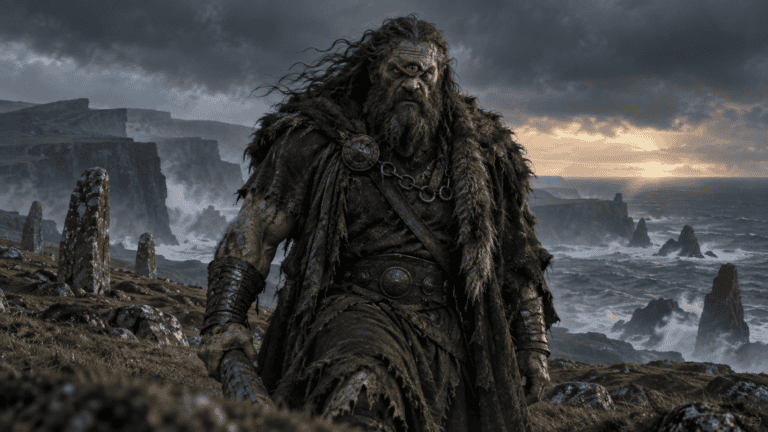
About three hundred years after the Flood, Partholón arrived with his followers. They cleared the first plains, and in their time new lakes burst out of the ground. They fought the first battle in Ireland against the Fomorians, a race of monstrous, often one-eyed beings from the sea. Then, in a single week, the whole people of Partholón died of plague. According to one tradition, only Tuan mac Cairill survived, and like Fintan, he lived on through the centuries in a series of animal shapes, as a stag, a boar, a hawk, and a salmon, until he was reborn as a man and told his story to Christian monks.
Nemed
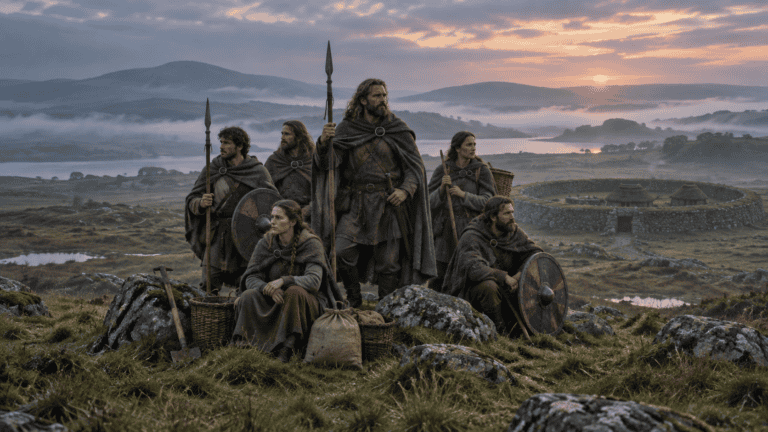
After thirty years of emptiness came Nemed and his people. They too fought the Fomorians, and after Nemed’s death, his people were forced to pay a crushing tribute every Samhain: two-thirds of their corn, their milk, and their children. They rose up and stormed the Fomorian tower on Tory Island, but in the slaughter that followed, only a few ships’ crews escaped. Their descendants scattered across the world, and some would return.
The Fir Bolg
The first to return were the Fir Bolg, descendants of Nemed who had lived in slavery in Greece. They divided Ireland into five provinces and established the first kingship. Their rule lasted until the arrival of a people far more powerful.
The Tuatha Dé Danann
The Tuatha Dé Danann, “the people of the goddess Danu,” were also descended from Nemed. They had spent their exile in four cities in the northern islands of the world, where they learned magic, poetry, and every art. They arrived in Ireland on dark clouds, landing on a mountain in Connacht, and in some versions they burned their ships so that they could never retreat. They brought four great treasures: the Lia Fáil, a stone that cried out under the rightful king; the spear of Lugh; the sword of Nuada; and the Dagda’s cauldron, from which no one ever left unsatisfied.
They defeated the Fir Bolg at the first Battle of Mag Tuired, where their king Nuada lost his hand, and later defeated the Fomorians at the second battle, where the young god Lugh killed the Fomorian champion Balor. For a time, Ireland belonged to them.
The Sons of Míl
The last to arrive were the sons of Míl Espáine, the Milesians, from Spain. According to the story, one of their family, Íth, first saw Ireland from the top of a tower in Spain on a clear winter evening. When they landed, their poet, Amergin, spoke a famous chant claiming the land, in which he declares himself to be a wind on the sea, a wave, a stag, a hawk, and much else besides.
As they crossed the country, they met three queens of the Tuatha Dé, Banba, Fódla, and Ériu, each of whom asked that the island be named after her. Amergin promised it to Ériu, and her name survives in Éire, the Irish name for Ireland. Banba and Fódla became poetic names for Ireland too.
The Tuatha Dé raised a magical storm to drive the Milesian ships away, and Amergin calmed it with poetry, though one of the Milesian leaders, Donn, was drowned. The Milesians then defeated the Tuatha Dé in battle.
The Division of Ireland
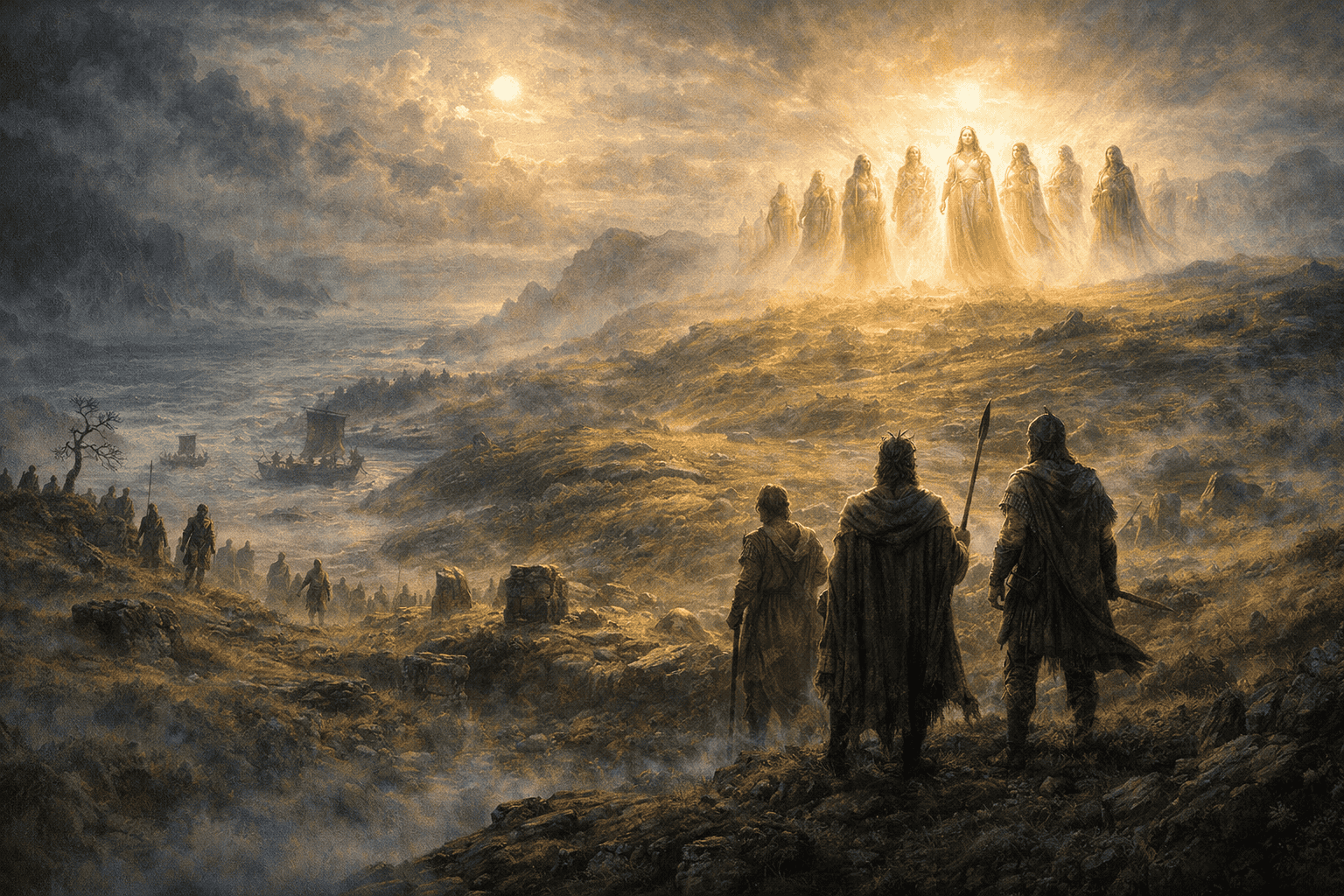
The story ends not with the destruction of the Tuatha Dé Danann but with a division of the land. In the version most often retold today, Amergin judged that the Milesians would have the part of Ireland above ground, and the Tuatha Dé would take the part below it. The old gods went into the hills and ancient mounds, the síd, and there they became the Aos Sí, the fairy people of later Irish folklore.
That is why this story matters more than any other to Irish folklore. It explains where the fairies came from, why they live in the mounds and forts, and why they have a claim to the land that humans must respect. It also explains why Irish tradition places the Otherworld so close to this one, just beneath the fields and hills. The world, in this sense, did not begin with a single act of creation. It took its final shape when the land was divided between the living and the hidden people beneath it.
What the Story Meant to Its Writers
For the medieval scholars who compiled it, the Lebor Gabála did several jobs at once. It gave the Irish a place in world history, alongside the Hebrews, Greeks, and Romans. It traced the leading families of Ireland back to the sons of Míl, and through them to Noah, giving their claims to power an ancient pedigree. And it found a respectable place for the old gods, recasting them not as gods at all but as a powerful people of the distant past.
The repeated destructions also reflect the Christian view of history. Each people rises, sins or suffers, and falls, as in the Bible, until the land passes to those who were destined to hold it.
Did the Irish Believe Ireland Was Created?
If they had a native creation story, it has not survived, so we cannot say. What has survived suggests that, for the early Irish, the most important question was not how the world began but who had the right to the land. The Lebor Gabála answers that question, and its answer still shapes Irish folklore: the land belongs to the living, but the Otherworld people were there first.
Sources and Further Reading
- R. A. S. Macalister, ed. and trans., Lebor Gabála Érenn: The Book of the Taking of Ireland, 5 vols., Irish Texts Society (1938 to 1956).
- John Carey, The Irish National Origin-Legend: Synthetic Pseudohistory, Department of Anglo-Saxon, Norse, and Celtic, University of Cambridge (1994).
- John Carey, ed. and trans., In Tenga Bithnua: The Ever-New Tongue, Apocrypha Hiberniae II, Brepols (2009).
- Kim McCone, Pagan Past and Christian Present in Early Irish Literature, An Sagart (1990).
- Proinsias Mac Cana, Celtic Mythology, Hamlyn (1970).
- Dáithí Ó hÓgáin, Myth, Legend and Romance: An Encyclopaedia of the Irish Folk Tradition, Ryan Publishing (1990).