QUICK SUMMARY
Irish mythology developed over thousands of years, beginning with early Celtic beliefs and evolving through oral tradition, Christian influence, and written manuscripts. Rather than disappearing, it adapted, preserving its core ideas about the Otherworld, the Aos Sí, and the relationship between humans and the land.
What Irish Mythology Really Is
Irish mythology is not a single collection of stories written at one time. It is a layered tradition, shaped over centuries by different cultures, beliefs, and ways of understanding the world.
At its core, it reflects how people in Ireland once interpreted:
- the natural landscape
- life and death
- unseen forces
- the passage of time
This is important to understand from the start. Irish mythology is not just entertainment or fantasy. It is a system of meaning. The stories are how people explained what they could not directly see, and how they gave structure to experiences that felt larger than ordinary life.
That is why the mythology endured. It was never just about stories. It was about reality.
The Pre-Christian Foundations
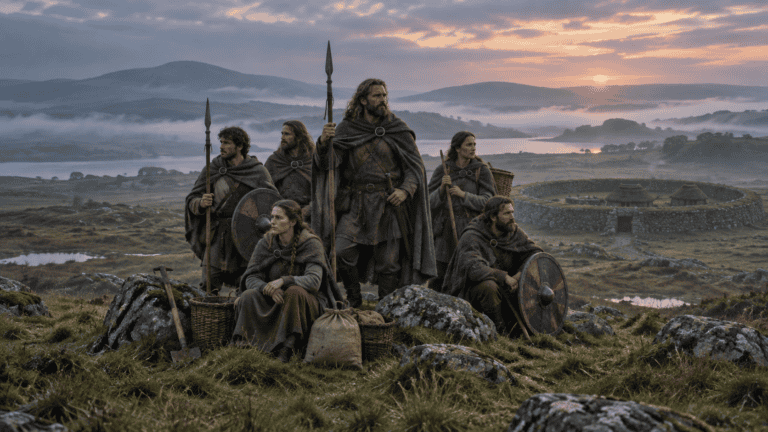
The earliest roots of Irish mythology lie in the beliefs of the ancient Celtic peoples who lived in Ireland long before written records existed. These early traditions were not organized into a formal religion in the way modern systems are. They were fluid, local, and deeply tied to the land.
The world was understood as alive and interconnected. Rivers, hills, trees, and stones were not passive objects. They carried presence and meaning. Certain places were seen as sacred, not because they were built that way, but because they were recognized as such.
Central to this worldview was the idea of the Otherworld, a parallel realm that existed alongside the human world. It was not distant or unreachable. It could be accessed through specific locations such as burial mounds, lakes, or hidden paths.
This is where many later figures originate, including the Aos Sí. These beings were not originally “fairies” in the modern sense. They were powerful, ambiguous presences tied to place, lineage, and the unseen structure of the world.
Nothing about this early system was simple or clearly defined. And that is exactly why it worked.
Oral Tradition and Storytelling
For centuries, Irish mythology existed entirely as an oral tradition. Stories were passed from person to person, shaped by memory, performance, and local interpretation.
This had two major effects.
First, it allowed the mythology to remain flexible. Stories could change depending on who told them, where they were told, and what details mattered most in that setting. There was no single “correct” version, only variations that carried the same core ideas.
Second, it made storytelling a cultural skill. The people who preserved these stories, often poets or storytellers, were not just entertainers. They were carriers of knowledge. Their role was to remember, adapt, and pass on traditions that might otherwise disappear.
This period is why Irish mythology feels alive. It was never fixed in text. It existed in voices, in memory, and in the shared experience of listening.
The Arrival of Christianity
One of the most important turning points in the history of Irish mythology came with the arrival of Christianity in Ireland, beginning around the 5th century.
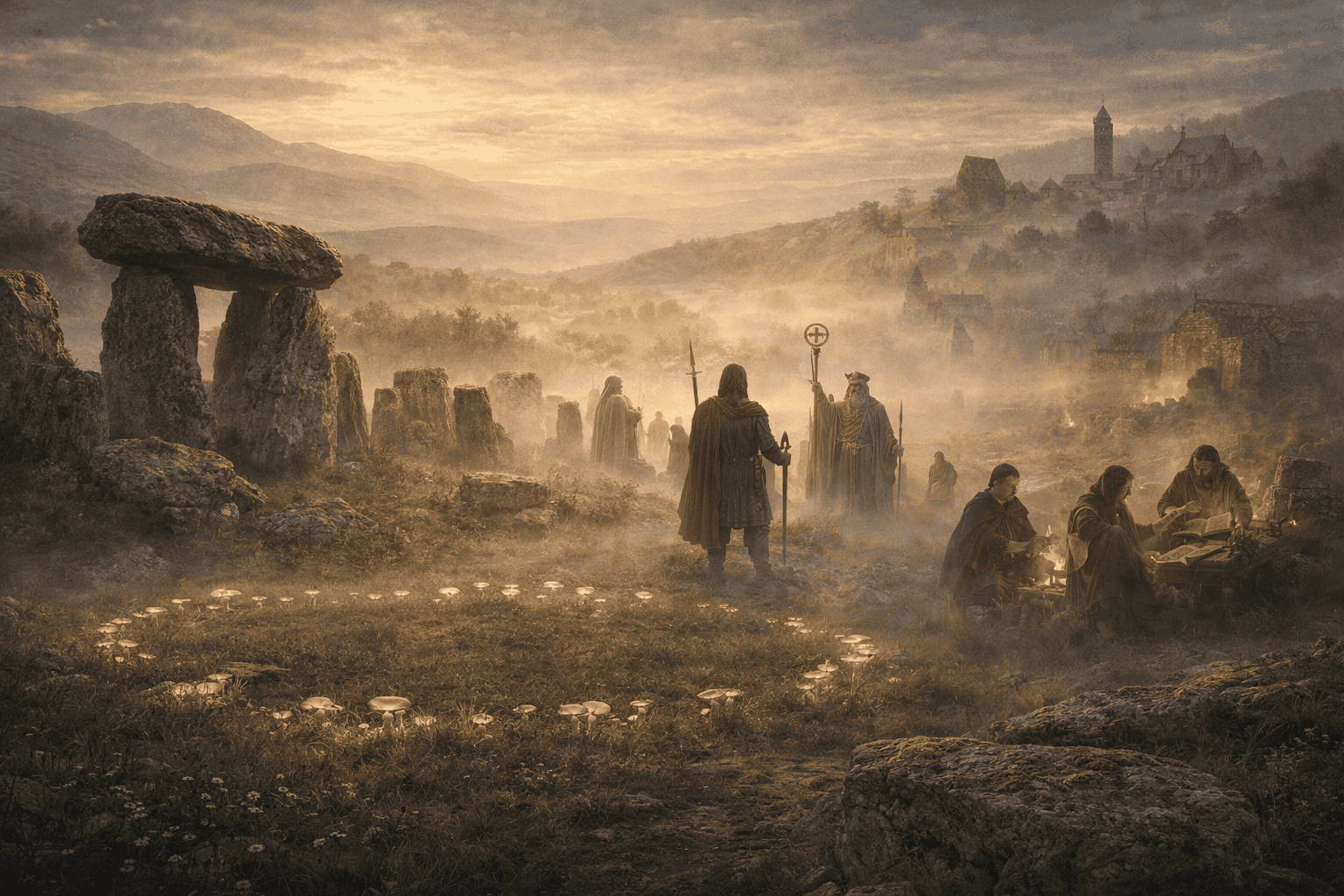
Unlike in some regions, where older belief systems were aggressively replaced, Ireland experienced a more gradual transition. Christian monks became the first people to write down many of the older stories, preserving them in manuscripts.
This created a strange but important situation.
The people recording the mythology did not necessarily believe in it in the same way it had originally been understood. As a result, the stories were often reshaped. Gods became heroes, supernatural beings were softened or reframed, and certain elements were interpreted through a Christian lens.
Yet despite these changes, much of the original material survived.
This is one of the reasons Irish mythology is so rich today. It was not erased. It was adapted and recorded, even if imperfectly.
The Mythological Cycles
Over time, the preserved stories came to be grouped into what are now known as the major cycles of Irish mythology. These are not strict categories, but they help organize a large and complex body of material.
The main cycles include:
- The Mythological Cycle: Stories of the earliest inhabitants of Ireland, including the Tuatha Dé Danann, who are closely linked to the later concept of the Aos Sí.
- The Ulster Cycle: Heroic tales centered on warriors such as Cú Chulainn, emphasizing conflict, honor, and fate.
- The Fenian Cycle: Stories of Fionn mac Cumhaill and his followers, blending heroism with more personal and reflective themes.
- The Cycle of Kings: Narratives focused on historical and semi-historical rulers, connecting mythology with recorded history.
These cycles show how Irish mythology evolved. It expanded from cosmological and supernatural origins into stories that included human heroes, social structures, and political themes.
It became broader, but it never lost its connection to the unseen world.
The Transformation of the Gods
One of the most striking changes in Irish mythology is what happened to the gods.
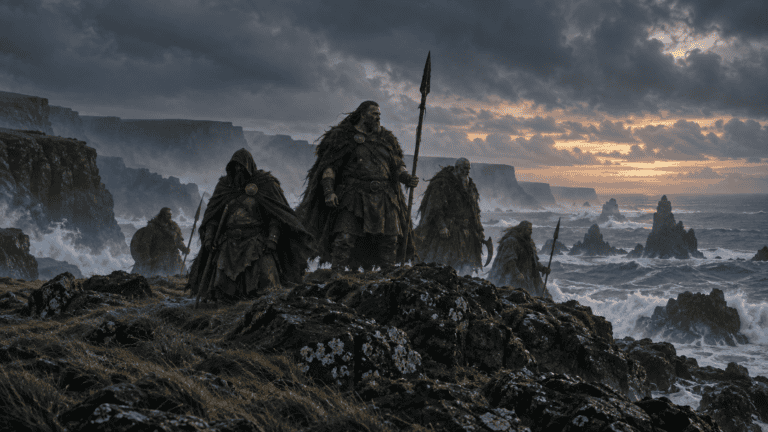
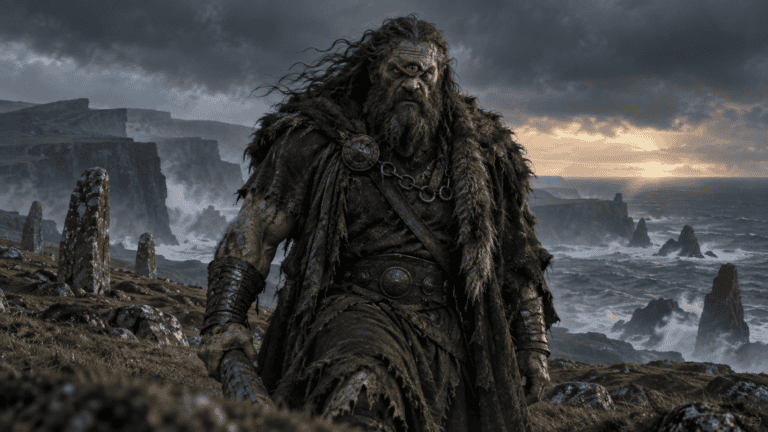
In earlier traditions, figures like the Tuatha Dé Danann were powerful, otherworldly beings. Over time, especially under Christian influence, they were reinterpreted. They became less like gods and more like legendary figures, or even hidden beings who retreated into the landscape.
This transformation is where the idea of the Aos Sí becomes especially important.
The gods did not disappear. They changed form. They became the unseen inhabitants of mounds, hills, and hidden places, continuing to exist, but no longer openly part of the human world.
This shift allowed the mythology to survive without directly conflicting with newer belief systems. It was a form of adaptation, not erasure.
Folklore and Everyday Belief
As Irish mythology moved further from its ancient origins, it blended more deeply with folklore.
Instead of grand mythic narratives, the focus shifted toward:
- local stories
- encounters
- warnings
- traditions tied to daily life
Beliefs about fairy rings, fairy forts, the banshee, and the púca all belong to this phase. These are not distant myths. They are stories that feel close, personal, and connected to real places.
This is where mythology becomes part of everyday experience. It influences behavior, shapes caution, and creates a shared understanding of how the world works, even if that understanding is not openly discussed.
The Role of the Landscape
Throughout its history, Irish mythology has remained deeply connected to the land.
Unlike some traditions that move into abstract or symbolic spaces, Irish mythology stays grounded in physical locations. Hills, rivers, stones, and fields are not just settings. They are part of the meaning.
Certain places are associated with specific stories or beings. Over time, these associations become part of local identity. The land itself becomes a kind of archive, holding memory in a way that does not rely on written text.
This connection is one of the reasons the mythology has endured. It is not easy to forget something that is tied to the ground beneath your feet.
Modern Interpretations and Misunderstandings
In modern culture, Irish mythology is often simplified or reshaped to fit entertainment formats. Stories are turned into fantasy narratives, characters are made more clearly heroic or villainous, and the ambiguity that defines the original tradition is reduced.
This makes the mythology easier to consume, but less accurate.
The original material is not clean or straightforward. It is complex, inconsistent, and often unresolved. That is part of its strength. It reflects a world that is not fully understood, rather than one that has been neatly explained.
When that complexity is removed, something essential is lost.
Why Irish Mythology Still Matters
Irish mythology continues to matter because it offers a way of thinking about the world that is different from purely rational or scientific frameworks.
It emphasizes:
- connection to place
- respect for boundaries
- awareness of the unseen
- acceptance of uncertainty
These ideas are not outdated. They remain relevant, even if they are expressed differently today.
The mythology does not demand belief in a literal sense. It invites a different kind of attention, one that recognizes that not everything can be reduced to explanation.
Final Thoughts
The history of Irish mythology is not a straight line from past to present. It is a layered process of belief, adaptation, preservation, and transformation.
From its origins in ancient Celtic traditions, through the influence of Christianity, to its survival in folklore and modern culture, it has continuously changed while holding onto its core ideas.
At every stage, it has reflected the same underlying truth: that the world is more complex, more connected, and more uncertain than it first appears.
And that, more than any single story, is what Irish mythology has always been trying to express.