In Short
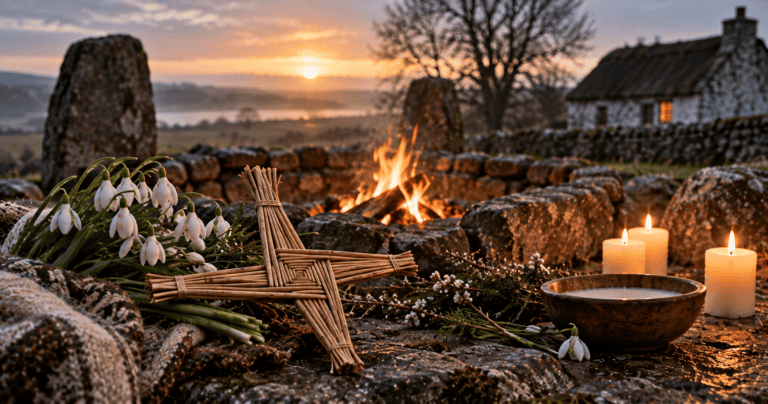
A St. Brigid’s Cross (in Irish, Cros Bhríde, pronounced KROSS VREE-juh) is a small cross woven from rushes or straw on the eve of St. Brigid’s Day, 1 February, and hung in the house to protect it through the coming year, especially from fire. The familiar four-armed design is only one of many regional styles. The custom is usually described as ancient, but the earliest written record of it dates from the seventeenth century.
| Irish name | Cros Bhríde, also crosóg Bhríde |
|---|---|
| Pronunciation | KROSS VREE-juh |
| Made on | 31 January, the eve of St. Brigid’s Day |
| Materials | Mostly rushes or straw; also reeds, grass, wood, and goose quills |
| Purpose | To bring Brigid’s blessing and protect the house and animals, especially from fire |
| Where hung | Over the door, in the rafters or thatch, and in animal sheds |
| Main styles | Diamond, four-armed, three-armed, wheel, and interlaced |
| Earliest record | Seventeenth century |
What Is a St. Brigid’s Cross?
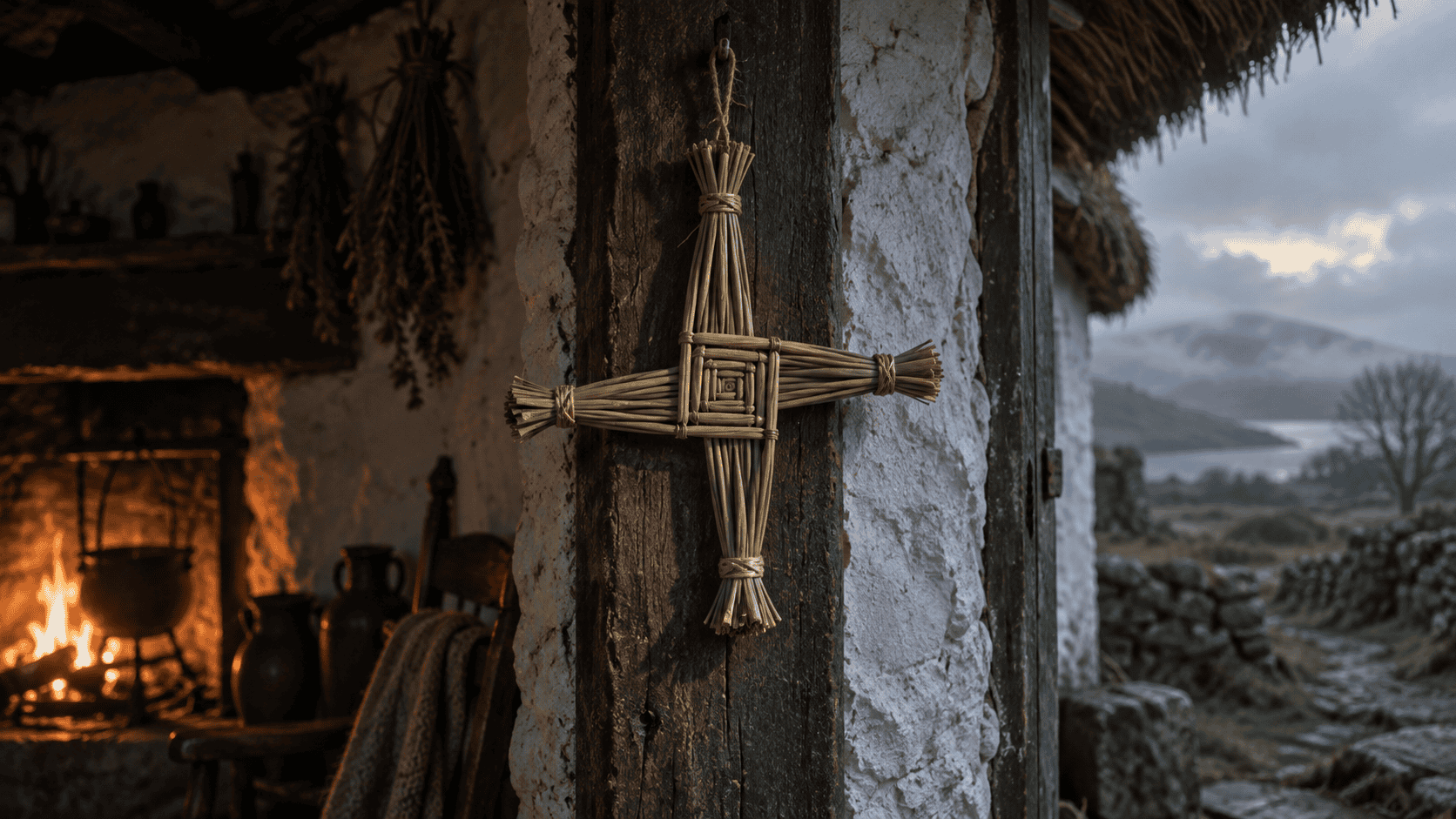
If you have been inside an Irish kitchen, there is a fair chance you have seen one: a small, square-centered cross of dried rushes, pinned above the door or tucked behind a picture. It may have been there for years. It may have been made last February by a child at school. Either way, it is doing the same job it has done in Irish homes for centuries, which is asking St. Brigid to keep an eye on the house.
The cross is made on the eve of Brigid’s feast, 31 January, from rushes, the tall, stiff, grass-like plants that grow in damp fields and bogs all over Ireland. It is hung in the house and in the byre or cowshed, and it is believed to protect the family and their animals, above all from fire. The next year, a new cross is made, and the old one is either kept alongside it or burned.
The Legend of the First Cross
The story most people know is simple. Brigid was sitting at the bedside of a dying pagan chieftain, in some tellings her own father. He was delirious, and she wanted to tell him about the Christian faith before he died. So she picked up rushes from the floor, which in those days was strewn with them, and began to weave them into a cross, explaining its meaning as she worked. The chieftain grew calm, listened, and asked to be baptized before he died.
It is a lovely story, and it is the one told in Irish schools every February. It is also impossible to date. The legend does not appear in the early Lives of Brigid, and it seems to have grown up to explain a custom that was already widespread. Like many stories about the origins of Irish customs, it tells us more about what the cross meant to the people who made it than about how it began.
How Old Is the Custom?
St. Brigid’s crosses are usually described as ancient, and sometimes as older than Christianity itself. The written evidence tells a different story. According to the folklorist T. G. F. Paterson, who studied the custom in County Armagh in the 1940s, the earliest written record of making the crosses dates from the seventeenth century. Brigid herself lived more than a thousand years earlier.
That does not mean the custom began in the 1600s. Rural traditions like this one were rarely written down until someone from outside took an interest in them, so the cross may well be older than its first mention. But there is no evidence that it goes back to Brigid’s own time, and none that it existed before Christianity. By the mid-twentieth century, the custom was in decline in many areas, partly because modern houses with plastered ceilings left nowhere to tuck a cross into the rafters. Schools and the Irish revival of interest in Brigid have since brought it back.
More Than One Kind of Cross
The four-armed cross, with its woven square center and arms turning at right angles, is so familiar that most people assume it is the only kind. It is not. The National Museum of Ireland, whose Irish Folklife Collection at Turlough Park in County Mayo holds examples of most regional styles, groups Brigid’s crosses into seven broad types. They include diamond-shaped crosses, four-armed and three-armed woven crosses, wheel-shaped crosses, interlaced designs, and simple Latin crosses of straw or bound wood.
The four-armed cross was favored in the north of Ireland. Across the country as a whole, the museum notes, diamond-shaped crosses were more popular, especially in Munster and Connacht. These are made by weaving straw or rushes around two crossed sticks until a diamond, or several diamonds, fills the frame. In parts of Ulster, people also made a three-armed cross, which some writers have compared to the triskele, the ancient three-spiraled design.
The materials varied as much as the shapes. Rushes and straw were the most common, but crosses were also made from reeds, grass, hay, wood, goose quills, wire, and even fabric. What mattered was the ritual around them. The material was usually sprinkled with holy water before the weaving began, and a prayer was said to welcome the saint into the home.
Making the Cross on St. Brigid’s Eve
The making of the crosses was part of a larger ritual on the last night of January. In many homes, a member of the family went out after dark to gather the rushes. In some districts, the rushes were pulled up by hand rather than cut. The person with the rushes then came back to the door and knocked, asking for Brigid to be welcomed in, and the family inside answered that she was. Once the rushes were inside, the family sat down together to weave.
The finished crosses went up over the door, in the kitchen, in the rafters or the thatch, and in the byre where the cattle slept. In some houses, each year’s cross was added to the collection above it, so that an old farmhouse roof might hold decades of them, turning brown with smoke. In others, the old cross was burned when the new one went up.
How to Make a Four-Armed St. Brigid’s Cross
You will need about sixteen fresh rushes, each at least thirty centimeters long, and four short pieces of thread or small rubber bands. If you can’t find rushes, drinking straws or long strips of paper work well for practice.
- Hold one rush upright. Fold a second rush in half around its middle, so that the fold hugs the first rush and the two ends point to the right.
- Hold the center tightly between your thumb and finger, and turn the whole piece a quarter turn counterclockwise, so the ends you just added now point up.
- Fold a third rush in half over the top of the ends that are pointing up, with its own ends pointing to the right.
- Turn the piece a quarter turn counterclockwise again, and fold in the next rush the same way. Keep going, always turning in the same direction and always pulling each new rush snug against the center.
- After about twelve to sixteen rushes, the square in the middle will be the size you want. Tie off each of the four arms near the center with thread, then trim the ends of the arms so they are even.
The woven square in the center should be tight and flat. If it starts to twist, you have probably turned the piece the wrong way once. Unwind back to that point and carry on.
If you’d rather watch it done, this video walks through weaving a cross step by step.
St. Brigid’s Cross in Popular Culture
For more than thirty years, the St. Brigid’s Cross was one of the most recognized images in Ireland, because it was the logo of the national broadcaster. It first appeared on screen when Telefís Éireann began broadcasting on New Year’s Eve, 1961, and a version of it stayed in the RTÉ logo until 1995. Many people still associate the four-armed design with the station, which helped make that one style the “standard” cross for the whole country.
Since 2023, when Ireland held its first public holiday for St. Brigid’s Day, interest in the custom has grown again. Cross-making workshops are held in libraries, schools, and heritage centers every year, and the crosses are sold as souvenirs and gifts across Ireland and among the Irish abroad. Our guide to Brigid covers the goddess, the saint, and the other customs of her feast day.
Is the St. Brigid’s Cross a Pagan Symbol?
It is often called one, usually on the grounds that Brigid was also a goddess and that her feast falls on Imbolc, the old festival of early spring. Some writers have also suggested that the turning arms of the cross represent the sun. These ideas are interesting, but they are speculation. There is no early evidence that the cross existed before Christianity, the earliest written record of it comes from the seventeenth century, and the people who made it understood it as a Christian object, blessed with holy water and made in honor of a saint. What is fair to say is that it belongs to a feast day that was already very old when Brigid’s name was attached to it.
Sources and Further Reading
- T. G. F. Paterson, “Brigid’s Crosses in County Armagh,” Ulster Journal of Archaeology 8 (1945).
- Thomas H. Mason, “St. Brigid’s Crosses,” Journal of the Royal Society of Antiquaries of Ireland 75 (1945).
- Kevin Danaher, The Year in Ireland: Irish Calendar Customs, Mercier Press (1972).
- Seán Ó Duinn, The Rites of Brigid: Goddess and Saint, Columba Press (2005).
- Anne O’Dowd, Straw, Hay and Rushes in Irish Folk Tradition, Irish Academic Press (2015).