In Short
A fairy tree in Irish folklore is a tree, most often a lone hawthorn standing in the middle of a field, that is believed to belong to the fairies. Tradition says it must never be cut down, damaged, or have its branches broken off, and that anyone who harms one will suffer bad luck, illness, or worse. The belief is still strong enough in Ireland that farmers plough around these trees, and in 1999 a motorway in County Clare was built around one after a campaign by the folklorist Eddie Lenihan.
| What it is | A tree believed to belong to, or be a gathering place of, the fairies |
|---|---|
| Usual tree | A lone hawthorn, or whitethorn; sometimes an ash |
| Irish name for hawthorn | Sceach gheal, “white thorn” |
| Where found | Standing alone in fields, near fairy forts, or beside holy wells |
| The rule | Never cut it, damage it, or take its branches |
| Other taboo | Never bring hawthorn blossom into the house |
| Famous example | The Latoon fairy bush beside the M18 motorway in County Clare |
| Famous legend | The DeLorean car factory near Belfast |
| Related | Rag trees at holy wells, and the protective rowan |
What Is a Fairy Tree?
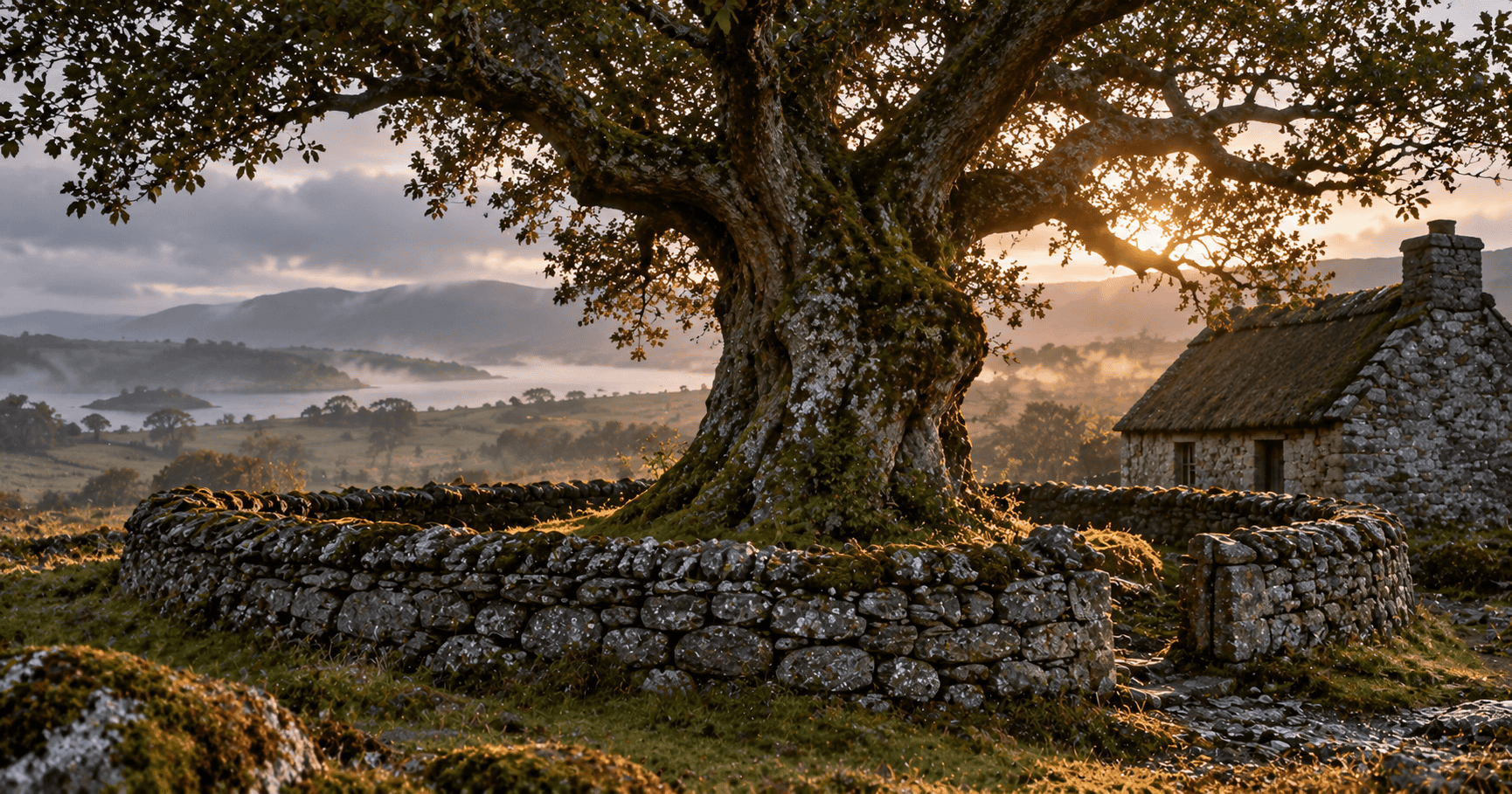
Drive through the Irish countryside and sooner or later you will see one: a single thorn tree standing on its own in the middle of a field, gnarled and bent by the wind. The field around it has been ploughed, mown, or grazed for generations. The tree has not been touched. Nobody has cut it, trimmed it, or even pulled a branch from it, and the farmer’s tractor goes carefully around it every year.
This is a fairy tree, sometimes called a fairy thorn or a lone bush. In Irish tradition, it belongs to the Aos Sí, the fairy people, who are said to gather at it, dance around it, or use it as a meeting place or a doorway between their world and ours. It is not a place anyone owns, whatever the deeds to the land might say, and harming it is one of the surest ways to invite the fairies’ anger.
Why the Hawthorn?
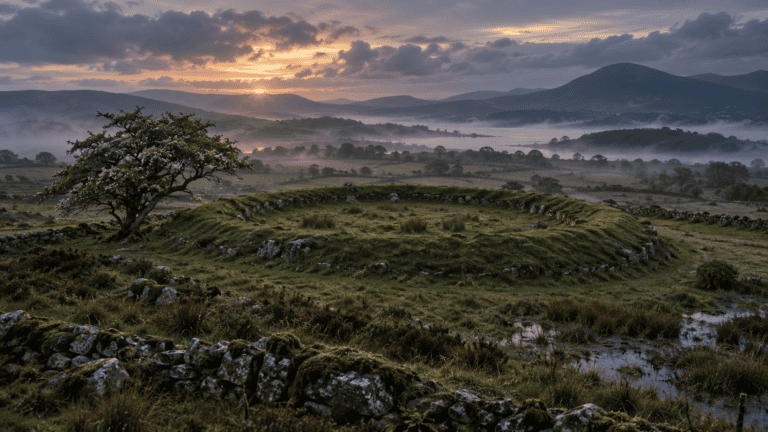
Almost any tree could be a fairy tree, but the one most often named is the hawthorn, also called the whitethorn, in Irish sceach gheal. It is one of Ireland’s most common native trees, and it is used everywhere as a hedging plant. It becomes special when it grows alone, especially in the open middle of a field or on the bank of an old ringfort. A thorn that has been left standing by itself, when all the land around it has been cleared, seemed to many people to have been left there for a reason.
The hawthorn flowers at the start of May, around the festival of Bealtaine, when its branches turn white with blossom. That was one of the times of year when the fairies were thought to be most active. Hawthorns can also live for hundreds of years, so a lone thorn might have been standing in the same spot for longer than anyone could remember. Accounts of fairy thorns turn up in every part of Ireland in the folklore collected by schoolchildren for the Schools’ Collection in the 1930s.
The Rules of the Fairy Tree
The rules around fairy trees were simple and widely known.
- Never cut it down. This is the first and most serious rule, and the one that stories most often warn about.
- Never break a branch. Even trimming a fairy thorn, or pulling a twig from it, could bring trouble.
- Never bring the blossom indoors. Hawthorn blossom in the house was widely believed to bring illness or death, even when the tree was not a fairy tree.
- Work around it. Farmers left a wide berth when ploughing, and did not disturb the ground at its roots.
What Happens If You Cut One Down?
In the stories, nothing good. People who cut down a fairy thorn were said to suffer illness, accidents, the death of their animals, or the death of someone in the family. Some say the culprit would never have another good night’s sleep.
The belief has had real consequences. In 1954, residents of a housing estate in Sligo town were reported to be deeply uneasy after a local priest had a lone hawthorn removed and replaced it with a religious shrine, and three young men from the estate then died. Stories like this are impossible to prove or disprove, but they show how seriously the rule was taken well into the twentieth century.
The Latoon Fairy Bush
The most famous fairy tree in modern Ireland stands beside the M18 motorway at Latoon, near Newmarket-on-Fergus in County Clare. In 1999, the planned route of the new road passed straight through it. The folklorist and storyteller Eddie Lenihan, one of the few traditional storytellers, or seanchaithe, still working in Ireland, warned publicly that the whitethorn was an important meeting place for the fairies of the region, and that destroying it could bring death and misfortune to drivers on the new road.
His letters to local newspapers were picked up by the Irish Times and then by the New York Times, and the story spread around the world, as Lenihan later told TheJournal.ie, with journalists arriving from the BBC, CNN, and European news outlets. In the end, the bush was spared. The road was built beside it, and the tree still grows today on a strip of land between the motorway and a slip road at Junction 11, looked after by Clare County Council.
The DeLorean Factory
Another famous story, told as a local legend, concerns the DeLorean car factory at Dunmurry, near Belfast, which made the stainless-steel DeLorean sports car in 1981 and 1982. The story goes that a lone hawthorn stood on the site, and that local workmen refused to cut it down. Some versions say outsiders were brought in to do it. Others say John DeLorean himself drove a bulldozer into it. Either way, the tree was destroyed, and within a few years the company had collapsed. The legend is repeated in almost every article about fairy trees, including this one from IrishCentral, and the details vary so much from one telling to the next that it is best treated as modern folklore rather than history.
Other Trees in Fairy Lore
The hawthorn is the classic fairy tree, but it is not the only tree in Irish folk belief.
- Rag trees. Beside many holy wells, a hawthorn or ash is hung with strips of cloth, ribbons, and small offerings. Traditionally, a rag taken from the clothes of a sick person was tied to the tree as part of a prayer for healing, with the idea that the illness would fade as the cloth rotted away. These are Christian pilgrimage sites, though the custom may be older.
- The ash. Ash trees are often found beside holy wells, and a lone ash could also be treated as a fairy tree.
- The rowan. The rowan, or mountain ash, was the opposite of a fairy tree. Its wood and berries were believed to protect against fairies and witchcraft, and sprigs were hung over doors and in byres, especially at May Eve.
Fairy Trees Today
Fairy trees are still very much part of the Irish landscape. Lone thorns stand untouched in fields across the country, and many farmers and builders would still rather go around one than risk the consequences, whether out of belief, respect for tradition, or simple caution. For many, the reasoning is simple: leaving a tree alone costs nothing, and being wrong could cost a great deal. Fairy trees have also become an attraction for visitors, and some, especially those at holy wells, have been decorated with ribbons, coins, and notes.
Is It Illegal to Cut Down a Fairy Tree in Ireland?
Not as such. No Irish law protects fairy trees because of their place in folklore. However, most fairy thorns are hawthorns growing in fields or hedgerows, and under the Wildlife Act, cutting vegetation in hedgerows in the Republic of Ireland is generally restricted between 1 March and 31 August to protect nesting birds, with some exceptions. Trees at protected sites, such as National Monuments, also have legal protection. In practice, the strongest protection most fairy trees have is still the one they have always had: nobody wants to be the one who cuts them down.
Sources and Further Reading
- The Schools’ Collection, National Folklore Collection, University College Dublin (1937 to 1939), on dúchas.ie.
- Niall Mac Coitir, Irish Trees: Myths, Legends and Folklore, The Collins Press (2003).
- Eddie Lenihan and Carolyn Eve Green, Meeting the Other Crowd: The Fairy Stories of Hidden Ireland, Tarcher (2004).
- Kevin Danaher, The Year in Ireland: Irish Calendar Customs, Mercier Press (1972).
- “Double Take: The Fairy Bush in Co Clare That Moved a Motorway,” TheJournal.ie (2019), thejournal.ie.