In Short
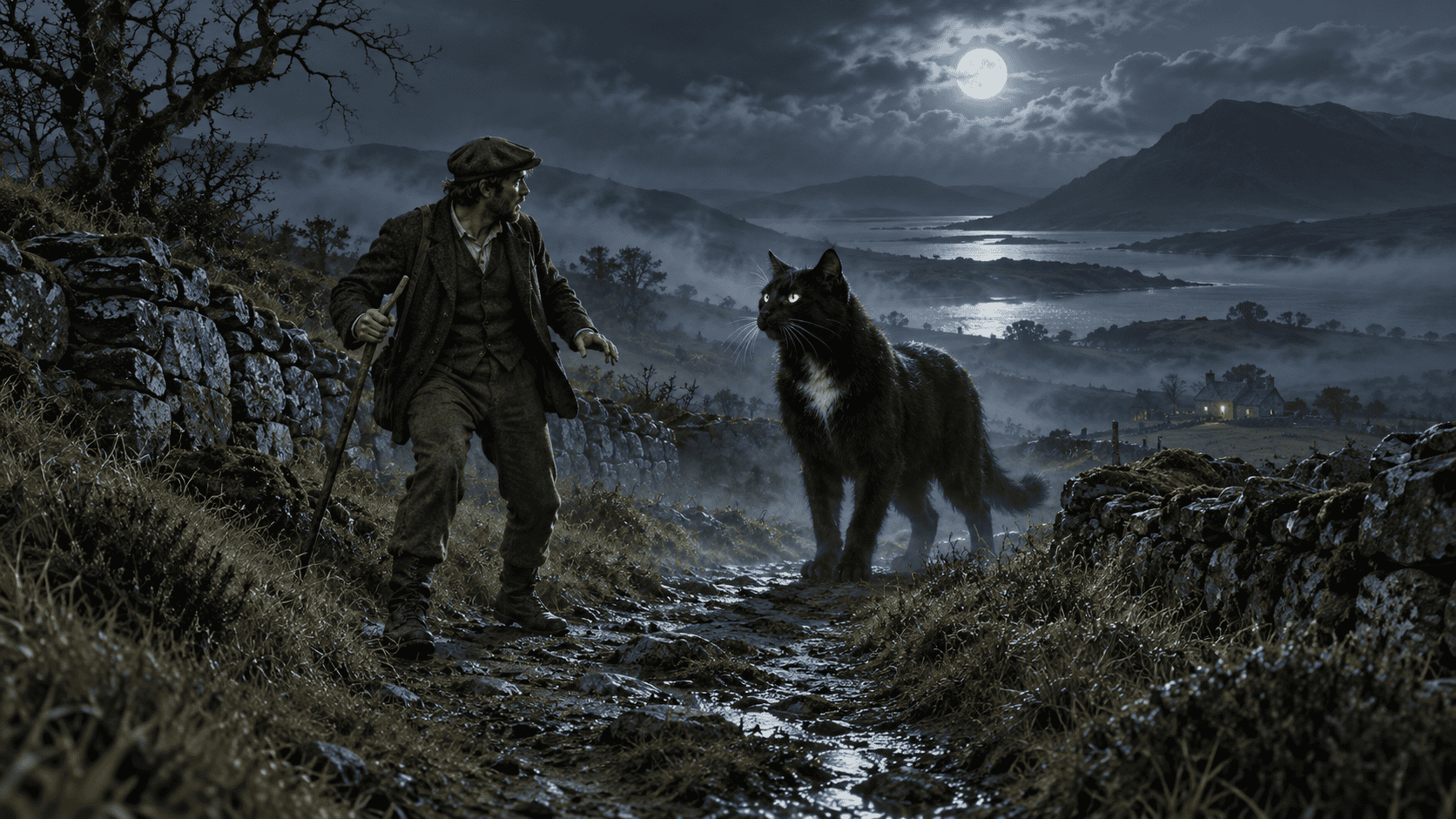
The cat sídhe (pronounced kat SHEE, “fairy cat”) is a fairy creature said to look like a huge black cat, as large as a dog. It belongs mainly to the folklore of the Scottish Highlands, where it is known as the cat sìth, and where some said it was not a fairy at all but a witch in cat form. Irish tradition has its own great fairy cat, Irusan, the King of the Cats, who carried off the chief poet of Ireland on his back. Many popular details about the cat sídhe, such as its white chest spot, its soul-stealing at wakes, and the saucer of milk left out for it at Samhain, are repeated widely online but are hard to trace to early sources.
| Name | Cat sídhe; Irish cat sí; Scottish Gaelic cat sìth |
|---|---|
| Meaning | “Fairy cat” |
| Pronunciation | kat SHEE |
| Appearance | A black cat as large as a dog, back arched and bristling |
| Where | Mainly the Scottish Highlands |
| Fairy or witch? | Some Highlanders said it was a witch in cat form |
| Irish relative | Irusan, the King of the Cats |
| Real animal behind it | Possibly the Scottish wildcat |
What Is the Cat Sídhe?
A crofter walking home through a Highland glen at dusk sees a cat on the path ahead. But it is no ordinary cat. It is black, and as big as a sheepdog, and as he stops, it arches its back and its fur bristles up along its spine. It stares at him, unafraid, and then slips away into the heather. He does not tell the story as a meeting with a wildcat. He tells it as a meeting with the cat sìth, the fairy cat.
The name simply means “fairy cat,” from cat and sìth, the Scottish Gaelic form of the Irish sí, the fairy people. In Irish, it is written cat sí, or in the older spelling, cat sídhe. Like the Aos Sí themselves, it was believed to belong to the hidden world beside ours.
Scottish or Irish?
The cat sídhe belongs above all to the folklore of the Scottish Highlands, and most of what is written about it comes from Scottish sources. Highland folklore collected in the late nineteenth century describes the fairy cat as being as large as a dog and black, and as showing itself with its back arched and its bristles erect. It is usually said to have a single white spot on its chest, though that detail is harder to trace to the early collectors.
Ireland shared the word and the idea, but not much of the lore. The great Irish fairy cat is a different figure altogether, found in a medieval tale about poets, and he is described below.
Fairy or Witch?
Not everyone in the Highlands agreed that the fairy cat was a fairy. Many people believed it was really a witch who had taken the form of a cat. This fits a much wider belief across Scotland, Ireland, and Britain that witches could turn themselves into animals, especially cats and hares, to travel unseen and do mischief.
Modern writers often add that a witch could make this change only nine times, and that on the ninth, she would stay a cat forever, and that this explains why cats are said to have nine lives. It is an appealing story, but the saying about nine lives is much older and more widespread. Shakespeare’s Mercutio already teases Tybalt, the “King of Cats,” about his nine lives in Romeo and Juliet, written in the 1590s.
Irusan, the King of the Cats
Ireland’s great fairy cat appears in a comic medieval tale about Seanchan, the chief poet of Ireland, which Lady Wilde retold in 1887. At a feast held by Guaire, the king of Connacht, Seanchan is so proud and prickly that he refuses to eat. When he finally agrees to eat an egg, it turns out that mice have eaten it first. Furious, he composes a satire that kills ten mice on the spot, and then turns on the cats, for failing to keep the mice down. He composes a satire against Irusan, the King of the Cats.
Irusan, an enormous cat living in a cave near Clonmacnoise, is not amused. He comes to the feast, seizes Seanchan, and carries him off on his back. As he races past the monastery of Clonmacnoise, Saint Ciarán sees the chief poet being carried away and throws a red-hot iron bar, killing the great cat, and Seanchan is freed. The tale is a satire on the arrogance of poets, who in early Ireland could ruin a man with a verse, but it also gives Ireland a king of cats as fearsome as any Highland fairy.
The King of the Cats
A different “King of the Cats” story is told in England and Scotland. A man walking home at night sees a procession of cats carrying a tiny coffin with a crown on it, and one of them tells him to take a message: “Tell Tom Tildrum that Tim Toldrum is dead.” When he gets home and tells his wife, their old house cat leaps up, cries that he is now King of the Cats, and vanishes up the chimney. The story was published by Joseph Jacobs in More English Fairy Tales in 1894, and it is often linked with the cat sídhe because of its secret society of talking cats.
Cats at the Wake
Many modern articles say that the cat sìth could steal the soul of a dead person by passing over the body before burial, and that Highland families held a special “late wake” to keep it away, with games, riddles, music, and catnip, and no fire in the room. These details are repeated so often that they are now part of the legend, but they are difficult to trace to early sources.
What is well recorded, in both Scotland and Ireland, is the custom of keeping cats away from a corpse. A cat that jumped over the body was thought to bring bad luck, and in some places it was said that such a cat had to be killed. There were practical reasons too: a cat could disturb or damage a body laid out in a house for days. The fairy cat may have given that old caution a supernatural face.
The Saucer of Milk at Samhain
Another popular claim is that on Samhain, the cat sìth would bless any house that left out a saucer of milk for it, and would dry up the cows of any house that did not. This too is hard to trace to the older collections. It is, however, very close to a real and widespread custom: in both Ireland and Scotland, people left food and milk out for the fairies at Samhain, to keep them friendly as they moved about on that night.
A Real Cat Behind the Legend?
The Scottish wildcat is larger and far fiercer than a house cat, with a thick, bristling coat, and it arches its back and puffs up its fur when threatened, just as the fairy cat does. For centuries, it lived in the wild glens where the cat sìth was said to roam. Some writers have also pointed to the Kellas cat, a large black hybrid of wildcat and domestic cat, first brought to naturalists’ attention in the 1980s in Moray, in north-east Scotland. A glimpse of one of these animals at dusk could easily become a meeting with the fairy cat.
The Cat Sídhe in Popular Culture
The fairy cat has become a favorite in fantasy and games. It appears as the cat Cait Sith in the Final Fantasy series, as a character in fantasy novels, and in countless Halloween illustrations, usually as a black cat with a white patch on its chest. It is also often credited with starting the link between black cats and Halloween, though that connection has many sources.
Is the Cat Sídhe Good or Evil?
Neither, like most Irish and Scottish fairies. It was treated warily, because a fairy cat, or a witch in cat form, could bring bad luck to those who crossed it. But it was not usually thought of as a killer. Irusan is the exception, and even he was only defending the honor of cats against an insulting poet.
Sources and Further Reading
- John Gregorson Campbell, Superstitions of the Highlands and Islands of Scotland, James MacLehose and Sons (1900).
- Lady Wilde, Ancient Legends, Mystic Charms, and Superstitions of Ireland, Ward and Downey (1887).
- Joseph Jacobs, More English Fairy Tales, David Nutt (1894).
- Katharine Briggs, An Encyclopedia of Fairies, Pantheon Books (1976).
- Owen Connellan, ed. and trans., Imtheacht na Tromdhámhe (“The Proceedings of the Great Bardic Institution”), Transactions of the Ossianic Society 5 (1860).