In Short
In Irish folklore, the banshee’s cry is a warning that someone in a family is about to die. People described it as a long, rising and falling wail, like a woman keening at a wake, usually heard at night near the house of someone who was ill. The banshee was never thought to cause the death, only to announce it. Many of the sounds people took for her were probably vixens or barn owls, but the cry has lasted because it gave voice to something every family knew: the dread of a death that everyone could see coming.
| What it means | A death is coming in the family |
|---|---|
| What it sounds like | A long, rising and falling wail, like keening |
| When | Usually at night, often shortly before a death |
| Where | Outside the house, by a window, or at a distance |
| Who hears it | The family, and sometimes neighbors |
| Human parallel | The caoineadh, the lament sung at Irish wakes |
| Likely natural sources | A vixen’s scream or a barn owl’s shriek |
| Famous account | Sir Jonah Barrington’s story of Lord Rossmore, 1801 |
What the Banshee’s Cry Means
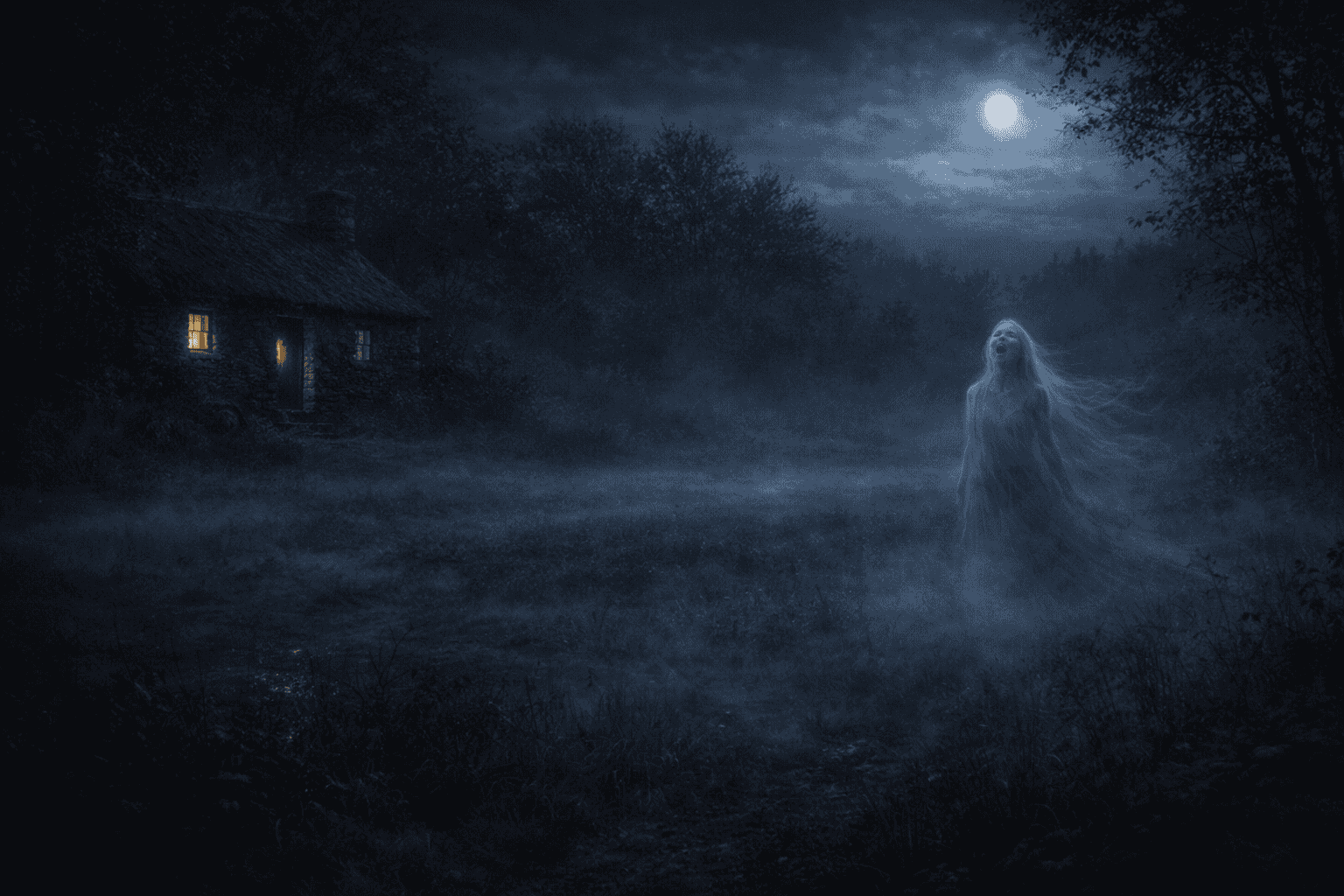
A family sits up late in a farmhouse where an old man lies ill. Outside, the night is still. Then, from somewhere beyond the yard, comes a sound: a woman’s voice, crying and wailing, rising and falling, going on and on. Someone goes to the door. There is nobody on the road. The sound comes again, then fades away. Nobody needs to say what it was. Before morning, or within a day or two, the old man is dead.
That is the banshee’s cry as Irish people described it for generations. Its meaning was never in doubt. It announced a death, usually in one of the old families she was said to follow, and it came before the death rather than after it. In some accounts, she cried on three nights in a row. In others, the cry was heard once, far off, at the very hour a family member died in another county or another country.
What It Sounds Like
Most people who told of the banshee never saw her. They heard her. The words they used for the sound were the words of mourning: crying, wailing, lamenting, keening. It was usually described as a sustained, sorrowful wail that rose and fell, not a single scream. Some said it was beautiful and heartbreaking, others that it was the most dreadful sound they had ever heard. Some heard words in it, even a name.
The cry could seem to come from just outside the window, or from a hill or a riverbank a long way off, and people often could not tell which. That uncertainty was part of the terror. The sound was everywhere and nowhere, and when someone went out to look, there was nothing to see.
The Cry and Irish Keening
To understand why the cry sounded the way it did, it helps to know about keening. For centuries, an Irish wake included the caoineadh, a loud, rhythmic lament for the dead, sung or chanted by women of the family and community, and sometimes by professional keening women. It was full of raw grief, with cries of ochón and olagón, and it was considered an essential part of a proper send-off. The custom faded during the nineteenth and early twentieth centuries.
The banshee’s cry is keening, performed by a woman from the Otherworld. The folklorist Patricia Lysaght, whose 1986 study remains the standard work, saw the banshee as a supernatural counterpart to the human keening women. The one great difference is timing. The women at the wake keened after the death. The banshee keens before it.
The Night Lord Rossmore Died
One of the most famous accounts of the cry comes from Sir Jonah Barrington, an Irish judge and politician, who told it in his memoirs. In 1801, he and his wife were staying at the house of Lord Rossmore, the commander of British forces in Ireland, at Mount Kennedy in County Wicklow. In the middle of the night, they were woken by strange, plaintive sounds outside their window, which Barrington said ended with the name “Rossmore” called out three times. In the morning, they learned that Lord Rossmore had been found dying in his room at about the time they had heard the voice.
Barrington was a lively and not always reliable storyteller, but the account became one of the best-known banshee stories in English, and it shows how the belief reached well beyond rural cottages.
What Did People Really Hear?
There are natural sounds in the Irish countryside that fit the descriptions remarkably well. The most likely is the vixen, the female fox, whose scream during the winter mating season sounds startlingly like a woman in distress. Another is the barn owl, which does not hoot but gives a long, rasping shriek, and hunts at night around farmyards and churchyards. Its Irish name, scréachóg reilige, means “graveyard screecher.”
On still, cold nights, sound carries a long way over fields and bog, and it can be hard to tell where it is coming from. In a household already waiting anxiously beside a sick bed, a fox or an owl calling in the dark could easily become the banshee, and a death the next day would seem to confirm it.
None of this takes away from the belief’s meaning. The cry lasted because it gave a sound to something families already felt: the dread of a death that everyone could see coming but nobody wanted to name.
Was Hearing the Cry Always Bad?
It always meant grief, but it was not thought of as a curse. The banshee never harmed anyone, and her cry could not be answered, argued with, or stopped. For many families, it was even a kind of honor. The banshee was said to follow only old families, especially the Ó and Mac names of Gaelic Ireland, so hearing her was a sign that a family was ancient and rooted in its place, and that its dead would be properly mourned.
Can Anyone Hear the Banshee?
According to tradition, the banshee cries for particular families, and usually only the family or those close to them hear her. Some accounts say neighbors heard her too, and knew at once which house she was crying for. People who emigrated sometimes reported hearing the cry abroad when a relative died at home in Ireland, as if the banshee followed the family wherever it went.
Sources and Further Reading
- Patricia Lysaght, The Banshee: The Irish Supernatural Death-Messenger, Glendale Press (1986).
- Sir Jonah Barrington, Personal Sketches of His Own Times, Henry Colburn (1827 to 1832).
- W. B. Yeats, ed., Fairy and Folk Tales of the Irish Peasantry, Walter Scott (1888).
- Seán Ó Súilleabháin, Irish Wake Amusements, Mercier Press (1967).
- The Schools’ Collection, National Folklore Collection, University College Dublin (1937 to 1939), on dúchas.ie.