In Short
The far darrig (pronounced far DARR-ig, from the Irish fear dearg, “red man”) is a solitary fairy of Irish folklore, a small figure dressed in red who is known for practical jokes, many of them grim. W. B. Yeats described him in 1888 as one who busies himself with practical joking, especially gruesome joking. In the best-known story, from County Donegal, a tinker who cannot tell a story is forced through a night of horrors by a band of supernatural men, only to be told months later that now, at least, he has a story to tell.
| Irish name | Fear dearg, “red man” |
|---|---|
| Pronunciation | far DARR-ig |
| Type | A solitary fairy, like the leprechaun and clurichaun |
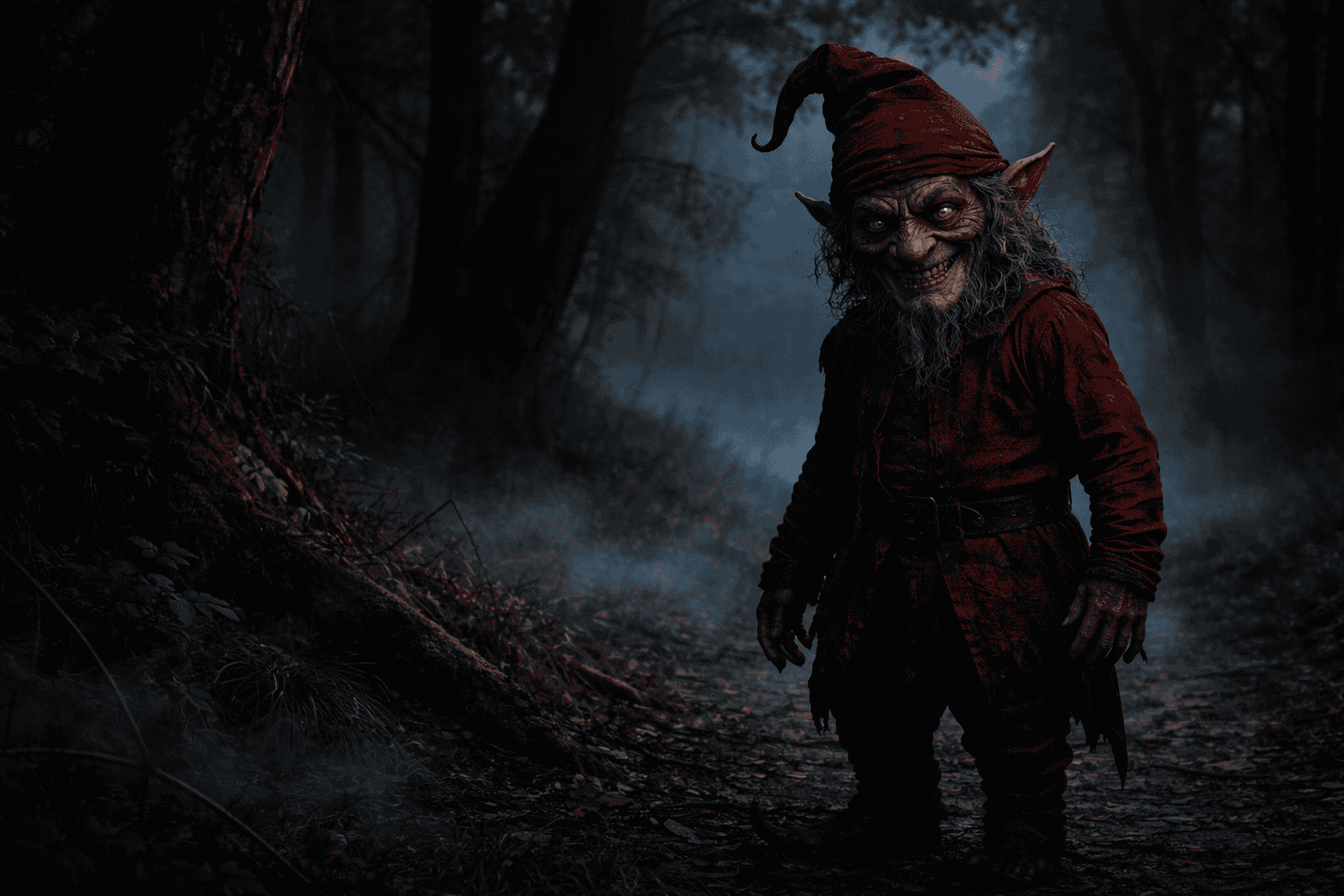
| Appearance | Small, dressed in red, often with a wrinkled face and long grey hair |
| Known for | Practical jokes, often gruesome |
| Best-known tale | “Far Darrig in Donegal,” Letitia Maclintock, in Yeats’s 1888 collection |
| Main sources | Thomas Crofton Croker; W. B. Yeats |
What Is the Far Darrig?
On a wild night, there is a knock at the door of a farmhouse. Outside stands a little man, dressed from cap to coat in red, dripping with rain, asking to come in and warm himself by the fire. It would be unlucky to refuse him. It may be even more unlucky to let him in, because before the night is out, the household may find itself the butt of one of his jokes.
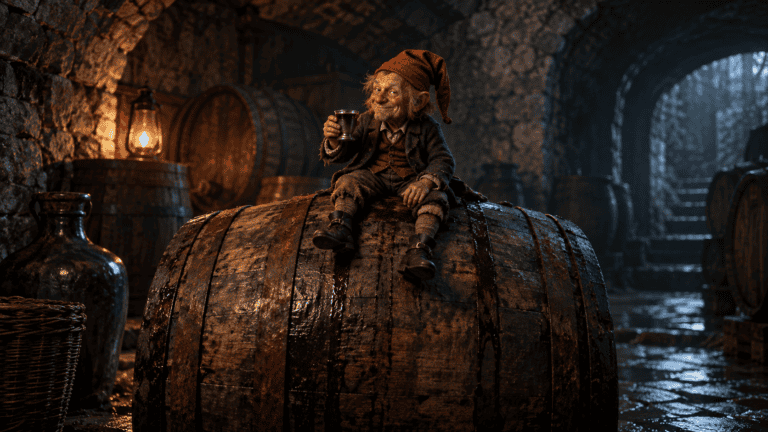
The far darrig is one of the solitary fairies of Irish tradition, living and working alone rather than in the great fairy communities under the hills. His name is the English spelling of the Irish fear dearg, “red man,” after the red clothes he always wears. He is often grouped with the leprechaun and the clurichaun, the leprechaun’s hard-drinking cousin, but his particular talent is for trickery.
What He Looks Like
Thomas Crofton Croker, collecting folklore in Munster in the 1820s, described the far darrig as a small figure, about two and a half feet tall, with a wrinkled face and long grey hair, wearing a red coat and a tall, pointed sugarloaf hat. Other accounts vary his size and looks, but the red clothing is constant. It is what gives him his name, and it links him to other red-capped figures of fairy lore.
A Taste for Gruesome Jokes
W. B. Yeats, in his 1888 collection Fairy and Folk Tales of the Irish Peasantry, listed the far darrig among the solitary fairies and described him as the one who “busies himself with practical joking, especially with gruesome joking.” Yeats was not exaggerating. The far darrig’s jokes are not harmless pranks, like a leprechaun’s trick to keep his gold. They are designed to frighten, confuse, and humiliate, and they often involve corpses, graves, and the terrors of the night.
Yet the stories usually end with the victim unharmed. The far darrig wants to scare people, not kill them, and there is often a strange kind of logic, even justice, in what he does.
The Far Darrig in Donegal
The best-known far darrig story was collected in County Donegal by the folklorist Letitia Maclintock and published by Yeats in 1888. Its hero, or victim, is Pat Diver, a traveling tinker.
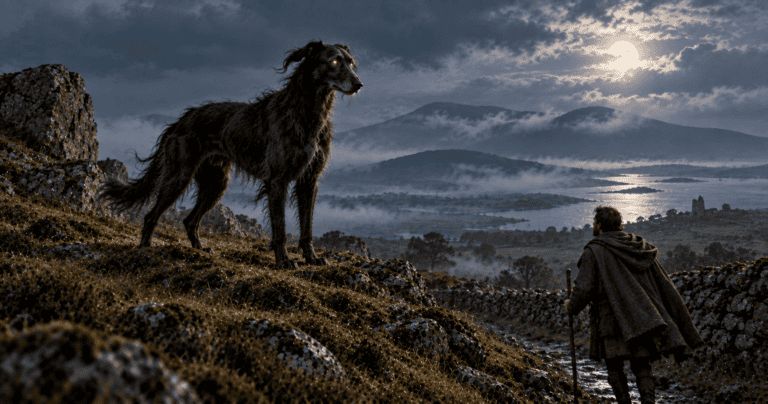
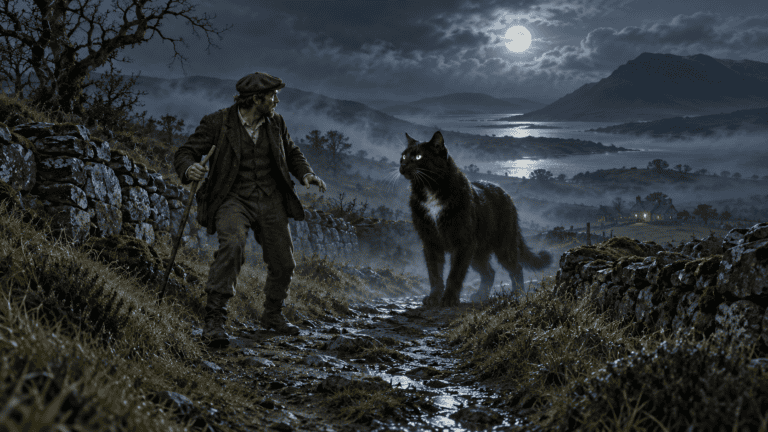
One night on the Inishowen peninsula, Pat knocks at door after door asking for a night’s lodging, and is refused everywhere. At last an old man at one cottage asks him a strange question: can he tell a story? Pat says he cannot, and is turned away, since only those who can tell a story are let in. He creeps into a barn behind the cottage and falls asleep in the straw.
He is woken by four enormously tall men dragging a corpse into the barn. They light a fire, hang the body from a beam, and start roasting it. When one grows tired of turning it, the biggest refuses to take his turn, and points out that Pat Diver is hiding in the straw. Pat is dragged out and told to turn the corpse, and warned that if he lets it burn, he will be roasted in its place. The rope burns through, the body falls into the fire, and Pat runs for his life.
Wherever he hides, they find him. They make him carry the corpse to the ruined Kiltown Abbey and are about to make him dig its grave when the cocks begin to crow at dawn, and the men vanish, telling him he was lucky, or he would have gone into the grave too.
Two months later, at the fair in Raphoe, Pat meets the biggest of the men in the crowd. The man bends down and whispers that when Pat goes back to Inishowen, he will have a story to tell.
The joke, in the end, was the answer to the old man’s question. Pat could not tell a story, so the far darrig gave him one he would never forget.
Why the Stories Matter
The far darrig tales carry a hint of moral. In the Donegal story, Pat is treated harshly partly because he sneers at storytelling as “old wives’ fables.” In other accounts, the far darrig comes to the door asking to warm himself by the fire, and refusing him was thought to bring bad luck, while some said his presence in a house could even bring good fortune. As with many Irish fairies, courtesy was the best protection.
The stories also show how much Irish country people valued a good story. In a world where long winter nights were passed around the fire with tales, a man who had no story to tell was poorer than he knew.
The Far Darrig and Other Fairies
The far darrig belongs to the family of solitary fairies described by Yeats, which also includes the leprechaun, the clurichaun, the púca, and the banshee. Some later writers also connect him with changelings and with nightmares, though the older collections say little of this. Our guide to the types of Irish fairies describes the whole family.
Is the Far Darrig Dangerous?
He is frightening rather than deadly. His jokes are cruel and his sense of humor is dark, but in the traditional stories his victims usually survive, shaken and humbled. The safest course, according to tradition, was to treat him politely, give him a seat by the fire if he asked for one, and never mock him or the old ways he seems to protect.
Sources and Further Reading
- Thomas Crofton Croker, Fairy Legends and Traditions of the South of Ireland, John Murray (1825).
- W. B. Yeats, ed., Fairy and Folk Tales of the Irish Peasantry, Walter Scott (1888), including Letitia Maclintock, “Far Darrig in Donegal.”
- James MacKillop, A Dictionary of Celtic Mythology, Oxford University Press (1998).
- Katharine Briggs, An Encyclopedia of Fairies, Pantheon Books (1976).
- Dáithí Ó hÓgáin, Myth, Legend and Romance: An Encyclopaedia of the Irish Folk Tradition, Ryan Publishing (1990).