In Short
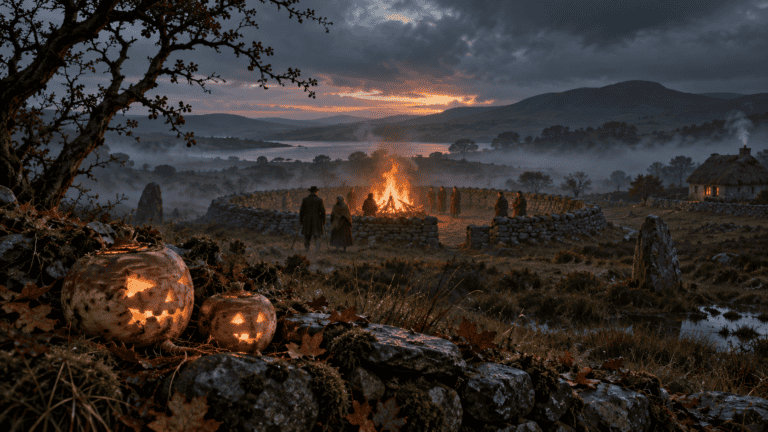
Imbolc (pronounced ih-MOLG, or ih-MOL-ug in Irish) is the old Irish festival of early spring, held on 1 February, halfway between the winter solstice and the spring equinox. It is one of the four great festivals of the early Irish year, alongside Bealtaine, Lughnasadh, and Samhain, and it was tied to lambing and the first milk of the ewes. In Christian Ireland, it became St. Brigid’s Day, and most of its surviving customs belong to her.
| Irish name | Imbolc; Imbolg in modern Irish |
|---|---|
| Pronunciation | ih-MOLG in English; ih-MOL-ug in Irish, with the b silent |
| Date | 1 February, with the eve on 31 January |
| Marks | The start of spring and the lambing season |
| Christian feast | St. Brigid’s Day, 1 February; Candlemas follows on 2 February |
| Customs | Brigid’s crosses, the brat Bríde, the Brídeog, visits to holy wells |
| Earliest mentions | Early Irish tales and poems, including Tochmarc Emire |
| Other festivals | Bealtaine, Lughnasadh, and Samhain |
| Public holiday | First Monday in February, since 2023 |
What Is Imbolc?
By the end of January in Ireland, the worst of the winter is usually over, even if it doesn’t feel that way. The mornings are a little brighter. The first lambs are arriving in the fields. And for a farming people who had been living on stored food since November, the ewes coming into milk meant fresh food again, and the first real sign that the year was turning.
That turning point is Imbolc. It was one of the four great festivals of the early Irish year, which divided the calendar into quarters: Samhain at the start of winter, Imbolc at the start of spring, Bealtaine at the start of summer, and Lughnasadh at the start of the harvest. Each fell roughly halfway between a solstice and an equinox. Of the four, Imbolc is the quietest in the old stories and the one most completely absorbed into Christian tradition, because it became the feast of St. Brigid.
What Does the Word Imbolc Mean?
Nobody is sure, and the question has been argued over for more than a thousand years. The explanation you will see most often today is that Imbolc comes from the Irish i mbolg, “in the belly,” a reference to pregnant ewes carrying their lambs at this time of year.
Medieval Irish scholars preferred another answer. Cormac’s Glossary, compiled around the year 900, explains the word through a form spelled oimelc and links it to ewes’ milk, since the ewes began to give milk in early spring. Modern linguists treat that as a learned guess rather than a true origin, but it shows what the festival meant to the people who wrote about it: sheep, lambs, and milk. A third suggestion connects the name to an old Irish word for washing, which would make Imbolc a festival of cleansing. All three ideas are still in circulation, and none has won the argument.
Imbolc in the Early Sources
For such an important date, Imbolc leaves surprisingly few traces in early Irish literature. Samhain and Bealtaine are the settings for battles, prophecies, and Otherworld visits. Imbolc is mostly just named. It appears in Tochmarc Emire, “The Wooing of Emer,” one of the tales of Cú Chulainn, as one of the four festivals that mark out the year. A short Old Irish poem, published by the scholar Kuno Meyer in 1894, lists the foods that are proper to each of the four festivals, Imbolc included.
What the sources do make clear is that Imbolc belonged to the farm rather than the royal court. The historian Fergus Kelly, in his study of early Irish farming, suggests that the festival was probably associated at first with the goddess Brigid and was taken over by the Church early in the Christian period, when the goddess’s feast became the saint’s. That is a reasonable reading of the evidence, though, as with most things about pre-Christian Ireland, it can’t be proved.
A Festival of Lambs and Milk
To understand Imbolc, it helps to think like an early Irish farmer. Wealth was counted in cattle, and the whole year revolved around the herd. Winter was the hungry season: the animals were thin, milk was scarce, and people lived on what they had stored. Early February brought the lambing, and with it the first fresh milk of the year, which in turn meant butter and cheese.
So Imbolc was less a celebration of spring flowers than of survival. It marked the point where the stored food could be stretched a little further, the days would keep lengthening, and the farming year could begin again. That practical, pastoral flavor carried over into the customs of St. Brigid’s Day, which are full of cattle, butter, and blessings for the house and the byre.
The Stones at Tara
On the Hill of Tara in County Meath stands a Neolithic passage tomb known as the Mound of the Hostages, built around 3000 BC, long before anyone spoke Irish. Its short passage faces the rising sun in such a way that light reaches the back of the chamber in the weeks around early November and early February, the times of Samhain and Imbolc.
It is tempting to see this as proof that Imbolc is five thousand years old, and many websites say exactly that. The evidence is more modest. Because the passage is short, sunlight enters it on many mornings around those dates, not only on one, and some researchers think the tomb may have been aligned on the moon rather than the sun. What the alignment does show is that people in Neolithic Ireland paid close attention to the turning of the seasons. Whether they celebrated anything we would recognize as Imbolc is another question.
Imbolc Becomes St. Brigid’s Day
Whatever Imbolc once was, for most of Irish history it has been St. Brigid’s Day. Brigid, the abbess of Kildare and one of Ireland’s three patron saints, shares her name with a goddess of the old Irish tradition, and her feast falls on the same day. Her customs gave the festival its shape.
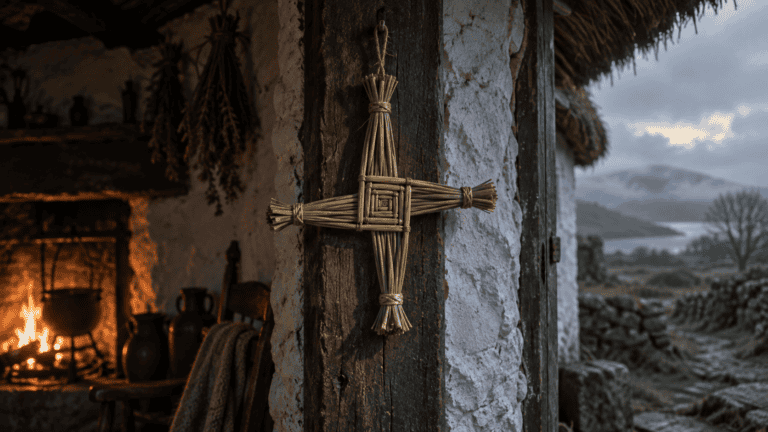
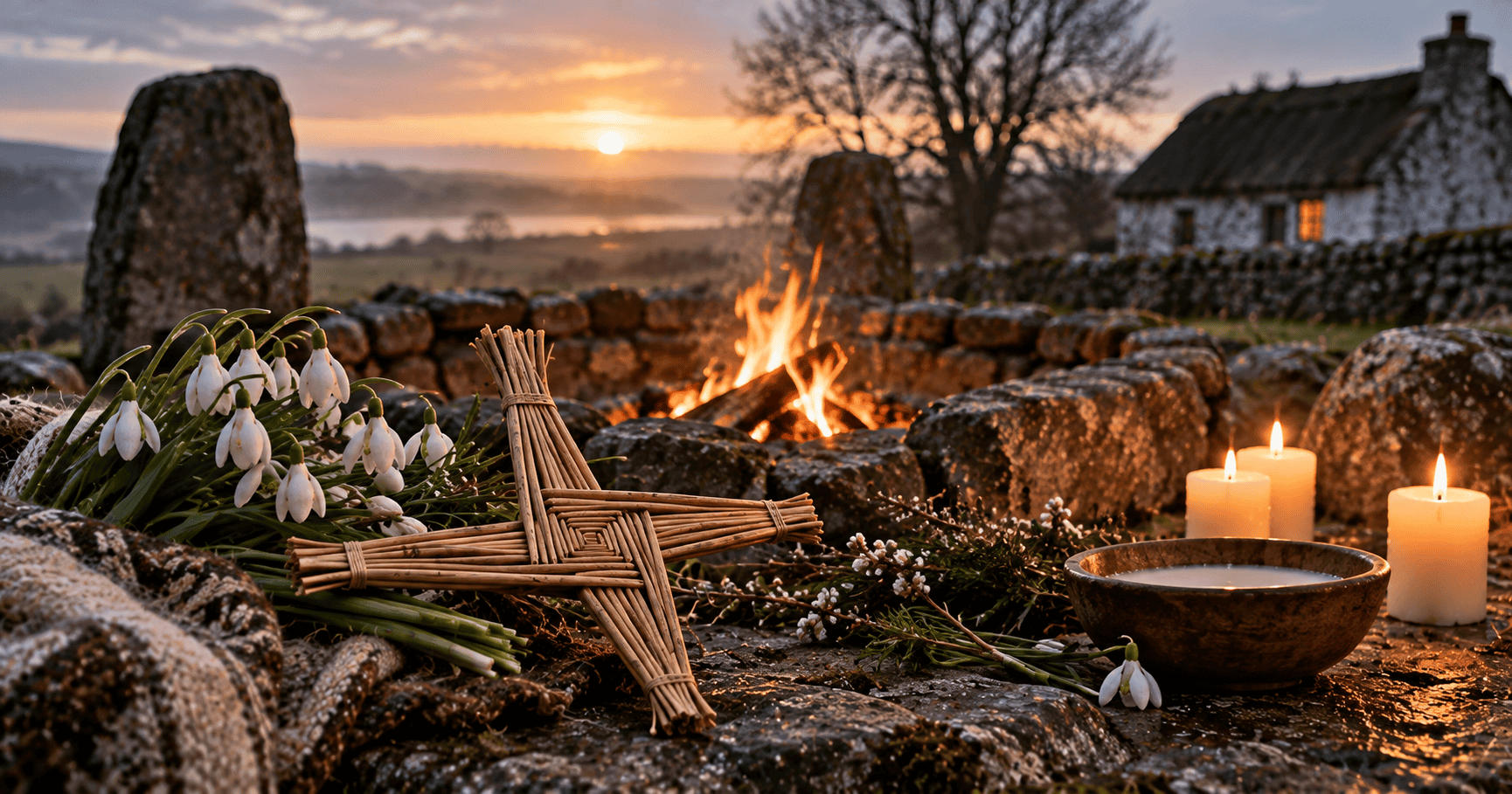
On the eve of the feast, families wove St. Brigid’s crosses from rushes and hung them in the house and the byre for protection. They left a piece of cloth outside, the brat Bríde or “Brigid’s cloak,” for the saint to bless as she passed in the night, and kept it for the rest of the year as a cure. In some districts, young people carried a figure of Brigid, the Brídeog, from house to house. Holy wells dedicated to Brigid were visited on the day itself, and people prayed there for health for themselves and their animals.
The Cailleach and the Weather
Imbolc also had its weather lore. In Scotland and the Isle of Man, it was said that the Cailleach, the old woman of winter, went out on 1 February to gather firewood for the rest of the season. If she planned to make the winter last, she would make sure the day was bright and dry, so she could gather plenty of wood. A wet, stormy Imbolc was good news, because it meant she was asleep indoors, would soon run short of fuel, and winter was nearly over.
A Scottish Gaelic proverb makes a similar prediction with a snake: on Brigid’s Day, the serpent comes out of its hole, even if there are three feet of snow on the ground. Most of this weather lore was recorded in Scotland rather than Ireland, where the Cailleach appears more often as a figure of the landscape, the Hag of Beara, than as a forecaster.
When Is Imbolc?
Traditionally, Imbolc falls on 1 February, with the customs beginning on the evening of 31 January. That is also St. Brigid’s Day. The following day, 2 February, is Candlemas, a Christian feast when candles were blessed in church, and the two days often blended together in folk practice.
Some modern pagans prefer to mark Imbolc at the true astronomical midpoint between the winter solstice and the spring equinox, which usually falls on 3 or 4 February. In Ireland, the public holiday for St. Brigid’s Day falls on the first Monday in February, or on 1 February itself when that date is a Friday.
Imbolc in Popular Culture
Imbolc has had two modern revivals. The first is religious. In modern paganism, including Wicca, Imbolc is one of the eight festivals of the Wheel of the Year and is often celebrated with candles, spring cleaning, and devotion to Brigid as a goddess of fire, poetry, and healing. The Wheel draws on the old Irish festivals, but the eight-part cycle as it is celebrated today took shape in the mid-twentieth century.
The second is national. In 2023, Ireland held its first public holiday for St. Brigid’s Day, the first Irish public holiday named for a woman. It has brought Brigid’s customs back into schools, libraries, and town squares, and festivals such as Féile Bríde in Kildare, where the Brigidine Sisters tend a flame in her honor, now draw visitors from around the world.
Is Imbolc the Same as Groundhog Day?
No, though the two are distant cousins. Groundhog Day, on 2 February, comes from European Candlemas weather lore, in which the weather on that day was said to predict the rest of the winter, often by watching whether a badger or bear came out of its den. German settlers brought the custom to Pennsylvania, where the groundhog took the badger’s place, and the first official Groundhog Day at Punxsutawney was held in 1887. The Scottish tale of the Cailleach gathering her firewood works on the same principle, since a bright day means more winter. But there is no evidence that Groundhog Day came from Imbolc. They are two branches of a very old habit, found across Europe, of looking at early February and trying to guess how much winter is left.
Sources and Further Reading
- Kuno Meyer, ed. and trans., Hibernica Minora, Clarendon Press (1894).
- Fergus Kelly, Early Irish Farming, Dublin Institute for Advanced Studies (1997).
- Kevin Danaher, The Year in Ireland: Irish Calendar Customs, Mercier Press (1972).
- Ronald Hutton, The Stations of the Sun: A History of the Ritual Year in Britain, Oxford University Press (1996).
- Seán Ó Duinn, The Rites of Brigid: Goddess and Saint, Columba Press (2005).