In Short
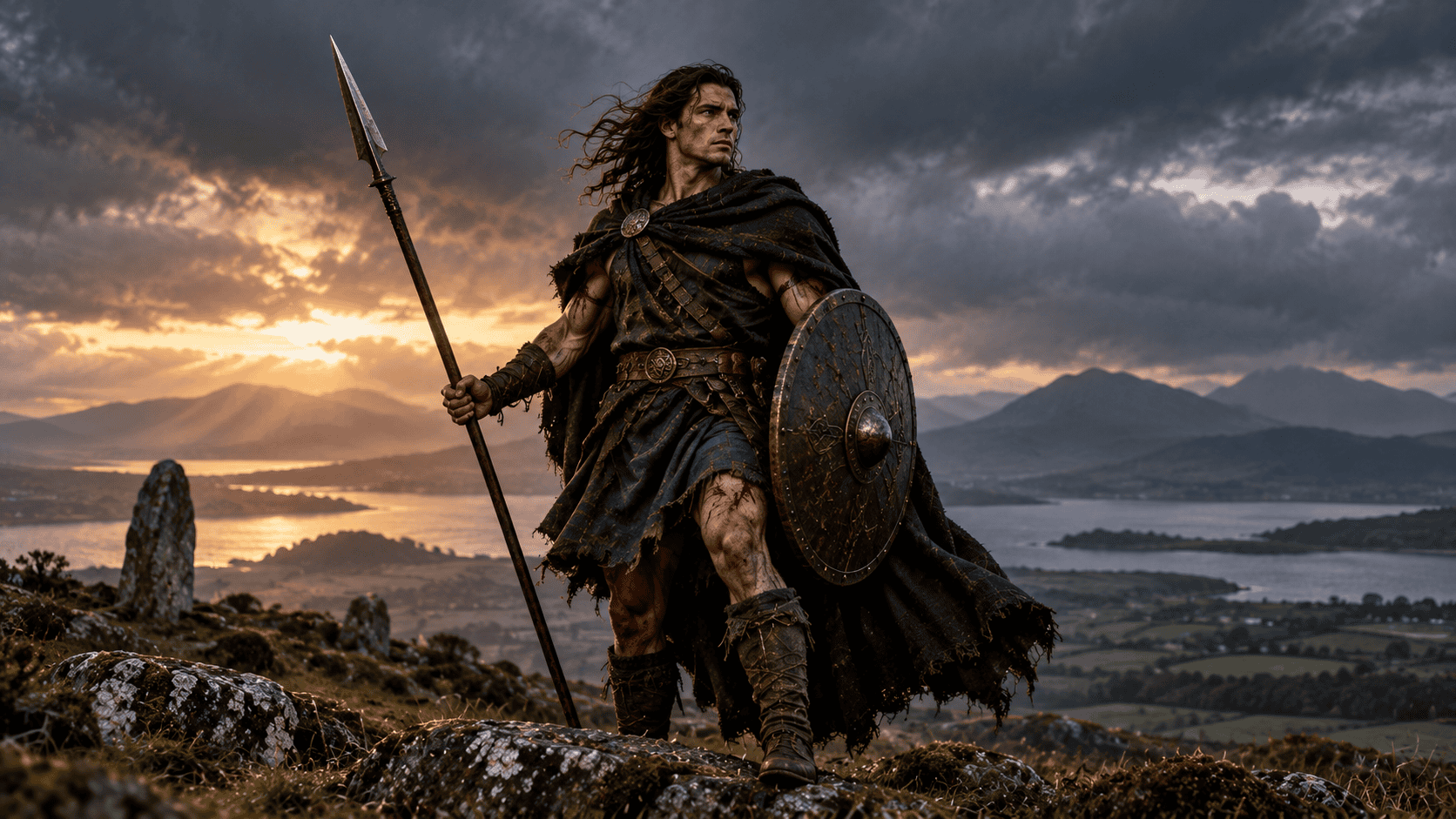
Cú Chulainn (pronounced koo KHUL-in, with the KH as in Scottish “loch”) is the greatest hero of early Irish literature, the champion of Ulster in the stories of the Ulster Cycle. Born Sétanta, he earned his name, “the hound of Culann,” as a boy, when he killed a smith’s guard dog and offered to take its place. At seventeen, he held back the armies of Connacht alone in the Táin Bó Cúailnge, “The Cattle Raid of Cooley.” He chose a short life and lasting fame, and he died young, tied to a standing stone so that he could face his enemies on his feet.
| Irish name | Cú Chulainn, “the hound of Culann”; born Sétanta |
|---|---|
| Pronunciation | koo KHUL-in, with KH as in “loch”; often anglicized as koo-KULL-in |
| Parents | Deichtine, kinswoman of King Conchobar; the god Lugh, or the mortal Sualtam |
| Home | Mag Muirthemne, in present-day County Louth |
| Wife | Emer, daughter of Forgall Monach |
| Teacher | Scáthach, the warrior woman of Alba (Scotland) |
| Weapon | The gáe bolga, a barbed spear |
| Greatest story | Táin Bó Cúailnge, “The Cattle Raid of Cooley” |
| Cycle | Ulster Cycle |
| Death | Killed by Lugaid mac Con Roí at a standing stone, still in his twenties |
Who Is Cú Chulainn?
A small boy arrives late to a feast at the house of Culann the smith. The gates are shut, and the guests are inside. In the yard, the smith has let loose his guard dog, an animal so savage that it takes three chains to hold it and three men on each chain. It comes at the boy. The boy, who has been playing hurling all the way there, does not run. When the men inside rush out, expecting to find him torn apart, the dog is dead.
That boy is Sétanta, and he will become Cú Chulainn, the most famous hero in Irish literature. He is the champion of the Ulaid, the people of ancient Ulster, in the group of tales known today as the Ulster Cycle. His stories are violent, strange, and often tragic. He kills his closest friend and his only son. He is loved by goddesses and hunted by witches. And he is so completely devoted to his own fame that he chooses, as a child, a short life over a long and forgettable one. Writers have long called him the Irish Achilles, and the comparison is a fair one.
Birth and Parentage
Cú Chulainn’s mother is Deichtine, a close kinswoman of Conchobar mac Nessa, the king of Ulster. In the later versions of the story, she is the king’s sister. His father is either the god Lugh, of the Tuatha Dé Danann, or the mortal Sualtam, Deichtine’s husband, depending on how you read the story of his conception. The medieval tellers seem to have wanted it both ways: Sualtam raises the boy as his own, while Lugh appears in the Táin to heal his wounded son. The hero was named Sétanta, and he grew up on the plain of Mag Muirthemne, in what is now County Louth, near the modern town of Dundalk.
How Sétanta Became the Hound
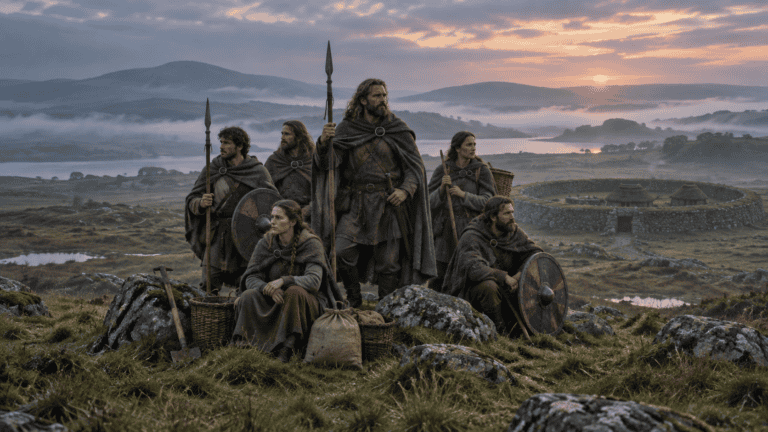
The story of his name comes from the Macgnímrada Con Culainn, “The Boyhood Deeds of Cú Chulainn,” a sequence of flashbacks inside the Táin, told by Ulster exiles to their enemies around a campfire. Sétanta sets off alone to join the boy-troop at Emain Macha, the royal seat of Ulster, now Navan Fort in County Armagh. He arrives without asking for protection, as custom required, and all one hundred and fifty boys attack him at once. He beats them all.
Soon afterward, King Conchobar invites the boy to a feast at the house of Culann the smith. Sétanta says he will follow after his game of hurling. The king forgets to mention this to his host, and Culann looses his hound. When the dog lies dead in the yard, Culann grieves for the animal that guarded his house and his herds. The boy offers a settlement. He will raise a pup to replace it, and until the new hound is grown, he will guard Culann’s house and lands himself. The druid Cathbad declares that from now on, the boy’s name will be Cú Chulainn, “the hound of Culann.” In the Táin, the storyteller says he was about six years old.
The Day He Took Arms
A year later, Cú Chulainn overhears Cathbad teaching his pupils. Someone asks what the day is good for, and the druid replies that whoever takes up arms that day will have a name that lasts forever. The boy goes straight to the king and asks for weapons. He breaks every set he is given until Conchobar hands over his own.
When Cathbad sees what has happened, he is dismayed. The boy had not heard the whole prophecy. Whoever took arms that day would be famous forever, but his life would be short. Cú Chulainn’s answer is the line that defines him: he does not care if he lives only a day and a night, as long as his fame lives after him. Parts of this story are alluded to in a poem that scholars date to the seventh century, making it one of the oldest pieces of his legend.
Training with Scáthach
As a young man, Cú Chulainn falls in love with Emer, daughter of Forgall Monach, and asks to marry her. Tochmarc Emire, “The Wooing of Emer,” tells how Forgall, hoping to be rid of him, suggests that he train with Scáthach, a famous warrior woman in Alba, Scotland. The journey is meant to kill him. Instead, he reaches her, and she teaches him every feat of arms she knows.
His fellow students include Ferdiad, who becomes his closest friend and foster-brother. Scáthach teaches them both the same skills, except for one. Only Cú Chulainn learns to use the gáe bolga, a terrible barbed spear, thrown with the foot, that spreads its barbs inside the body and has to be cut out of its victim.
While he is in Alba, Scáthach goes to war with a rival warrior woman, Aífe. Cú Chulainn fights Aífe in single combat and wins by a trick, shouting that her horses and chariot have fallen off a cliff. When she looks, he seizes her. He spares her life on two conditions: that she make peace with Scáthach, and that she bear him a son. When he leaves, he gives her a gold ring for the child and tells her to send the boy to Ireland when he is seven, with orders never to tell anyone his name. Then he goes home, storms Forgall’s fortress, and carries off Emer.
The Ríastrad
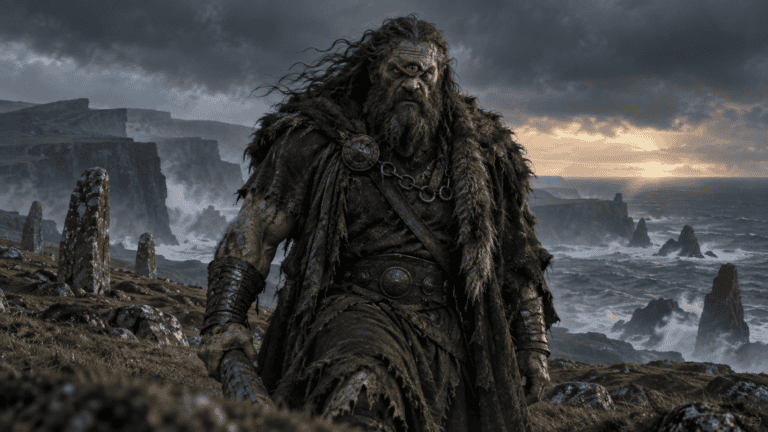
In battle, Cú Chulainn goes through a transformation called the ríastrad, often translated as the “warp spasm” or “distortion.” The Táin describes it in grotesque detail. His body twists inside his skin. One eye sinks deep into his head, and the other bulges out onto his cheek. His mouth stretches back to his ears, and a column of dark blood rises from the top of his head. In this state, he knows neither friend nor foe. He first goes into it, according to the boyhood deeds, when he is only seven years old.
The Cattle Raid of Cooley
Cú Chulainn’s greatest story is Táin Bó Cúailnge, the central epic of the Ulster Cycle. Queen Medb and King Ailill of Connacht argue over which of them is richer, and the only thing that separates them is a great bull. To match it, Medb raises an army to steal the Donn Cúailnge, the brown bull of Cooley, from Ulster.
Ulster should be able to defend itself, but its warriors are struck down by a curse laid on them long before by the goddess Macha, which leaves them as weak as a woman in labor at the moment they are needed most. Only Cú Chulainn, seventeen years old, is spared. For the whole winter, he holds back the army of four provinces alone, killing warriors with his sling and demanding single combat at the fords. Medb sends her champions against him one by one, and he kills them one by one. Along the way, he rejects the love of the goddess the Morrígan, who attacks him in the shapes of an eel, a wolf, and a heifer.
Ferdiad at the Ford
The most famous combat of all is the fight with Ferdiad, his foster-brother from Scáthach’s school. Medb bribes, flatters, and shames Ferdiad until he agrees to face his friend. They fight at the ford for three days, and each evening they embrace, share food and healing herbs, and rest together. On the third day, Ferdiad begins to win. Cú Chulainn calls to his charioteer, Láeg, for the gáe bolga, and Láeg floats it down the stream to him. Cú Chulainn kills his friend with it, then carries him across the ford and laments over his body. Scholars believe this episode is a later addition to the Táin, written no earlier than the eleventh century, but it has become the emotional center of the whole epic.
The Death of Aífe’s Only Son
Years later, a boy arrives on the coast of Ulster in a bronze boat with golden oars. He is seven years old, astonishingly skilled, and he will not tell anyone his name. He defeats the first Ulster warriors sent against him. Emer warns her husband that the boy is his own son, but Cú Chulainn will not listen. The honor of Ulster is at stake. He fights the boy in the water and, when he is losing, uses the gáe bolga. Only as the boy lies dying does Cú Chulainn see the gold ring and know that he has killed Connla, his only son. The story is called Aided Óenfhir Aífe, “The Death of Aífe’s Only Son,” and it is dated to the late ninth or early tenth century.
The Death of Cú Chulainn
Cú Chulainn’s death is told in Aided Con Culainn, “The Violent Death of Cú Chulainn,” preserved in the twelfth-century Book of Leinster. His enemies, led by Queen Medb and Lugaid, the son of a king he had killed, plan it carefully. They use his geasa, the sacred prohibitions he is bound by, against him. He is forbidden to eat dog meat, since the dog is his namesake. He is also bound never to refuse hospitality. When an old woman on the road offers him a meal of dog meat, he cannot refuse without breaking one taboo, and he cannot eat without breaking the other. He eats, and his strength begins to fail.
Lugaid has three spears made, each prophesied to kill a king. With the first, he kills Láeg, the king of charioteers. With the second, he kills Cú Chulainn’s horse, the Liath Macha, the king of horses. With the third, he wounds Cú Chulainn himself. Dying, the hero ties himself to a standing stone so that he can die on his feet, facing his enemies. For a long time, they are afraid to come near. Only when a bird lands on his shoulder do they know he is dead. As Lugaid cuts off his head, Cú Chulainn’s sword falls from his hand and cuts off Lugaid’s hand. His friend Conall Cernach avenges him soon afterward.
Local tradition identifies the stone as Clochafarmore, a standing stone near the village of Knockbridge in County Louth. By one reckoning, Cú Chulainn died in his twenty-seventh year.
How Old Are the Stories?
The Táin and the other tales of the Ulster Cycle are set in a heroic age before Christianity, and they describe a world of chariots, hill forts, and cattle raids. The texts themselves were written by Christian scholars in Irish monasteries. The oldest surviving version of the Táin is preserved in manuscripts from around the year 1100 onward, including Lebor na hUidre and the Book of Leinster, but it draws on material that is considerably older. The seventh-century poem that alludes to his first taking of arms is the oldest attested piece of his story, and scholars generally date the earliest form of the Táin to the seventh or eighth century.
Cú Chulainn in Popular Culture
Cú Chulainn was rediscovered during the Irish Literary Revival. Lady Gregory’s retelling, Cuchulain of Muirthemne, published in 1902, brought the stories to a wide English-speaking audience. W. B. Yeats wrote five plays about him, beginning with On Baile’s Strand, which retells the death of Connla and was performed on the opening night of Dublin’s Abbey Theatre in December 1904, and ending with The Death of Cuchulain in 1939.
He also became a political symbol, and not only for one side. Oliver Sheppard’s bronze statue of the dying hero, with a bird on his shoulder, was installed in Dublin’s General Post Office in 1935 as the memorial to the Easter Rising of 1916. In Northern Ireland, loyalist murals in Belfast have portrayed him as the “ancient defender of Ulster” against invaders from the rest of Ireland, while republican murals in the same city have used the same statue as a symbol of Irish freedom. Few figures from any mythology have been claimed so fiercely by both sides of the same argument.
Was Cú Chulainn a Real Person?
There is no evidence that he was. The Ulster Cycle is set in a legendary past, and Cú Chulainn’s divine father, his supernatural feats, and his dealings with goddesses place him firmly in the world of heroic legend. Some medieval Irish historians tried to fit him into their chronicles, placing him around the time of Christ, but modern scholars treat him as a figure of literature rather than history. What is real is the landscape the stories describe: Emain Macha, the plain of Muirthemne, Cooley, and the stone at Knockbridge can all still be visited today.
Sources and Further Reading
- Cecile O’Rahilly, ed. and trans., Táin Bó Cúailnge: Recension I, Dublin Institute for Advanced Studies (1976).
- Thomas Kinsella, trans., The Táin, Oxford University Press (1970).
- Kuno Meyer, trans., “The Wooing of Emer,” The Archaeological Review 1 (1888).
- Whitley Stokes, ed. and trans., “Cuchulainn’s Death,” Revue Celtique 3 (1876 to 1878).
- Lady Augusta Gregory, Cuchulain of Muirthemne, John Murray (1902).