In Short
Celtic knots are interlaced patterns of unbroken lines that pass alternately over and under one another, best known from the great illuminated manuscripts of early medieval Ireland and Britain, such as the Book of Kells. Despite the name, they are not pre-Christian. Knotwork first appears in Christian art of the seventh century, drawing on Roman, Mediterranean, and Germanic interlace. The monks who drew them left no record of what, if anything, individual knots meant, and most of the meanings attached to them today are modern.
| What they are | Interlaced patterns of lines passing over and under one another |
|---|---|
| Art historians’ term | Insular interlace, or Insular knotwork |
| First appear | Seventh century, in Christian manuscripts from Ireland and northern Britain |
| Roots | Roman mosaics, Coptic and Mediterranean manuscripts, Germanic metalwork |
| Famous examples | Book of Durrow, Lindisfarne Gospels, Book of Kells, Tara Brooch, high crosses |
| Older Irish designs | Spirals and curving patterns, but not knots |
| Best-known knot | The triquetra, or trinity knot |
| Modern revival | Nineteenth-century Celtic Revival; George Bain’s handbook of 1951 |
| Meanings | Mostly modern; not recorded by the original artists |
What Are Celtic Knots?
Open the Book of Kells to almost any page, and you will find them: ribbons of color that loop, twist, and weave through one another, over and under, around and back, filling every corner of the page. Look closely and you can follow a single line for what seems like forever, until you realize it has no beginning and no end. Twelve hundred years after monks drew them by hand, the patterns are still hard to take your eyes off.
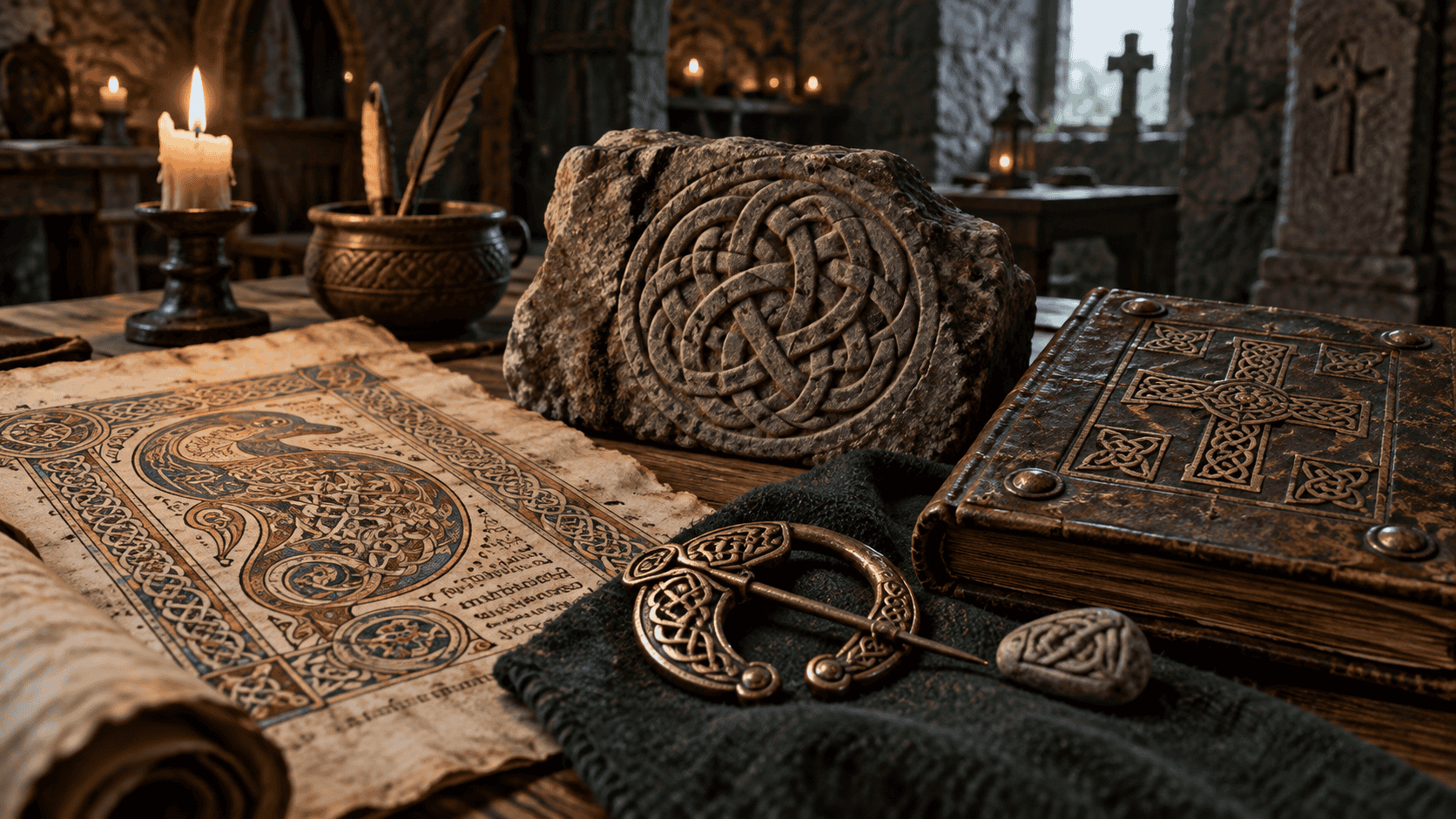
These are what we now call Celtic knots. They are made from one or more continuous lines that cross each other in a strict alternating rhythm, always over, then under, then over again. They decorated some of the most precious objects of early medieval Ireland and Britain, from Gospel books to brooches to stone crosses, and today they appear on everything from wedding rings to tattoos. Their history, though, is not quite what many people assume.
Are Celtic Knots Really Celtic?
The name suggests something ancient and pagan, reaching back to the Iron Age peoples of Europe known as the Celts. The evidence points elsewhere. The pre-Christian art of Iron Age Ireland and Britain, which art historians call La Tène style, was full of spirals, swirling curves, and three-armed triskeles, but it did not use knots.
Knotwork arrives later, with Christianity. Plaited and interlaced patterns were already common in late Roman art, especially in floor mosaics, and in the Christian manuscripts and textiles of Egypt and the eastern Mediterranean. The Germanic peoples of northern Europe, including the Anglo-Saxons, also used interlace in their metalwork, often woven from the bodies of animals. In the seventh century, monks in Ireland and northern Britain brought these influences together with the older spirals and created something new. The earliest known example of true knotwork in this style is in a fragment of a Gospel book made in northern Britain in the seventh century and now kept in Durham Cathedral.
Art historians call the result Insular art, from the Latin insula, “island,” because it belonged to the islands of Ireland and Britain as a whole, including Anglo-Saxon Northumbria in what is now northern England. So Celtic knots are not exclusively Irish, and not pre-Christian. They are the product of Christian monasteries in which Irish, British, and Anglo-Saxon monks worked, traveled, and learned from one another.
Knotwork in the Great Manuscripts
The finest knotwork is found in the illuminated Gospel books of the period. The Book of Durrow, made in the later seventh century, has whole “carpet pages” of ornament, pages with no text at all, only pattern. The Lindisfarne Gospels, made in the early eighth century at the monastery of Lindisfarne off the coast of Northumbria, take the interlace to astonishing levels of precision.
The greatest of them all is the Book of Kells, created around the year 800, probably by monks of the monastery founded by Saint Columba on the island of Iona, off the west coast of Scotland, and finished at Kells in County Meath. Its pages are crowded with interlaced lines, animals, and human figures whose limbs and hair tangle into knots. It is now in the library of Trinity College Dublin, where it is on public display.
Knotwork in Stone and Metal
The same patterns were carved into stone and worked into metal. The Tara Brooch, made around the year 700 and found on a beach near Bettystown in County Meath in 1850, is covered with tiny panels of gold interlace, some so fine that their details are hard to make out without magnification. Its name is a later invention: a jeweler who bought it named it after the royal site of Tara to make it more appealing.
The great high crosses of Ireland, carved from the ninth and tenth centuries onward, carry panels of knotwork alongside scenes from the Bible. Muiredach’s Cross at Monasterboice in County Louth, carved in the tenth century, is one of the finest, and its knotwork panels are still sharp after more than a thousand years in the open air.
How Celtic Knots Are Made
Celtic knotwork looks impossibly complex, but it is built on simple rules. Most designs begin as a plait, a regular braid of strands crossing over and under one another. The designer then breaks the plait at chosen points and reconnects the loose ends, turning a simple braid into a knot. Done carefully, the over-and-under rhythm never falters, and the line never simply ends.
In 1904, the Scottish antiquarian J. Romilly Allen identified eight basic knots from which nearly all the interlaced patterns in early medieval art could be built. In 1951, the Scottish artist George Bain published Celtic Art: The Methods of Construction, which showed step by step how the old designs could be drawn using grids and a few rules. Bain’s book is still in print, and it did more than any other single work to bring knotwork back into use in the twentieth century.
What Do Celtic Knots Mean?
This is the question most people ask, and it has an honest but unsatisfying answer: nobody knows for certain, and the artists who drew them left no explanations. No early medieval text tells us that a particular knot stood for eternity, love, or strength. Many of the knots in the manuscripts are parts of larger designs, filling spaces within letters and borders, and scholars disagree about whether individual knots were meant to carry separate meanings at all.
What can be said is that the knotwork appears in some of the holiest objects of the time, and that an endless, unbroken line is an easy image of eternity and of the endlessness of God. It is reasonable to think the monks saw it that way. But the specific meanings given to specific knots today, in jewelry catalogs and on tattoo websites, are modern interpretations, and most of them were invented in the last century or so.
Popular Knots and Their Modern Meanings
Here are the knots people most often ask about, with what is known of their history and the meanings they are given today.
The Trinity Knot
The triquetra, or trinity knot, is made of three interlaced loops, often with a circle woven through them. It appears in Insular manuscripts, including the Book of Kells, and on carved stones, and similar three-looped designs are found in Germanic and Scandinavian art of the same period. Today, it is usually explained as a symbol of the Christian Trinity: Father, Son, and Holy Spirit. That meaning is natural, and it has been used deliberately as a Christian symbol since the Celtic Revival of the nineteenth century. Whether the early artists intended it that way is less clear, since the triquetra often appears as a small filler within larger designs. More recently, some modern pagans have adopted it as a symbol of a triple goddess.
The Dara Knot
The Dara knot is usually said to take its name from the Irish word for oak, and to represent the roots of an oak tree and the strength and endurance they stand for. It is one of the most popular designs for jewelry and tattoos. However, there is no known example of a design called the Dara knot in early medieval Irish art, and the name does not appear in older studies of knotwork. It is best understood as a modern design built on the old principles, with a modern meaning.
Shield, Love, and Motherhood Knots
The same is true of many other named knots sold today, including the “shield knot” for protection, the “love knot” for lasting love, and the “motherhood knot” for the bond between mother and child. They use the techniques of early medieval knotwork, but their names and meanings are modern. That does not make them any less meaningful to the people who wear them. It simply means they are part of the living story of knotwork, not its ancient history.
The Triskele Is Not a Knot
The triskele, or triple spiral, is often grouped with Celtic knots, but it is a different kind of design, and a far older one. Triple spirals are carved into the great stones at Newgrange in County Meath, a passage tomb built around 3200 BC, long before the Celts or Christianity arrived in Ireland. Spirals remained part of Irish art for thousands of years and were later combined with knotwork in the manuscripts, but the triskele itself is made of curves, not interlaced lines.
The Celtic Revival
Knotwork gradually fell out of fashion in Ireland after the twelfth century, though it lived on longer in the West Highlands of Scotland. It returned in the nineteenth century, when a wave of interest in early Irish art, literature, and history, known as the Celtic Revival, swept through Ireland and Britain. The discovery of the Tara Brooch in 1850 helped start it. Dublin jewelers soon began making copies and adaptations of early brooches, and the style became fashionable. Designers began using interlace in book covers, church furnishings, gravestones, and jewelry, and it became a way of expressing Irish, Scottish, and Welsh identity. Romilly Allen’s studies and Bain’s handbook gave later craftspeople the tools to make new designs of their own.
Celtic Knots in Popular Culture
Today, Celtic knots are everywhere. They became especially popular as tattoo designs in the United States in the 1970s and 1980s, and they remain a favorite among people with Irish, Scottish, or Welsh roots. They appear on wedding rings, pub signs, and gravestones around the world. The trinity knot reached a new audience through the television series Charmed, in which it decorates the cover of the sisters’ Book of Shadows.
Do Celtic Knots Have Pagan Meanings?
Not in the way they are often described. The knotwork of early medieval Ireland and Britain was created in Christian monasteries, for Christian books and Christian monuments, and it appears after the conversion to Christianity, not before it. The older, pre-Christian art of the Iron Age used spirals rather than knots. The pagan meanings often given to knots today, such as the triple goddess or the cycle of life, death, and rebirth, come from modern spirituality rather than from early sources. They are sincere for many people, but they are new additions to a very old design.
Sources and Further Reading
- J. Romilly Allen, Celtic Art in Pagan and Christian Times, Methuen (1904).
- George Bain, Celtic Art: The Methods of Construction, William MacLellan (1951).
- Bernard Meehan, The Book of Kells, Thames and Hudson (2012).
- Michelle P. Brown, The Lindisfarne Gospels: Society, Spirituality and the Scribe, British Library (2003).
- Peter Harbison, The High Crosses of Ireland, Rudolf Habelt (1992).