In Short
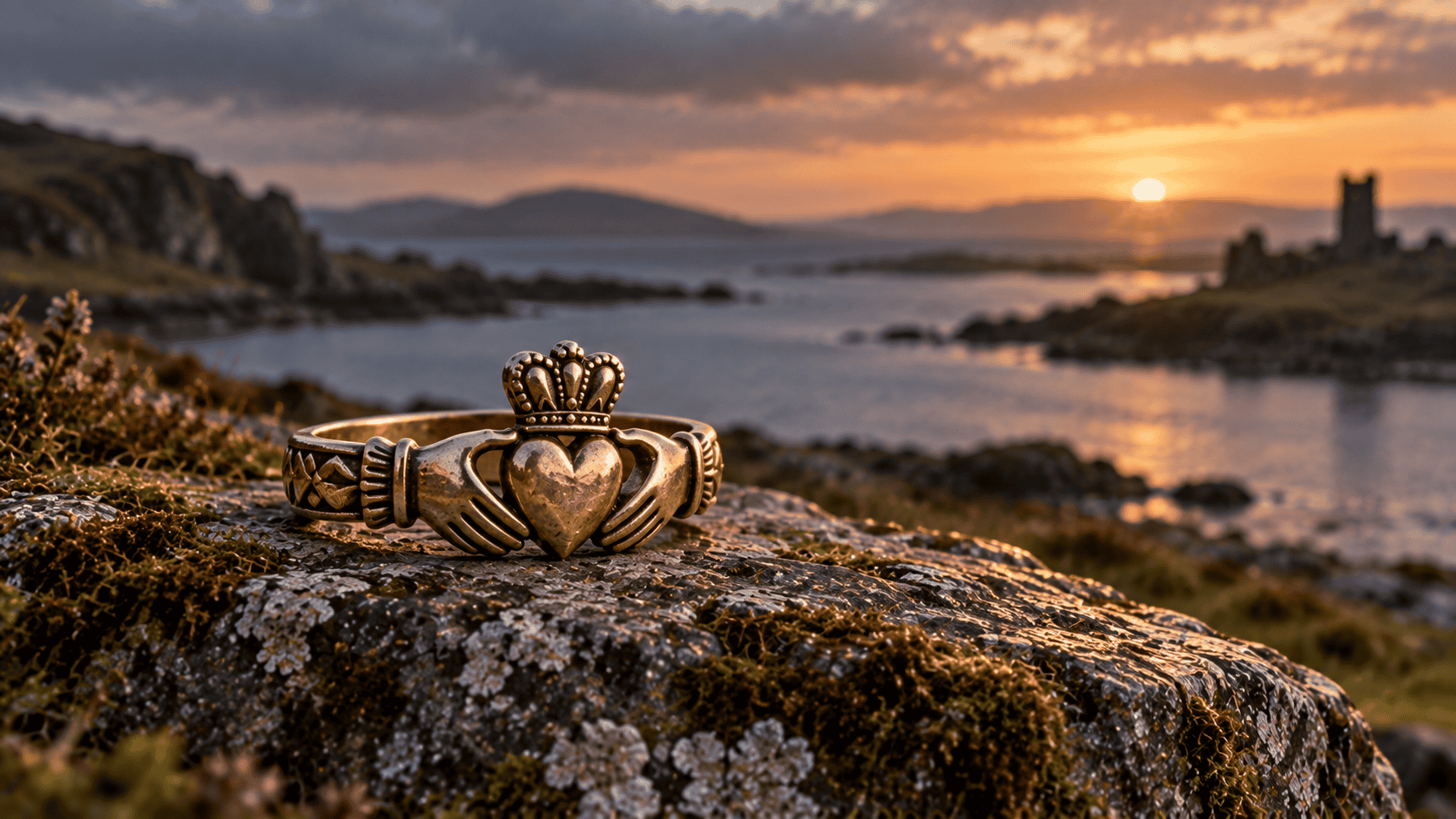
The Claddagh ring (pronounced KLAD-uh) is a traditional Irish ring showing two hands holding a heart, with a crown above it. The hands stand for friendship, the heart for love, and the crown for loyalty. It takes its name from the Claddagh, an old fishing village beside Galway city, where it was worn as a wedding ring. The oldest known examples date from around 1700 and carry the mark of the Galway goldsmith Richard Joyce, whose escape from slavery in Algiers is the ring’s most famous legend.
| Name | From the Claddagh, in Irish An Cladach, “the shore” |
|---|---|
| Pronunciation | KLAD-uh in English; the Irish An Cladach is roughly un KLAD-ukh, with the final sound as in “loch” |
| Design | Two hands holding a crowned heart |
| Meaning | Hands for friendship, heart for love, crown for loyalty |
| Oldest known ring | Around 1700, marked “RI” for Richard Joyce, now in Galway City Museum |
| Traditional use | A wedding ring in the Claddagh, often handed down from mother to daughter |
| Older relatives | Fede rings, showing clasped hands, dating back to Roman times |
| Main legend | Richard Joyce, enslaved in Algiers, released in 1689 |
| Wearing “rules” | A modern tradition, and sources disagree on the details |
What Is a Claddagh Ring?
For generations, in a fishing village on the edge of Galway Bay, a bride would receive a gold ring showing two small hands holding a heart, with a crown resting on top. She wore it for the rest of her life. When she grew old, it often went to her daughter, and from her to the next daughter after that. The village was the Claddagh, and the ring took its name.
Today, the Claddagh ring is one of the most recognizable pieces of Irish jewelry in the world. It is worn as an engagement ring, a wedding ring, a friendship ring, or simply as a sign of Irish roots. Its story is part history, part legend, and part modern marketing, and this guide tries to separate the three.
What Do the Hands, Heart, and Crown Mean?
The meaning usually given for each part of the design is simple and consistent. The two hands stand for friendship. The heart they hold stands for love. The crown above the heart stands for loyalty. The whole design is often summed up in the words “Let love and friendship reign.”
These meanings are widely repeated, but it is worth knowing that they are an explanation of the design rather than something recorded when the first rings were made. The clasped hands, as we will see, are much older than the Claddagh, and they originally stood for a pledge or a promise.
Where Does the Name Come From?
The Claddagh, in Irish An Cladach, meaning “the shore,” was a fishing village just outside the old walls of Galway city, on the west bank where the River Corrib runs into Galway Bay. Its people were fishermen who spoke Irish, lived in thatched cottages, sold their catch at the market across the river near the Spanish Arch, and kept to their own customs. The village even had its own “king,” who led the fishing fleet and settled disputes.
The old cottages were demolished in the 1930s and replaced with council housing, and the Claddagh is now part of Galway city. But the name lives on around the world in the ring its people wore.
The Legend of Richard Joyce
The most famous story about the ring’s origin concerns Richard Joyce, a member of one of the leading merchant families of Galway known as the Tribes of Galway. As a young man, around 1675, he set sail for the West Indies. His ship never arrived. It was captured by corsairs, pirates operating out of North Africa, and Joyce was taken to Algiers and sold as a slave.
His buyer was a wealthy goldsmith, who noticed that his new slave was clever and good with his hands, and taught him the trade. Joyce spent about fourteen years in captivity. Then, in 1689, King William III came to the throne of England and demanded the release of all his subjects held as slaves in Algiers. Joyce’s master is said to have been so reluctant to lose him that he offered Joyce his only daughter in marriage and half his wealth if he would stay. Joyce refused and sailed home to Galway, where he became a successful goldsmith.
In the romantic version told today, Joyce had a sweetheart in Galway who waited faithfully for him all those years, and on his return he gave her the first Claddagh ring, a design he had dreamed up during his captivity.
What the Evidence Actually Shows
Joyce was a real person, and much of his story holds up. The main account of his captivity comes from James Hardiman’s History of the Town and County of the Town of Galway, published in 1820, and it matches what is known about Irish captives in North Africa at the time. Joyce did return to Galway, married, had three daughters, and died around 1737.
What Hardiman’s account does not do is mention a ring. It says only that Joyce followed the business of a goldsmith with considerable success. The link between Joyce and the Claddagh ring rests on something more solid than a love story: his work. The oldest known Claddagh ring, now in Galway City Museum, is a heavy gold ring, probably made for a man, stamped twice with Joyce’s maker’s mark, “RI.” A few other early rings carry the mark of another Galway goldsmith, Thomas Meade. So Joyce was certainly one of the first known makers of the ring, but whether he invented the design, and whether he made the first one for a sweetheart, cannot be proved.
The Eagle and Margaret Joyce
A second, much more fanciful legend belongs to another member of the same family. Margaret Joyce, a Galway woman of the sixteenth century, married a wealthy Spanish merchant named Domingo de Rona. After his death, she used her fortune to build bridges in Galway and Sligo, and she later married Oliver Óg French, who served as mayor of Galway in the 1590s. As a reward for her charity, the story goes, an eagle flew over her one day and dropped a gold ring into her lap, and that ring became the model for the Claddagh. Nobody treats this as history, but it shows how strongly the ring came to be tied to the Joyce name.
Fede Rings: The Older Tradition
The Claddagh ring did not appear out of nowhere. It belongs to a much older family of rings known as fede rings, from the Italian mani in fede, “hands in faith.” These rings, showing two right hands clasped together, go back to the Romans, who used them as tokens of a promise or a contract, including the promise of marriage. The design stayed popular across medieval and Renaissance Europe as a betrothal and wedding ring.
What makes the Claddagh ring distinctive is what was added to that old design: the hands no longer simply clasp each other but hold a heart between them, and the heart wears a crown. Richard Joyce is often credited with this change, and it may well have been his, but the evidence only shows that the new design was being made in Galway by around 1700.
The Ring in the Claddagh
In the Claddagh itself, the ring was above all a wedding ring. It was valuable, it was made of gold, and in a poor fishing community it was often a family’s most precious possession. It was commonly passed down from mother to daughter as an heirloom. By the second half of the nineteenth century, writers from outside Galway had begun to take notice. In 1877, the antiquarian William Jones described clasped-hands rings in his book Finger-Ring Lore, noting that they were still the fashion and in constant use in the Claddagh community.
Tradition also says that during the Great Famine of the 1840s and the emigration that followed, many families carried their Claddagh rings with them to America, Britain, and Australia. Whether or not every ring made that journey, the design certainly traveled with the Irish, and it became one of the ways Irish families abroad marked their roots.
How to Wear a Claddagh Ring
Today, most jewelers and websites give a set of rules for wearing the ring, based on which hand you wear it on and which way the heart points. “Heart facing out” means the point of the heart faces your fingertip. “Heart facing in” means it points toward your wrist. The version most often given is this:
| Right hand, heart facing out | Single |
|---|---|
| Right hand, heart facing in | In a relationship |
| Left hand, heart facing out | Engaged |
| Left hand, heart facing in | Married |
These rules are fun, and many people follow them. But they are a modern tradition, not an old one. They do not appear in the older accounts of the ring, which describe it simply as a wedding ring, and even today the sources do not agree. Some Galway jewelers describe the positions the other way around, saying that the crown pointing toward the fingernail means the wearer is in love. In the Claddagh itself, the ring was worn as any wedding ring would be. The honest answer to how to wear a Claddagh ring is: in whatever way means something to you and to the person who gave it.
The Claddagh Ring in Popular Culture
The Claddagh ring has become a popular gift and souvenir, and it is made in every style from traditional gold bands to modern designs set with diamonds and woven with Celtic knotwork. For many people in the Irish diaspora, it is the single object that says “Irish” most clearly, and it is given for engagements, weddings, graduations, and friendships alike.
It has also had a starring role on television. In Buffy the Vampire Slayer, the vampire Angel gives Buffy a Claddagh ring for her seventeenth birthday, explaining its meaning, and the ring became a symbol of their relationship through the series. Galway jewelers have long advertised that famous figures, from Queen Victoria to Grace Kelly, wore Claddagh rings, though these claims are hard to confirm from independent sources.
Is It Bad Luck to Buy Your Own Claddagh Ring?
You will often read that a Claddagh ring must be given, and that buying one for yourself brings bad luck. We have not found this belief in any of the older accounts of the ring. It appears to be a modern addition, like the wearing rules, and it may simply reflect the ring’s long use as a gift between people who love each other. Plenty of people buy their own, as a reminder of family, heritage, or a trip to Galway, and there is no tradition that says they should not.
Sources and Further Reading
- James Hardiman, The History of the Town and County of the Town of Galway, W. Folds and Sons (1820).
- William Jones, Finger-Ring Lore: Historical, Legendary, Anecdotal, Chatto and Windus (1877).
- RTÉ Brainstorm, “The Fascinating History of the Claddagh Ring and Its Creator” (2026).
- Galway City Museum, “Richard Joyce and the Oldest Known Claddagh Ring” (2024).
- National Geographic, “Irish Claddagh Rings Have an Unexpected History, and It Involves Pirates” (2024).