In Short
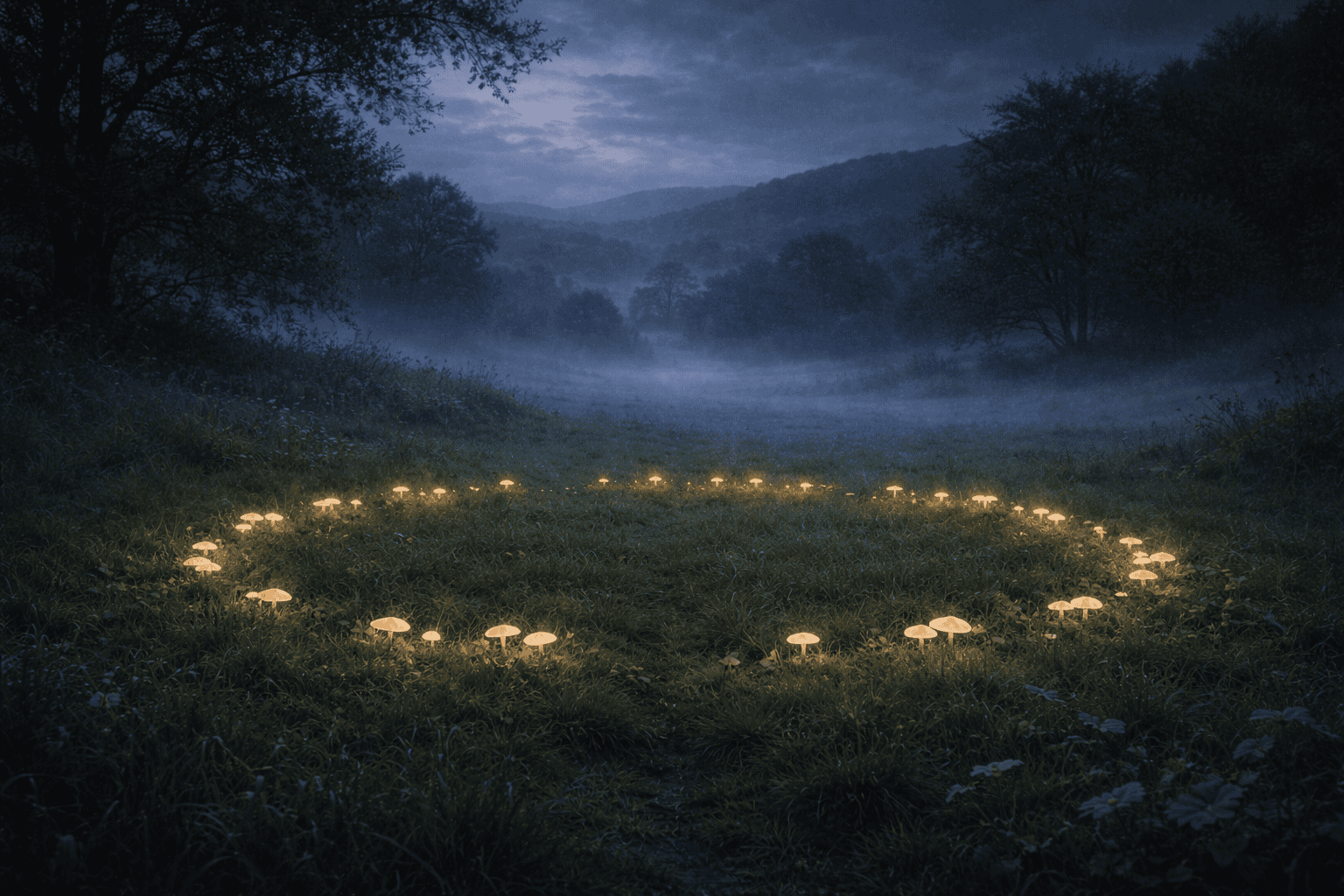
According to Irish and British folklore, a person who steps into a fairy ring, especially at night, may be caught up in the fairies’ dance and unable to stop, may lose all sense of time, or may be carried off into the fairy world. Someone who seems to have danced for a few minutes can come out to find a year has passed. Rescue was possible, but only if a friend kept one foot outside the circle and pulled the dancer out. In Ireland, a related danger was the fóidín mearaí, the “stray sod,” a patch of fairy ground that left anyone who stepped on it hopelessly lost.
| Main danger | Being drawn into the fairies’ dance |
|---|---|
| Time | Minutes in the ring can be a year or more outside |
| Worst case | Being taken into the fairy world for good |
| Most dangerous times | Night, and the festival nights of Samhain and Bealtaine |
| How to rescue someone | Keep a foot on the edge of the ring and pull them out |
| Irish relative | The fóidín mearaí, or stray sod |
| Cure for the stray sod | Turn your coat inside out |
| Real risk | None, but never eat mushrooms from one without expert identification |
Why Stepping Into a Fairy Ring Was Feared
To country people across Ireland and Britain, a ring of mushrooms or dark grass in a field was not a curiosity. It was the mark of the fairies’ dancing, worn into the ground the night before, and it belonged to them. Stepping inside meant walking onto someone else’s ground, and possibly into the middle of a dance that had not quite ended. The ring looked harmless, and that was exactly the danger: anyone could blunder into one by accident, especially in the dark.
What Could Happen Inside
The stories describe a handful of fates, some mild and some very serious. They share one idea: inside the ring, the fairies’ rules apply, not ours.
Caught in the Dance
The most common warning is that a person who enters the ring at night will hear music, feel an irresistible urge to join in, and be swept into the fairies’ dance. Once dancing, they cannot stop. Some dance until they drop from exhaustion. In the stories, the dancer usually does not realize anything is wrong. It feels like the best night of their life.
Losing Time
Many fairy ring stories add a twist in time, the same one found in the legend of Tír na nÓg. A dancer who seems to have joined the ring for only a few minutes is pulled out and discovers that a whole year has gone by, or much longer. In the most extreme versions, the dancer steps out after what feels like one dance to find that everyone they knew is long dead.
Taken Into the Fairy World
The worst fate was to be carried off entirely. Some stories treat the ring as a doorway into the fairy world, and a person who danced too long, or ate or drank what the fairies offered, might never come back. This fear connects the fairy ring to the wider Irish belief in people being “taken” by the Aos Sí.
Lesser Troubles
Not every consequence was so dramatic. Some said that stepping into a fairy ring simply brought bad luck or a sudden illness. Others said it simply offended the fairies, and that alone was reason enough to walk around the ring instead of through it.
How to Rescue Someone From a Fairy Ring
The stories offer a way out, but it is never easy, and it always needs someone outside the ring to help.
The best-known account comes from Wales and was published by the American consul Wirt Sikes in British Goblins in 1880. Two farm servants, Rhys and Llewelyn, are heading home at dusk when Rhys hears music and stops to dance, telling Llewelyn to go on ahead. Rhys never comes home. Llewelyn is suspected of murdering him, until a local man familiar with fairy lore suggests a search at the spot, a year later. There, Llewelyn hears the music and sees Rhys dancing in a ring. Keeping one foot on the edge of the circle, he reaches in, grabs Rhys by his coat, and pulls him out. Rhys insists he has been dancing for only a few minutes. He never recovers from the shock.
The rule the story teaches is repeated in many versions: never step fully into the ring to fetch someone out, or you will be caught too. Keep one foot outside on ordinary ground, and pull. Some accounts add that the rescuer should carry something protective, such as iron or a sprig of rowan, which the fairies were thought to fear.
The Fiddlers Who Played for a Hundred Years
A famous Scottish story shows how far the time twist could go. Two fiddlers from Strathspey, often named as Farquhar Grant and Thomas Cumming, came to Inverness to play at Christmas. A strange old man offered them double pay to play for one night at a gathering, and led them into the hill of Tomnahurich, where they played until dawn for a company of richly dressed dancers.
When they came out and walked back into town, nothing looked right. The streets had changed, their clothes drew stares, and nobody knew them. They had played not for one night but for a hundred years. In the usual ending, they went into a church, and when the minister spoke the name of God, the two old fiddlers crumbled into dust. The dancers were not in a mushroom ring but inside a fairy hill, yet the lesson was the same: an evening’s music with the fairies can cost a lifetime.
Why Iron and Rowan Protected You
Iron and rowan turn up again and again as protection against fairies, around rings and everywhere else. Iron was thought to be something the fairies could not bear. Country people kept a horseshoe over the door, a pair of tongs across a cradle, or a nail in their pocket when they went out at night. Rowan, the mountain ash, with its bright red berries, was believed to guard against enchantment of every kind, and sprigs of it were hung over doors and tied to the cows at Bealtaine. A rescuer with iron in his pocket or a rowan stick in his hand could reach into the ring with a little more confidence.
The Stray Sod: Ireland’s Own Version
Irish folklore has its own version of the danger of stepping on fairy ground, and it needs no mushrooms at all. The fóidín mearaí (pronounced roughly FOH-jeen MAR-ee), “the stray sod” or “sod of bewilderment,” was a patch of enchanted ground that looked no different from the grass around it. Anyone who stepped on it was struck with confusion and could wander for hours, even in fields they knew well, unable to find the way home.
The remedy was simple and widely known: turn your coat, or another piece of clothing, inside out. That broke the spell, and the lost traveler would suddenly recognize where they were. Stories of the stray sod were still being told in the twentieth century, and many people had a relative who swore it had happened to them.
How to Stay Safe
The traditional advice was straightforward. Walk around a fairy ring, never through it. Be especially careful at night and on the great festival nights of Samhain and Bealtaine, when the fairies were most active. Never dig up or damage a ring. And if you hear music coming from an empty field at night, keep walking.
Is It Actually Dangerous to Step in a Fairy Ring?
No. Fairy rings are made by fungi growing outward underground, and there is no physical danger in walking through one. The only real caution is about the mushrooms: some species that grow in rings are poisonous, so never eat one without expert identification. Still, plenty of people in Ireland walk around a fairy ring anyway, just in case.
Sources and Further Reading
- Wirt Sikes, British Goblins: Welsh Folk-Lore, Fairy Mythology, Legends and Traditions, Sampson Low (1880).
- Katharine Briggs, An Encyclopedia of Fairies, Pantheon Books (1976).
- James MacKillop, A Dictionary of Celtic Mythology, Oxford University Press (1998).
- The Schools’ Collection, National Folklore Collection, University College Dublin (1937 to 1939), on dúchas.ie.
- Dáithí Ó hÓgáin, Myth, Legend and Romance: An Encyclopaedia of the Irish Folk Tradition, Ryan Publishing (1990).