In Short
The banshee grew out of several older Irish traditions woven together. Her name, bean sí, “woman of the fairy mound,” places her among the Otherworld women of early Irish literature. Her role as a messenger of death echoes the war goddesses and the grim washer at the ford of the medieval tales. Her attachment to old ruling families echoes the goddesses of sovereignty, like Aoibheall of the O’Briens, who foretold the deaths of kings. And her cry is the keening of Irish wakes, sung before a death instead of after it.
| Name | Bean sí, older ben síde, “woman of the fairy mound” |
|---|---|
| Otherworld roots | The women of the síd in early Irish literature |
| Battle roots | Badb, the Morrígan, and the washer at the ford |
| Family roots | Local goddesses of old dynasties, such as Aoibheall and Clíodhna |
| Human model | The keening women of the Irish wake |
| Early accounts | Cogadh Gáedhel re Gallaibh (12th century); Caithréim Thoirdhealbhaigh (about 1350) |
| Key study | Patricia Lysaght, The Banshee, 1986 |
A Legend with Several Roots
There was no single moment when the banshee was invented. By the time folklorists began collecting her stories in the nineteenth and twentieth centuries, she was a familiar figure all over Ireland: a supernatural woman who cried or keened before a death in certain old families. But the pieces that make her up are much older, and each can be traced through Irish literature and custom. Looking at them one by one shows how a figure of goddesses and battlefields became the mourner at the window of a farmhouse.
A Woman of the Síd
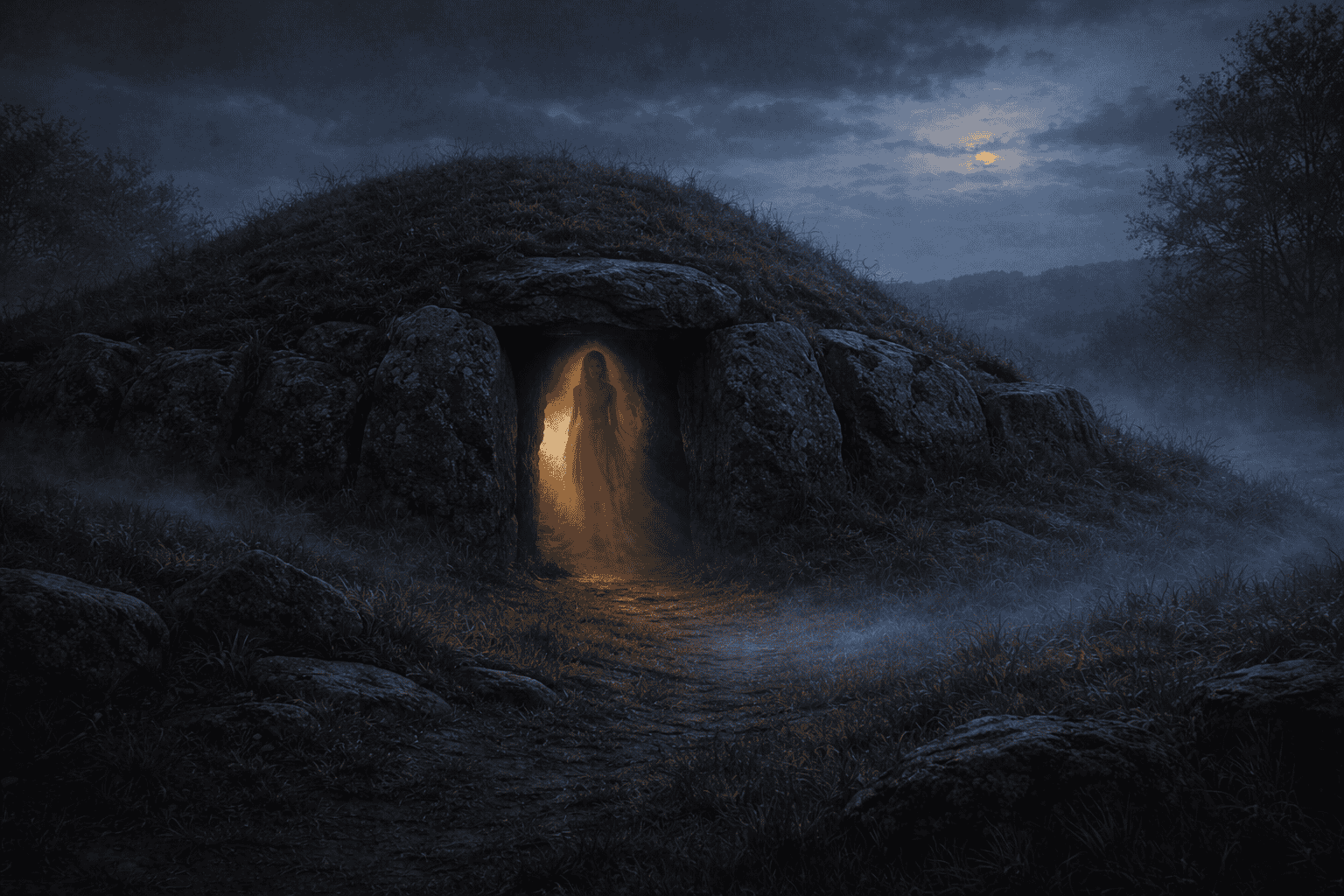
The banshee’s name tells us where she comes from. Bean sí, in older spelling ben síde, means “woman of the síd.” A síd was one of the ancient mounds where the people of the Otherworld, the Aos Sí, were believed to live. In early Irish literature, women of the síd appear often: they come to heroes as lovers, prophets, and guides, and they usually know what is about to happen.
So the banshee was, first of all, an Otherworld woman. Her knowledge of death came from the same source as the gifts of prophecy that Otherworld women have throughout Irish tradition.
Goddesses of Battle and the Washer at the Ford
Early Irish literature has a group of fearsome female figures linked to war and death. The Morrígan and Badb appear before battles, often as crows, shrieking over the warriors and foretelling slaughter. Closely related is the washer at the ford, a woman seen washing the clothes, arms, or bodies of warriors who are about to die.
The most vivid example comes from Caithréim Thoirdhealbhaigh, a history of the O’Brien wars in County Clare written around 1350. Before a battle in 1317, an army meets a hideous woman at a lake, washing a heap of heads and limbs until the water runs red. She tells them the heads are theirs, and by evening most of them are dead. The same figure lives on in Scottish folklore as the bean nighe.
The banshee’s role as a messenger of death seems to descend from these figures. Tellingly, in parts of south-east Ireland, including Wexford, Kilkenny, and Tipperary, the banshee was known as the Badhbh or the Bow, the name of the old battle goddess.
Guardian Women of the Old Families
One of the banshee’s most distinctive traits is that she follows particular families, traditionally the old Gaelic families whose names begin with Ó or Mac. This, too, seems to have an ancient origin.
In early Ireland, a king’s right to rule was imagined as a marriage between the king and a goddess who represented the land itself, the goddess of sovereignty. Many ruling families had their own local goddess, a woman of the síd who watched over them. In north Munster, the O’Briens were guarded by Aoibheall, who lived at Craig Liath, a hill overlooking the Shannon near Killaloe. In the twelfth-century account of the Battle of Clontarf, Cogadh Gáedhel re Gallaibh, Aoibheall appears before the battle of 1014 and tries to keep a young warrior she loves, Dúnlang Ó hArtagáin, from fighting, knowing that he and Brian Boru’s forces will fall. In south Munster, Clíodhna was linked in the same way with the MacCarthys and O’Keeffes.
Many scholars see these guardian goddesses as the ancestors of the family banshee. A goddess bound to a dynasty would naturally mourn its kings, and as the old kingdoms faded, she survived in folk memory as the woman who cries for the family’s dead.
The Keening Women
The final, and perhaps most important, root is human. For centuries, an Irish wake included the caoineadh, a loud, rhythmic lament for the dead, performed by women of the family and community and sometimes by paid keening women. It was considered a necessary part of a proper farewell, and a family of standing would expect its dead to be keened well.
The banshee’s cry is described in exactly the same terms. The folklorist Patricia Lysaght, whose 1986 book is still the standard study, saw her as a supernatural counterpart to the human keening women, who performed their duty for the family before the death rather than after it. In some districts, the banshee was even called the bean chaointe, “the keening woman.”
From Legend to Folk Belief
By the seventeenth century, the banshee in her familiar form was being reported by eyewitnesses. The Englishwoman Lady Ann Fanshawe described seeing a pale, red-haired woman at her window while staying with the O’Briens in the 1650s, the night a member of the household died. In the nineteenth century, collectors such as Thomas Crofton Croker, Lady Wilde, and W. B. Yeats published banshee stories, and the figure became famous well beyond Ireland.
In the 1970s and 1980s, Patricia Lysaght studied a large body of accounts from the National Folklore Collection and from her own fieldwork. She found that belief in the death messenger had been remarkably widespread and consistent across the whole island, though her names and appearance varied from region to region.
How the Banshee Changed
As the old keening custom faded in the nineteenth and early twentieth centuries, the banshee lost one of her closest human parallels, and outside Ireland, she was increasingly reimagined as a screaming ghost or a horror monster. Films, comics, and games made her louder and more frightening. But the older traditions still shape how she is remembered in Ireland: as a mourner rather than a killer, and as a sign that a family was old enough, and important enough, to be wept for by the Otherworld.
Is the Banshee a Goddess?
Not in folk belief, where she is a fairy woman who belongs to a family. But her roots almost certainly include goddesses: the war goddesses who foretold death in battle, and the local goddesses of sovereignty who watched over the old ruling families. In figures like Aoibheall and Clíodhna, who were remembered both as Otherworld queens and as family banshees, the two ideas meet.
Sources and Further Reading
- Patricia Lysaght, The Banshee: The Irish Supernatural Death-Messenger, Glendale Press (1986).
- James Henthorn Todd, ed. and trans., Cogadh Gaedhel re Gallaibh: The War of the Gaedhil with the Gaill, Longmans (1867).
- Standish Hayes O’Grady, ed. and trans., Caithréim Thoirdhealbhaigh: The Triumphs of Turlough, Irish Texts Society (1929).
- Gearóid Ó Crualaoich, The Book of the Cailleach: Stories of the Wise-Woman Healer, Cork University Press (2003).
- Dáithí Ó hÓgáin, Myth, Legend and Romance: An Encyclopaedia of the Irish Folk Tradition, Ryan Publishing (1990).