In Short
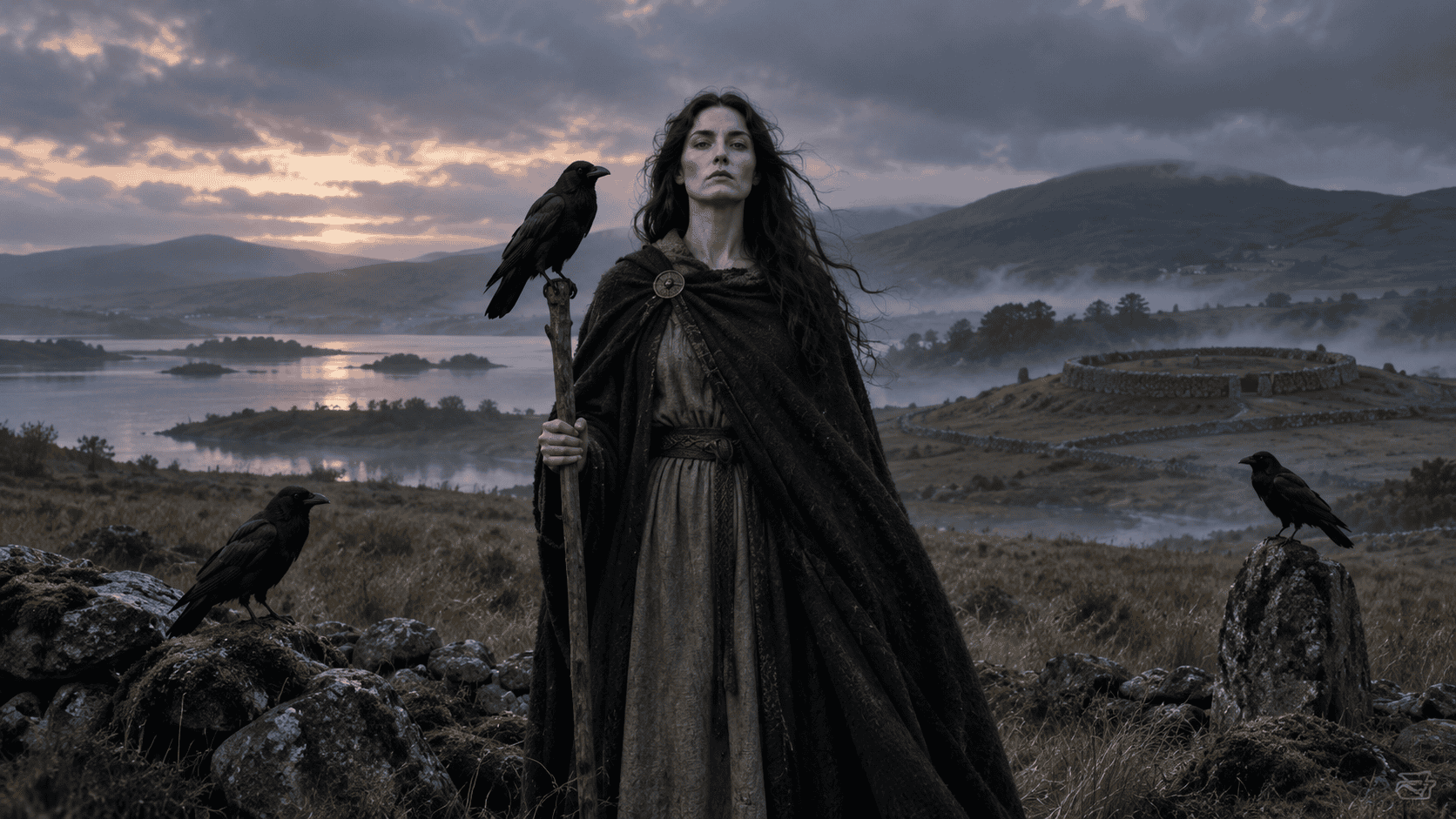
The Morrígan (pronounced MOR-ree-gan) is a goddess of battle, prophecy, and fate in early Irish literature, one of the Tuatha Dé Danann. She appears before battles to foretell victory or death, often in the shape of a crow, and she can also take the form of an eel, a wolf, a heifer, or an old woman. Her best-known stories are her meeting with the Dagda at a river on Samhain and her long feud with the hero Cú Chulainn.
| Irish name | Morrígan, also Mórrígan or Morrígu |
|---|---|
| Pronunciation | MOR-ree-gan, stressed on the first syllable as in Old Irish; often said mor-REE-gan today |
| Meaning | Debated: “Phantom Queen” or “Great Queen” |
| Associated with | Battle, prophecy, fate, and death |
| Forms | Crow, eel, wolf, heifer, young woman, old woman |
| Sisters | Badb and Macha, in some sources Nemain |
| Key texts | Cath Maige Tuired, Táin Bó Cúailnge, Táin Bó Regamna |
| Linked festival | Samhain, from her meeting with the Dagda |
| Often confused with | Morgan le Fay, who is a separate figure |
Who Is the Morrígan?
A young warrior is guarding a river ford alone, holding back an army. Between fights, a beautiful woman appears and offers him her love and her help. He is tired, he is busy, and he tells her so, rudely. She promises that the next time he fights, she will be there too. She keeps her word. In the middle of his next duel, an eel wraps itself around his legs in the water.
The warrior is Cú Chulainn, the greatest hero of early Irish literature, and the woman is the Morrígan. She is one of the most striking figures in Irish mythology: a goddess who turns up at the edge of battles, foretells who will live and who will die, changes shape at will, and makes bargains with gods and heroes on her own terms. She is not a gentle figure, and she is not a simple one. She helps the Tuatha Dé Danann win their greatest battle, and she also stalks and wounds the finest champion of Ulster.
What Does Her Name Mean?
Scholars still disagree, and the argument turns on a single accent mark. The second half of the name is clear: rígan means “queen.” The first half is the problem. In later medieval manuscripts, the name is sometimes written Mórrígan, with an accent that makes the first part mór, “great,” giving the familiar translation “Great Queen.”
The earlier manuscripts mostly leave the accent off. Without it, the first part looks like a word related to the old English “mare” in “nightmare,” a frightening supernatural female. That gives “Phantom Queen,” the reading many scholars now prefer, and the historian Ronald Hutton has suggested that “Nightmare Queen” may be the most accurate of all. Others argue that the word needed for that reading never appears on its own in Old Irish, and prefer “Great Queen.” Both translations are in common use, and neither has won the debate.
The Morrígan and the Dagda
Her most famous scene comes in Cath Maige Tuired, “The Second Battle of Mag Tuired,” the medieval tale of the war between the Tuatha Dé Danann and the Fomorians. Before the battle, on Samhain, the Dagda goes to meet her at the river Unshin in what is now County Sligo. He finds her washing herself, standing astride the river with one foot on each bank and her hair loose in nine tresses.
They sleep together, and the place is afterward called the Bed of the Couple. But the meeting is as much a council of war as a love scene. She tells the Dagda where the Fomorians will land and promises to go against their king, Indech, and take from him the blood of his heart. During the battle, she urges the Tuatha Dé on. When it is over, she proclaims the victory in two poems. The first is a vision of peace and plenty. The second foretells a far grimmer future, a world where the seasons fail, loyalty breaks down, and the end of all things approaches.
This scene is the source of the Morrígan’s genuine link with Samhain. Many modern connections between Irish gods and festivals are recent inventions, but this one is in the medieval text.
The Morrígan and Cú Chulainn
Her story with Cú Chulainn runs through the Táin Bó Cúailnge, “The Cattle Raid of Cooley,” and one of its shorter preludes, Táin Bó Regamna. In the prelude, she warns the young hero that she is guarding his death, and she tells him exactly how she will attack him during the great war to come.
Three Shapes at the Ford
During the Táin, while Cú Chulainn is holding the ford against the armies of Connacht, she comes to him as a young woman and offers him her love. He refuses. When he next fights, against the warrior Lóch, she attacks him three times, just as she warned. First, she comes as an eel that coils around his legs and trips him in the water. Next, she comes as a wolf that drives a stampede of cattle across the ford. Last, she comes as a heifer at the head of the herd. Each time, Cú Chulainn wounds her, and he still defeats Lóch.
The Old Woman and the Cow
Afterward, the exhausted hero meets an old woman milking a cow. She has three wounds, matching the ones he gave the eel, the wolf, and the heifer. She gives him three drinks of milk, and after each one he blesses her, and each blessing heals one of her wounds. Only when she is whole again does he realize who she is. Had he known, he tells her, he would never have healed her.
The Crow on His Shoulder
When Cú Chulainn finally dies, he ties himself to a standing stone so that he can face his enemies on his feet. They are afraid to come near until a bird lands on his shoulder, and only then do they know he is dead. Later retellings usually identify the bird with the Morrígan, closing the circle that began at the ford. That image became one of the most famous in Ireland through Oliver Sheppard’s bronze statue of the dying Cú Chulainn, modeled in 1911, with a crow on the hero’s shoulder. It was installed in Dublin’s General Post Office as the memorial to the 1916 Rising and unveiled on Easter Sunday in 1935.
The Three Sisters
The Morrígan rarely appears entirely alone. The Lebor Gabála Érenn, the medieval “Book of Invasions,” names her among the daughters of Ernmas, alongside Badb and Macha, and some texts add a figure called Nemain. The names overlap and blur. Badb, whose name is linked to a word for crow, often plays the same role as the Morrígan, and the two can be hard to tell apart. Scholars sometimes call the group the Morrígna, the plural of her name.
Together, these figures belong to the battlefield. They appear as crows over the slaughter, shriek to terrify armies, and are sometimes pictured washing the bloodstained clothes of warriors who are about to die. That washer at the ford is one of the most haunting images in Irish tradition, and it has often been compared with the banshee of later folklore, who also foretells death.
Goddess of War, or Something More?
The Morrígan is usually called a war goddess, and battle is certainly her element. But her stories suggest a wider role. She deals in prophecy as much as in fighting, and she is interested in who will win before the battle begins. Her union with the Dagda at the river, on the night the year turns, has led some scholars to see her as a goddess of sovereignty and the land, a figure who grants victory and rule to those who meet her terms. That reading is appealing, but it is an interpretation of the stories rather than something the texts say outright.
The Morrígan in Popular Culture
Few Irish goddesses have had a busier modern career. In video games, she lends her name to Morrigan, the shapeshifting witch of BioWare’s Dragon Age: Origins, released in 2009, and to Morrigan Aensland, a succubus in Capcom’s fighting game series Darkstalkers, which began in 1994. She appears as herself, under the name The Morrigan, as a playable shapeshifting goddess in the game Smite. None of these characters follow the medieval stories closely, but they have made her name familiar to millions of people who have never read the Táin.
She is also a major figure in modern paganism, where she is often honored as a goddess of sovereignty, protection, and transformation. Much of that devotion draws on the medieval texts, but some of it, such as the idea of the Morrígan as a maiden, mother, and crone, comes from twentieth-century writers rather than from Irish tradition.
Is the Morrígan the Same as Morgan le Fay?
No, though the idea is often repeated. Morgan le Fay is an enchantress from the Arthurian legends of Britain and France, first named in the twelfth century. The resemblance in the names led some modern writers to connect the two. But most scholars think the names come from different roots, with Morgan’s usually linked to a Welsh word related to the sea. The two figures also have little in common beyond a talent for magic and a connection to the death of a hero. The Morrígan is Irish, older, and belongs to the battlefield. Morgan belongs to the courts and the enchanted islands of Arthurian romance.
Sources and Further Reading
- Elizabeth A. Gray, ed. and trans., Cath Maige Tuired: The Second Battle of Mag Tuired, Irish Texts Society (1982).
- Cecile O’Rahilly, ed. and trans., Táin Bó Cúailnge: Recension I, Dublin Institute for Advanced Studies (1976).
- R. A. S. Macalister, ed. and trans., Lebor Gabála Érenn: The Book of the Taking of Ireland, Irish Texts Society (1938 to 1956).
- Rosalind Clark, The Great Queens: Irish Goddesses from the Morrígan to Cathleen Ní Houlihan, Colin Smythe (1991).
- Angelique Gulermovich Epstein, War Goddess: The Morrígan and Her Germano-Celtic Counterparts, doctoral dissertation, University of California, Los Angeles (1998).