In Short
Irish folklore filled its lakes, rivers, and coasts with supernatural beings. The best known are the merrow, a mermaid who wears a magic red cap; the each uisce, a water horse that carries its riders to their deaths; the dobhar-chú, a monstrous “water hound” remembered on an eighteenth-century gravestone in County Leitrim; and the seal people, from whom some western families claimed descent. Lakes had their own monsters, often said to have been banished there by saints. Together, they reflect how much of Irish life depended on water, and how dangerous it could be.
| Sea beings | The merrow; the seal people |
|---|---|
| Lake and river beings | The each uisce; the dobhar-chú; the péist |
| Most dangerous | The each uisce and the dobhar-chú |
| Kindest | The seal people, who sometimes married into human families |
| Famous site | Grace Connolly’s gravestone, Conwell, County Leitrim, 1722 |
| Key sources | Croker (1825 to 1828), Yeats (1888), local tradition |
| Related | Holy wells, and lakes as entrances to the Otherworld |
Why Irish Folklore Is Full of Water Spirits
Ireland is an island crowded with lakes, rivers, bogs, and sea inlets, and for most of its history, people lived close to water and depended on it. Fishermen went out in small boats on the Atlantic. Women washed clothes at the lake shore. Travelers forded rivers and crossed bogs at night. Every community knew someone who had drowned.
It is no surprise, then, that the old stories filled the water with beings of its own. Some were beautiful, some were monstrous, and a few could even marry into human families. Most of them carried the same warning: water is never quite as empty or as safe as it looks.
The Water Spirits of Ireland
These are the best-known water beings of Irish folklore. Some belong only to Ireland, and others are shared with Scotland and the rest of the Gaelic world.
The Merrow
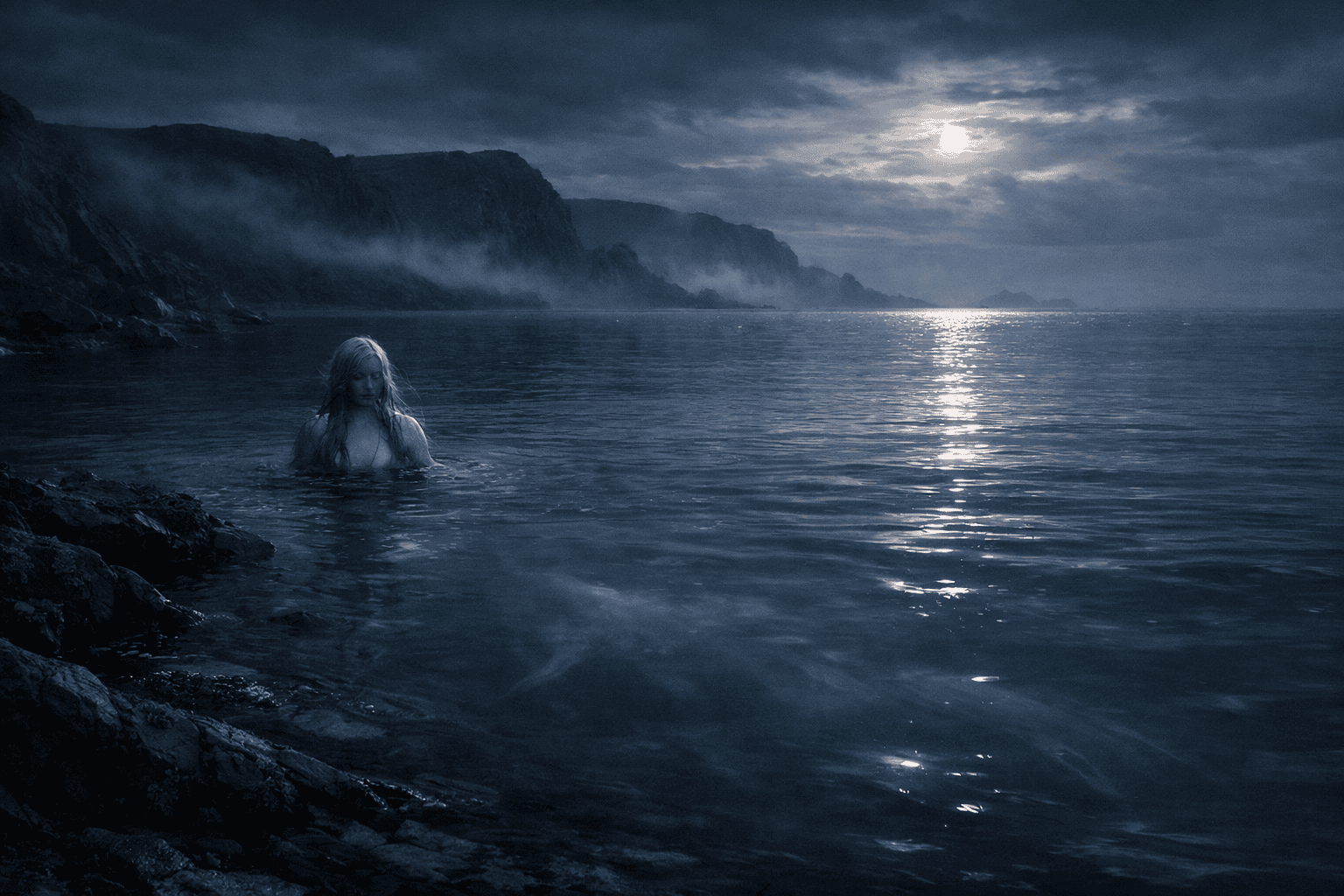
The merrow (pronounced MER-oh), from the Irish murúch, is Ireland’s mermaid. The women are beautiful, with fish tails and long green hair, and wear a little red cap that lets them travel between the sea and the land. In Thomas Crofton Croker’s “The Lady of Gollerus,” a Kerry fisherman steals a merrow’s cap and marries her, but when she finds it years later, she returns to the sea. The male merrows, Yeats recorded, had green teeth, green hair, and pigs’ eyes, and fishermen took the sight of any merrow as a sign that storms were coming.
The Each Uisce
The each uisce (pronounced roughly akh ISH-kuh), “water horse,” is one of the most dangerous beings in Gaelic folklore. It lives in lakes and the sea, and comes ashore as a handsome horse, calm enough to invite someone to climb on its back. Once a rider is mounted, the horse gallops into the water and dives, and the rider is never seen again. The belief is shared with Scotland, where the each-uisge is especially feared, and Irish stories tell of water horses rising out of lakes, especially in the west.
The Dobhar-Chú
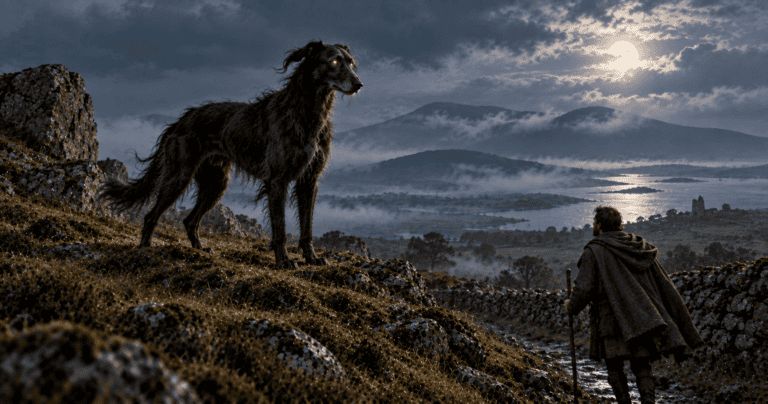
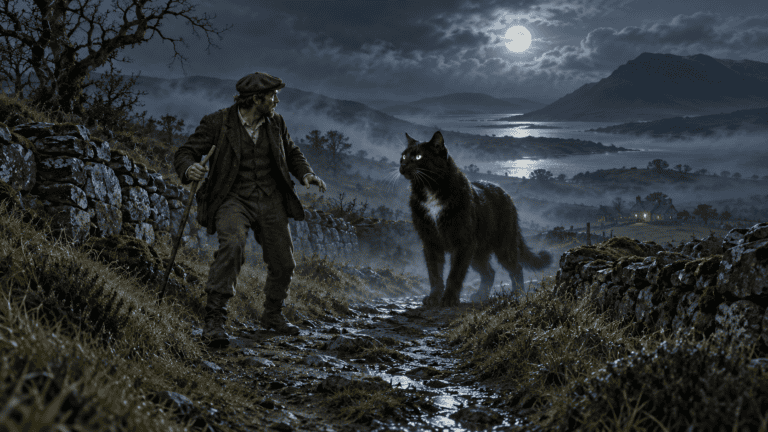
The dobhar-chú (pronounced roughly DOW-er-khoo), “water hound,” is a huge, savage otter-like beast of lakes and rivers. Its name is also an old Irish word for the otter itself. The most famous story comes from Glenade Lough in County Leitrim. In September 1722, according to local tradition, a woman named Grace Connolly went down to the lake and was killed by a dobhar-chú. Her husband, Terence, found the creature lying on her body and stabbed it. As it died, it gave a piercing whistle, and its mate rose from the lake and chased him until it too was killed.
What makes the story unusual is that there is physical evidence of the belief. In the old graveyard at Conwell, near Kinlough, a gravestone said to be Grace Connolly’s is carved with a strange animal, dog-like in body and legs, and local people have long pointed to it as proof of the tale.
The Seal People
Along the western coast, seals were often thought to be more than animals. Some were said to be people under enchantment, or a race of their own who could shed their skins and walk on land. As in the merrow stories, a man who hid a seal woman’s skin could keep her as his wife until she found it again. In Connemara, tradition held that the Conneely family was descended from seals, and that no Conneely should ever harm one. The same beliefs are found in Scotland and the Northern Isles, where the seal people are called selkies.
The Péist
Many Irish lakes were once said to hold a péist, a monstrous serpent or worm. In a common pattern, a saint drives the creature into a lake and confines it there until the end of the world. At Lough Derg in County Donegal, whose name means “red lake,” tradition said the water was stained by the blood of a monster killed there, in some versions by Saint Patrick. Stories of lake monsters continued into modern times, and reported sightings still turn up in the newspapers now and then.
Water as a Doorway to the Otherworld
In Irish tradition, water is not only dangerous but sacred. Lakes and the sea could be entrances to the Otherworld: in some stories, the land of the fairies lies beneath a lake, and in others, like the legend of Tír na nÓg, it lies across the western sea. Holy wells, many of them associated with saints, were visited for healing and prayer, and the sources of great rivers like the Boyne and the Shannon were said to be magical wells. Water spirits belong to this larger world, in which the boundary between the ordinary and the supernatural often runs along a shoreline.
What the Water Spirits Taught
Many of these stories work as warnings. Do not trust a strange horse standing by the water. Do not bathe alone in a lonely lake. Watch the weather when the fishermen say they have seen a merrow. For children especially, stories of water horses and lake monsters were a vivid way to keep them away from dangerous water. Beneath the warnings, the stories also carry a sense of loss: the merrow and the seal wife who go back to the sea are, in the end, stories about people who leave and cannot be held.
Is the Dobhar-Chú Real?
There is no evidence that a creature like the dobhar-chú exists, and naturalists have long suggested that the stories grew from encounters with unusually large otters, which can be aggressive when cornered. But the Glenade gravestone is real, and it shows how seriously some people took the belief in the eighteenth century. Reported sightings of “Ireland’s crocodile” still circulate today, keeping the legend alive.
Sources and Further Reading
- Thomas Crofton Croker, Fairy Legends and Traditions of the South of Ireland, John Murray (1825 to 1828).
- W. B. Yeats, ed., Fairy and Folk Tales of the Irish Peasantry, Walter Scott (1888).
- Dáithí Ó hÓgáin, Myth, Legend and Romance: An Encyclopaedia of the Irish Folk Tradition, Ryan Publishing (1990).
- Katharine Briggs, An Encyclopedia of Fairies, Pantheon Books (1976).
- David Thomson, The People of the Sea: A Journey in Search of the Seal Legend, Turnstile Press (1954).