In Short
The leprechaun (pronounced LEP-ruh-kawn, from Irish leipreachán) is a solitary fairy of Irish folklore, a small, wrinkled old man who works alone as a shoemaker and guards a hidden crock of gold. Catch him and keep your eyes on him, and he must lead you to his treasure; look away for a second, and he is gone. His earliest ancestors appear in an Irish tale of the eighth century, and in nineteenth-century accounts he wore red, not green.
| Irish name | Leipreachán; in the oldest text, lúchorpán |
|---|---|
| Pronunciation | LEP-ruh-kawn |
| Likely meaning | “Small body” |
| Type | Solitary fairy |
| Trade | Shoemaker, usually working on a single shoe |
| Size | “A span and a quarter” tall, in William Allingham’s poem |
| Treasure | A crock of gold, buried in a field |
| Traditional dress | A red coat and cocked hat, in nineteenth-century accounts |
| Earliest source | Echtra Fergusa maic Léti, eighth century |
| Relatives | The cluricaun and the far darrig |
What Is a Leprechaun?
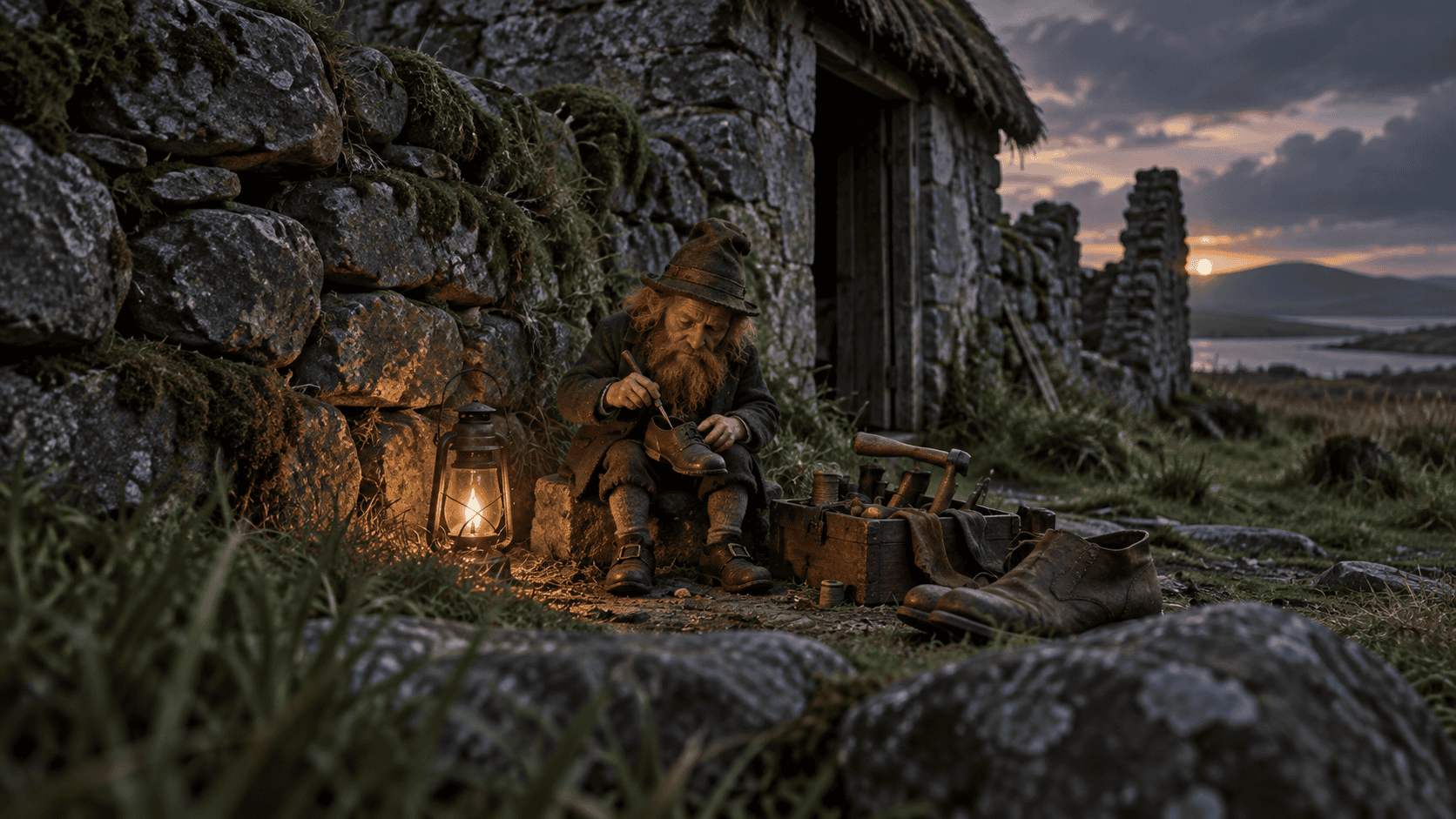
You are walking along a ditch on a summer evening when you hear it: a tiny, steady tap-tap-tap, like a hammer on a nail. You creep closer. Under the hedge sits a little old man, no taller than your knee, with a leather apron and a shoe in his lap, hammering away. You grab him. He looks at you, perfectly calm, and says good evening. And now the real contest begins, because you want his gold, and he has no intention of giving it to you.
That is the leprechaun of Irish folklore. Long before he became a cereal mascot and a St. Patrick’s Day costume, he was a solitary fairy, living and working alone, with a trade, a hoard, and a sharp tongue. He was not a creature of luck. He was a creature of bargains, and the people who met him rarely came out ahead.
Where the Word Comes From
The word has been spelled dozens of ways over the centuries, including lepracaun, lubrican, and leithbrágan. Scholars generally trace it to the Old Irish lúchorpán, which appears to mean “small body,” from a word for small and a word for body borrowed from the Latin corpus.
The word reached English early. The playwrights Thomas Dekker and Thomas Middleton mention an “Irish lubrican” in their play The Honest Whore, published in 1604, which makes it one of the oldest Irish fairy names in English literature.
There is also a popular folk explanation. Because the leprechaun was so often seen working on a single shoe, people linked his name to the Irish leith bhróg, “one shoe,” making him a “one-shoe maker.” It is a satisfying story, but most language scholars treat it as a guess that came along after the name, rather than the true origin.
The First Leprechauns
The leprechaun’s earliest known ancestors appear in Echtra Fergusa maic Léti, “The Adventure of Fergus mac Léti,” an Irish tale that scholars date to the eighth century. They are nothing like the modern image. They are water sprites.
Fergus, a legendary king of Ulster, falls asleep by the sea. While he sleeps, small creatures called lúchorpáin take his sword and begin carrying him down into the water. The cold wakes him, and he seizes three of them. To win their freedom, they grant him three wishes, including the power to breathe underwater. There is one condition: the gift will not work in Loch Rudraige, now Dundrum Bay in County Down. Fergus, being a king, goes swimming there anyway, and meets a monster called the Muirdris.
What survives from this story into later folklore is the pattern: a small magical being, caught by a human, who must pay a price to be set free.
The Fairy Shoemaker
By the nineteenth century, when collectors began writing down Irish folklore in earnest, the leprechaun had become a shoemaker. W. B. Yeats, in his 1888 anthology Fairy and Folk Tales of the Irish Peasantry, counted him among the “solitary fairies,” who live apart from the fairy host and have trades of their own. The leprechaun made shoes constantly, Yeats wrote, and had grown very rich from it, adding that many crocks of treasure buried long ago in wartime now belonged to him.
The poet William Allingham gave the shoemaker his most famous portrait in “The Lepracaun; or, Fairy Shoemaker,” which Yeats included in the same book. Allingham’s leprechaun is a wrinkled, bearded little man with spectacles on his nose and silver buckles on his stockings, tapping away at a pair of shoes in a castle ditch. When the narrator catches him, the leprechaun calmly offers him a pinch of snuff, flings it in his face, and vanishes while he sneezes.
In another account from 1888, the American writer D. R. McAnally Jr. suggested that the leprechaun was not a professional cobbler at all, but simply wore out his own shoes by running about so much, and was always having to mend them.
What Does a Leprechaun Look Like?
The old descriptions agree on the basics. He is small, old, and male, with a wrinkled face, and he is usually busy. Allingham gives his height as “a span and a quarter,” a span being the distance across an outstretched hand, which would make him about a foot tall. Allingham’s leprechaun wears spectacles on his pointed nose, a leather apron, and silver buckles on his stockings, and he keeps a snuff-box in his pocket.
Samuel Lover, writing in 1831, dressed him more grandly, in a coat laced with gold, a cocked hat, and buckled shoes. Yeats added a coat with seven rows of buttons, seven buttons to each row. And according to McAnally, in the north-eastern counties the leprechaun liked to stand on the point of his cocked hat and spin like a top.
He was found in out-of-the-way places: in ditches and under hedges, on the green mound of an old ringfort, or wherever the tapping of his hammer gave him away. Allingham’s poem has him spending the winter underground.
The Crock of Gold
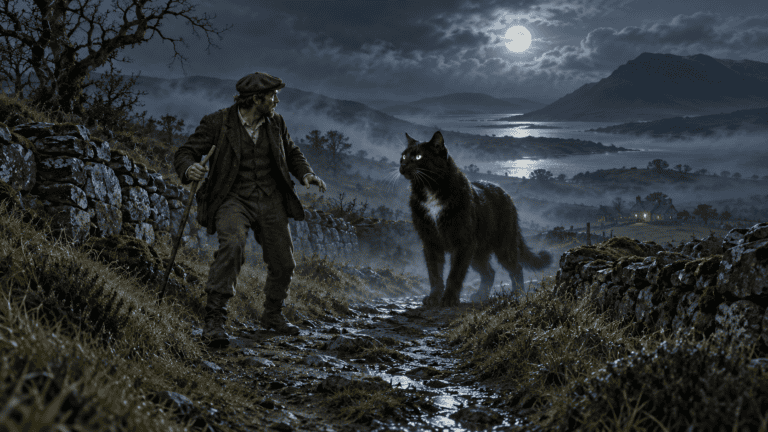
The leprechaun’s gold is the heart of almost every story about him. In the folk tales, it is not waiting at the end of a rainbow. It is buried in a crock somewhere in a field, and only the leprechaun knows where. The rule is simple. If you catch him, he must show you where it is, but only as long as you keep your eyes on him. The moment you look away, he disappears, and so does your fortune.
The Field of Boliauns
The most famous version of the trick comes from Thomas Crofton Croker’s Fairy Legends and Traditions of the South of Ireland, published in 1825. A young man named Tom Fitzpatrick catches a leprechaun and, by keeping a firm grip and never taking his eyes off him, forces him to reveal where his gold is hidden. The leprechaun leads him to a field full of boliauns, the tall yellow weed also called ragwort, and points to one plant. The gold is buried beneath it.
Tom has no spade, so he ties his red garter around the boliaun to mark the spot and makes the leprechaun promise not to take it off. The leprechaun agrees, and Tom lets him go. When Tom comes back with a spade, every single boliaun in the field has a red garter tied around it. The leprechaun kept his promise exactly, and Tom went home with nothing.
Red Coat or Green?
Today, everyone knows the leprechaun wears green. In the nineteenth century, he wore red. Samuel Lover’s leprechaun of 1831 was quite a dandy, and his square-cut coat was red. Yeats, too, gave him a red coat, and noted that the solitary fairies generally dressed in red, while the trooping fairies wore green.
The green suit belongs to the twentieth century, when the leprechaun became tied to St. Patrick’s Day, the shamrock, and Ireland’s image abroad. The shift was gradual, and nobody can point to a single moment when it happened. But the familiar green-suited figure is a modern version, not the one the old storytellers described.
The Leprechaun’s Relatives
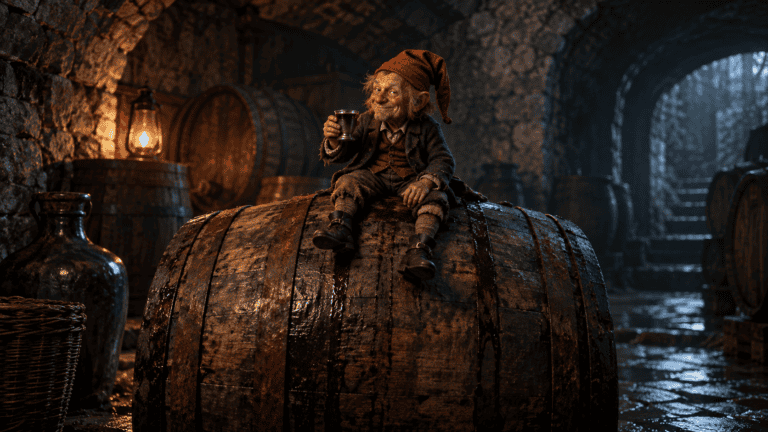
Yeats grouped the leprechaun with two other solitary fairies and admitted that hardly any two Irish writers agreed on where one ended and the next began. The cluricaun is a similar little man who haunts wine cellars and drinks himself merry, and some storytellers thought he was simply the leprechaun on his night off. The far darrig, or “red man,” is a practical joker whose tricks tend to be nastier. All three are old, wrinkled, solitary, and fond of making fools of people.
Are There Female Leprechauns?
Not in the traditional stories. Every leprechaun in the nineteenth-century collections, from Croker and Lover to McAnally and Yeats, is a little old man, and there is no traditional tale of a female leprechaun or of leprechaun families. That fits his character. He is a solitary fairy, living and working alone, in contrast to the trooping fairies, who live together in the forts in households and courts. Modern books, films, and costumes have added female leprechauns freely, but they are a recent invention.
The Leprechaun in Popular Culture
No figure from Irish folklore has traveled further. In Walt Disney’s 1959 film Darby O’Gill and the Little People, a young Sean Connery shares the screen with Brian, the king of the leprechauns. Lucky the Leprechaun was introduced to sell Lucky Charms cereal on St. Patrick’s Day in 1964. The stage musical Finian’s Rainbow, which reached the screen in 1968 with Fred Astaire, built its plot around a stolen crock of gold and the leprechaun who wants it back. The University of Notre Dame’s athletic teams use a fighting leprechaun as their mascot, and in 1993, the horror film Leprechaun, starring Warwick Davis, turned him into a killer hunting for his stolen gold.
The leprechaun’s link with St. Patrick’s Day is modern too. St. Patrick does not appear in the leprechaun tales, and the leprechaun does not appear in the saint’s legends. The two came together in the twentieth century, largely through St. Patrick’s Day celebrations and advertising in the United States, where the leprechaun became a cheerful symbol of Irishness and good luck.
In Ireland, the leprechaun has become partly a tourist attraction and partly a joke. Since 2009, campaigners in Carlingford, County Louth, have claimed that the leprechauns of Slieve Foy mountain are protected under the European Union’s Habitats Directive, a story the local community has told with great enjoyment and the world’s press has repeated every March. Some Irish people find the green-suited cartoon a tired stereotype, while others treat it as harmless fun. The old leprechaun of the folk tales, clever, solitary, and very hard to cheat, is a good deal more interesting than either.
Are Leprechauns Real?
Not in any sense that folklorists would claim. What is real is the tradition: stories about the leprechaun were told across rural Ireland and written down by collectors from the early nineteenth century onward, and belief in the “good people” more generally survived well into the twentieth century. The leprechaun belonged to that world of fairy belief, even if he was always one of its more comic figures. The stories are real, the tradition is real, and the lesson of the Field of Boliauns still holds: never take your eyes off a good thing.
Sources and Further Reading
- D. A. Binchy, “The Saga of Fergus mac Léti,” Ériu 16 (1952).
- Thomas Crofton Croker, Fairy Legends and Traditions of the South of Ireland, John Murray (1825).
- Samuel Lover, Legends and Stories of Ireland (1831).
- D. R. McAnally Jr., Irish Wonders, Houghton, Mifflin and Company (1888).
- W. B. Yeats, ed., Fairy and Folk Tales of the Irish Peasantry, Walter Scott (1888).