In Short
The clurichaun (pronounced KLOOR-ih-kawn) is a small, solitary fairy of Irish folklore who haunts wine cellars, drinks the stock, and plagues anyone sent down to fetch a bottle. He is a close relative of the leprechaun, and W. B. Yeats noted that some people thought the two were the same creature, the clurichaun being simply a leprechaun on a drinking spree. The most famous clurichaun story, Thomas Crofton Croker’s “The Haunted Cellar,” published in 1825, tells of Naggeneen, a tiny drunk in a red nightcap who drove every butler out of a County Cork mansion, and who, when his master threatened to move house, simply announced that he was coming too.
| Other spellings | Cluricaune, cluricaun; Irish clúracán |
|---|---|
| Pronunciation | KLOOR-ih-kawn |
| Type | A solitary fairy |
| Haunts | Wine cellars and storerooms |
| Known for | Drinking, and frightening the servants |
| Appearance | About six inches tall, in a red nightcap and leather apron, with a crimson nose |
| Relative | The leprechaun, possibly the same creature |
| Famous tale | “The Haunted Cellar,” Thomas Crofton Croker, 1825 |
What Is a Clurichaun?
A big house in County Cork has a famous wine cellar, a generous master, and a problem: no butler will stay. Every one of them leaves, and every one gives the same reason. The master is a fine man, but nobody can bear to go down to the cellar.
The reason is the clurichaun, a tiny fairy who has made the cellar his home. He drinks the wine, rocks the casks, and fills the dark vault with such roaring and bellowing that the servants flee. He is one of the solitary fairies of Irish tradition, like the leprechaun and the far darrig, who live and work alone rather than in the fairy hosts beneath the hills.
The Haunted Cellar
The best-known clurichaun story was published by Thomas Crofton Croker in his Fairy Legends and Traditions of the South of Ireland in 1825.
Justin Mac Carthy of Ballinacarthy, in County Cork, was famous for his hospitality and his enormous wine cellar, which his grandfather had cut into the solid rock beneath the house. But he could not keep a butler, because none of them would go down to the cellar. At last a stable lad, Jack Leary, offered to take the job, boasting that the cellar held no fears for him.
On his first night, near midnight, Mac Carthy rang for more wine for his guests, and Jack went down with a lantern. As he turned the key, he heard laughter inside, and the empty bottles at his feet began to rattle. When the door burst open, the cellar was full of a roaring like a mad bull, and every cask and barrel rocked back and forth. Jack fled upstairs, white and trembling, with no wine.
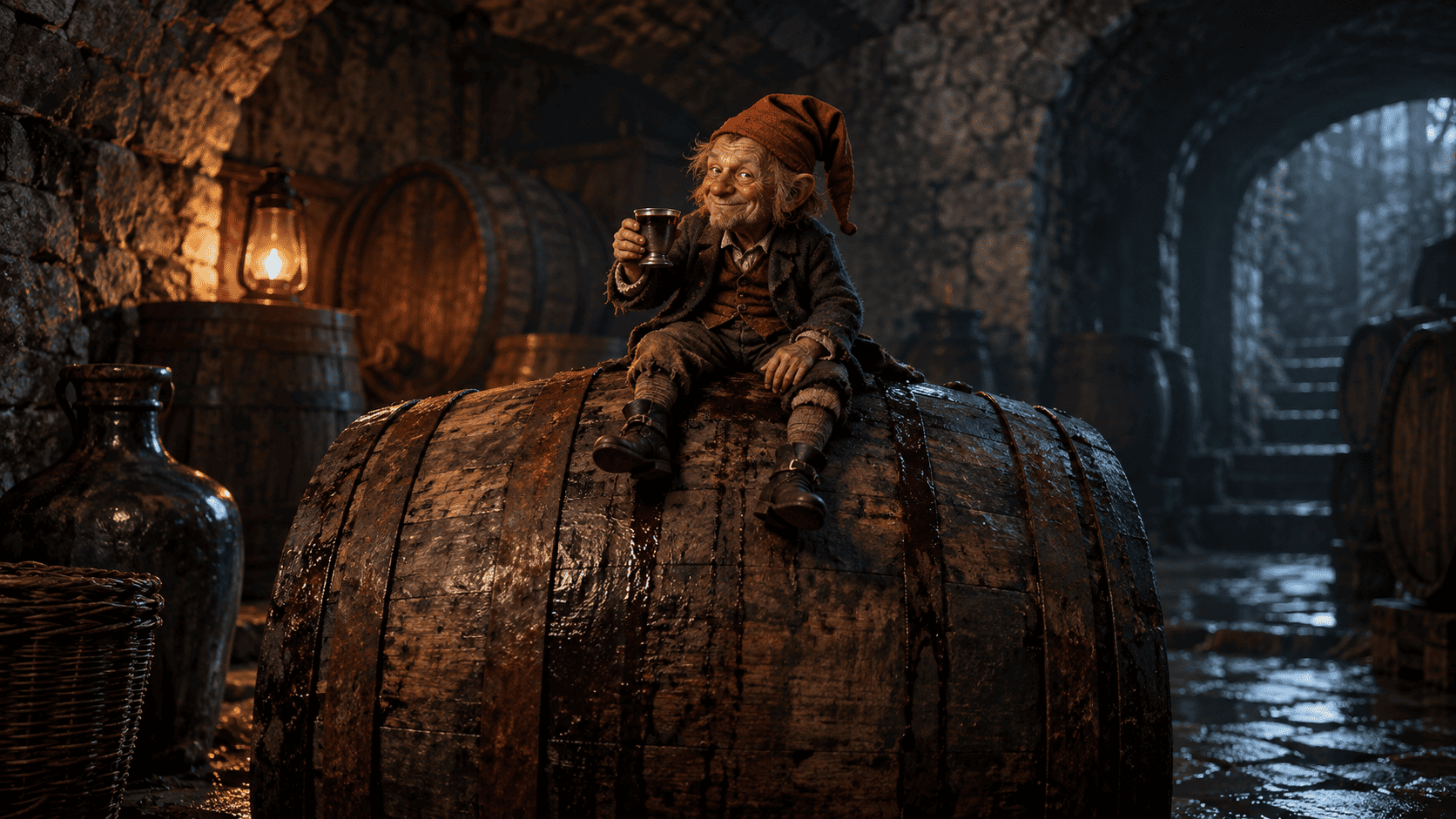
Mac Carthy lost his temper. He told his guests he would leave Ballinacarthy the very next day, and went down to the cellar himself. There, sitting astride a barrel of his oldest port, he found a little man about six inches tall, in a red nightcap, a short leather apron, long blue stockings, and high-heeled shoes with huge silver buckles. His face was like a withered winter apple, and his nose was bright crimson. He grinned up at his master and asked whether they were not moving tomorrow, and whether Mac Carthy would really leave his own little clurichaun Naggeneen behind.
Mac Carthy saw at once that there was no point in moving if Naggeneen was coming too. He stayed at Ballinacarthy for the rest of his life, and fetched his wine himself from then on, since the clurichaun seemed to respect him. When the cellar was finally emptied after his death, it was said that poor Naggeneen took it so hard that he was later seen wandering about in rags.
Why the Clurichaun Follows You
The punchline of “The Haunted Cellar” is a joke found all over Britain and Ireland: the household spirit that follows the family when they move. In the English version, a family plagued by a boggart packs its belongings to escape it, only to hear the boggart call out from the cart that it is moving too. The joke works because a household spirit belongs to the family, not the building. You cannot leave it behind, because it is part of your household, for better or worse.
That also explains the clurichaun’s odd loyalty. He torments the servants, but he respects the master, and in the story, he never troubles Mac Carthy himself.
Clurichaun or Leprechaun?
The clurichaun and the leprechaun are very close relatives, and the line between them is blurry. When Croker wrote in the 1820s, he used “cluricaune” as a general name for the little solitary fairy, and his cluricaune stories include tales that would today be told about leprechauns, such as a little fairy spotted by turf cutters on a bog, who vanishes behind a rick of turf just as they try to grab him. Croker noted that the little fairy went by different names in different parts of the country.
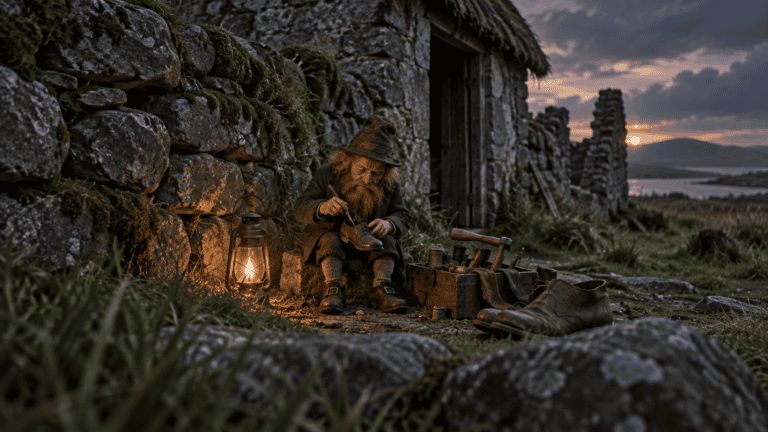
By 1888, W. B. Yeats was drawing a sharper line. In his Fairy and Folk Tales of the Irish Peasantry, he described the leprechaun as the fairy shoemaker and the clurichaun as the one “who gets intoxicated in gentlemen’s cellars.” He also noted that some people believed the two were one and the same, the clurichaun being simply the leprechaun on a spree, when his work was done. That is still the simplest way to think of them: the leprechaun is the fairy at work, the clurichaun the fairy at play.
What Else the Clurichaun Does
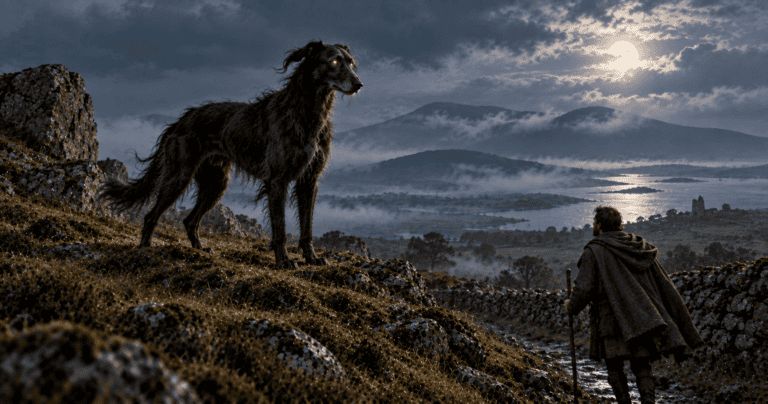
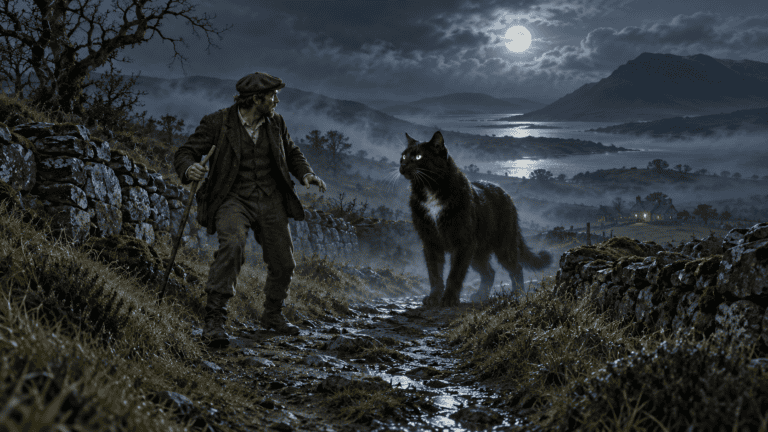
According to the folklorist Katharine Briggs, the clurichaun did not only drink. At night, it was said, he would ride sheep and shepherds’ dogs across the fields in wild races, leaving them exhausted and panting by morning. Like the púca, he enjoyed a wild ride. A farmer who found his sheepdog worn out at dawn, or his sheep muddy and scattered, might blame the clurichaun.
Why Tell Stories About a Drunken Fairy?
Clurichaun stories are comic, and part of their fun is the joke at the expense of the gentry. The clurichaun lives in the cellar of a rich man’s house, and drinks the wine the servants are never allowed to touch. When bottles went missing, or a servant came back from the cellar the worse for drink, the clurichaun was a convenient culprit. In a world where servants could lose their places for helping themselves, a thirsty fairy may have made a very useful excuse.
The Clurichaun in Popular Culture
The clurichaun has never become as famous as the leprechaun, but it turns up in fantasy novels, role-playing games, and Irish-themed collections of fairy tales, usually as a drunken, red-nosed leprechaun. Its best-known portrait remains the woodcut of Naggeneen astride his barrel in Croker’s book, which has been reprinted many times.
Is the Clurichaun Dangerous?
Not very. He frightens servants, empties cellars, and exhausts sheepdogs, but in the old stories, he harms no one. Treated with respect, he may even become a loyal, if thirsty, member of the household. The one thing you cannot do, as Justin Mac Carthy discovered, is get rid of him.
Sources and Further Reading
- Thomas Crofton Croker, Fairy Legends and Traditions of the South of Ireland, John Murray (1825), including “The Haunted Cellar” and “The Turf Cutters.”
- W. B. Yeats, ed., Fairy and Folk Tales of the Irish Peasantry, Walter Scott (1888).
- Katharine Briggs, An Encyclopedia of Fairies, Pantheon Books (1976).
- Dáithí Ó hÓgáin, Myth, Legend and Romance: An Encyclopaedia of the Irish Folk Tradition, Ryan Publishing (1990).