In Short
Irish folklore held that death rarely came without warning. The best-known sign is the cry of the banshee, heard outside the house before a death in one of the old families. Others were the headless Dullahan and his silent death coach, the “fetch,” or ghostly double of a living person, and a long list of everyday signs: three knocks with no one at the door, a bird flying into the house, a picture falling from the wall, a clock stopping, or a dog howling at night. Most omens were warnings, giving the family time to prepare, and they reflect a world in which death was close, familiar, and never quite silent.
| Best-known omen | The banshee’s cry |
|---|---|
| Most final omen | The Dullahan stopping and calling a name |
| Ghostly omens | The death coach; the fetch, a person’s double |
| Household signs | Three knocks, a falling picture, a stopped clock |
| Animal signs | A bird in the house, a howling dog, a cock crowing at night |
| Dream signs | Dreaming of a wedding, or of the dead calling |
What Is a Death Omen?
A death omen is a sign believed to foretell that someone will soon die. In rural Ireland, where most people died at home among their families, and where illness, childbirth, and the sea took lives every year, death was a constant presence, and people watched closely for its approach. The omens they recognized ranged from supernatural visitors to the smallest household accidents.
Most omens were understood as warnings rather than causes. They did not bring death. They announced it. That gave them a purpose: a family that heard the banshee, or saw a bird at the window, could send for the priest, gather the relatives, and prepare to say goodbye. The omens below are the ones most often recorded, grouped by kind, with the reasons people gave for them.
Supernatural Messengers
A few death omens were beings from the Otherworld, sent with a single message.
The Banshee
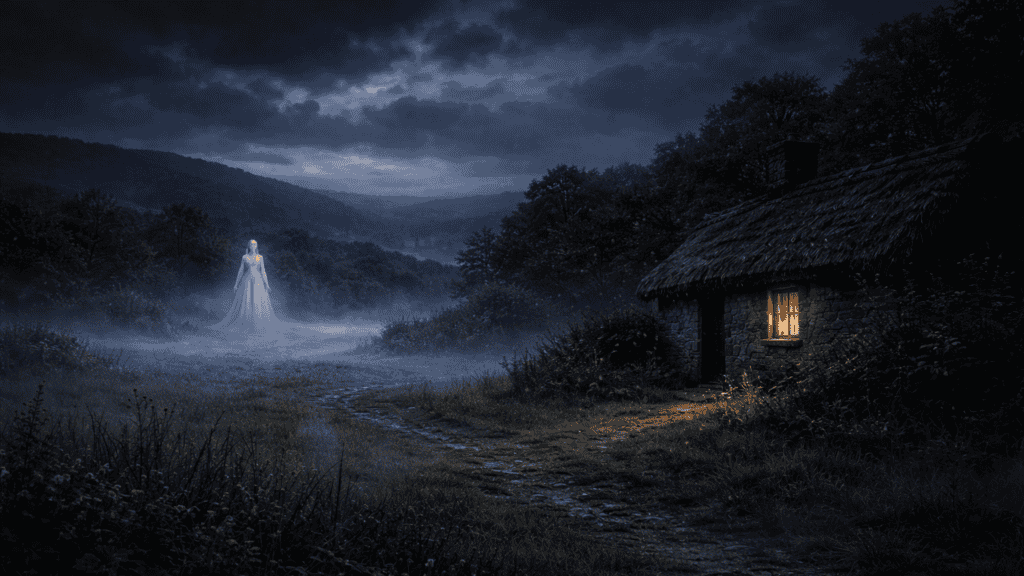
The banshee, the bean sí or “woman of the fairy mound,” is the most famous death omen in Ireland. She was said to follow particular old families, and her cry, a long, wailing lament like the keening of women at a wake, was heard outside the house at night shortly before a family member died. She does not cause the death. She mourns it in advance, which is why many families were proud to have her. Our article on the banshee’s cry explains what people heard, and what they may really have been hearing.
The Dullahan and the Death Coach
The Dullahan is the headless rider who carries his own head. When he stops at a house and calls a name, that person dies. Sometimes he drives the cóiste bodhar, the silent death coach, drawn by headless horses. Unlike the banshee, the Dullahan is not a warning but a summons, which is why he was more feared than any other omen.
The Washer at the Ford
Medieval Irish literature tells of a woman seen at a river ford, washing the bloody clothes or armor of warriors who were about to die in battle. In Scottish folklore, the same figure survived as the bean nighe, the washerwoman who scrubs the shrouds of the doomed. Both show death being prepared for before it arrives.
The Fetch
A fetch was the ghostly double of a living person, seen somewhere they could not possibly be. It was one of the most widely known death omens in Ireland in the nineteenth century, when the brothers John and Michael Banim made it the subject of their 1825 novel The Fetches. The timing mattered: a fetch seen in the morning was said to mean a long life, while one seen in the evening meant that the person would soon die. The belief seems to rest on the idea that the soul was already beginning to leave the body.
Signs in the House
Many omens happened inside the home, where the dying person lay and where the family kept watch.
- Three knocks. Three knocks at the door or on the headboard, with nobody there, were a well-known warning. Three is a number of great weight in Irish tradition, and the knock was understood as death, or a messenger, calling at the house.
- A falling picture. A picture or a holy image falling from the wall for no reason was taken as a sign, especially a picture of the person who was ill. A picture stands for the person, so its fall seemed to foretell theirs.
- A stopped clock. A clock stopping by itself was an omen, the reverse of the custom of stopping the clocks after a death. Time was running out, or had already stopped, for someone in the house.
- The death watch. A ticking sound in the walls or woodwork at night, like a slow clock, was called the death watch. It is actually made by the deathwatch beetle, a wood-boring insect that knocks its head against the wood to attract a mate, and it is most easily heard in the silence of a sickroom at night, which is how it got its name.
Signs From Animals and Birds
Animals were believed to sense the Otherworld before people could, and their behavior was watched closely.
- A bird in the house. A bird flying into the house, or tapping repeatedly at the window, was one of the most feared omens. Birds were widely seen as messengers between this world and the next, so a bird trying to get in was coming for someone. The robin, in particular, was said to visit a house where someone was about to die.
- A howling dog. A dog howling at night without cause, especially near the house of someone who was ill, was a warning. Dogs were believed to see spirits, and to howl at the approach of death.
- A cock crowing at night. A cock crowing at the wrong hour, at night instead of dawn, was an ill omen. The cock’s crow marks the proper order of the day, and a crow out of time was a sign that something was wrong.
- Magpies and crows. A single magpie was unlucky, and a crow or raven settling on the roof was a bad sign. Crows and ravens were linked since ancient times with battlefields, death, and the war goddess the Morrígan.
Dreams
Dreams could carry warnings too, and some of their meanings were the reverse of what you might expect. Dreaming of a wedding was said to foretell a death, while dreaming of a death foretold a wedding. The reversal may reflect an old idea that dreams show the opposite of what is coming. Dreaming of a dead relative who called to you, or beckoned you to follow, was a more obvious warning: the dead were coming to fetch one of their own.
Why the Omens Mattered
The death omens were not only frightening. They were useful. In a world without modern medicine, a family that believed death was coming could send for the priest so the dying person could receive the last rites, a matter of the greatest importance to Catholic families. Relatives could be sent for from other parishes. Preparations for the wake could begin. And the family could begin to accept the loss before it came.
The omens also gave meaning to death. A family who had heard the banshee felt that the death had been known and mourned by the Otherworld, and that their loved one had not simply slipped away unnoticed. Even today, many Irish families still remember a knock, a bird, or a falling picture before a death, and tell of it long afterward.
Are Death Omens Still Believed in Ireland?
Some are. Many Irish people will still mention a bird that flew into the house, or a picture that fell, before a relative died, often half seriously. Belief in the banshee has faded, but her name is still known everywhere in Ireland.
Sources and Further Reading
- Patricia Lysaght, The Banshee: The Irish Supernatural Death-Messenger, Glendale Press (1986).
- Thomas Crofton Croker, Fairy Legends and Traditions of the South of Ireland, part 2, John Murray (1828).
- John and Michael Banim, The Fetches, in Tales by the O’Hara Family, W. Simpkin and R. Marshall (1825).
- Seán Ó Súilleabháin, Irish Wake Amusements, Mercier Press (1967).
- The Schools’ Collection, National Folklore Collection, University College Dublin (1937 to 1939), on dúchas.ie.