In Short
Ogma is a god of the Tuatha Dé Danann, the champion of the gods in the saga of the Second Battle of Mag Tuired. Irish learned tradition also credits him with inventing ogham, the earliest writing in Ireland, and calls him a man skilled in speech and poetry.
| Name | Ogma (also spelled Oghma, Ogmae) |
|---|---|
| Group | Tuatha Dé Danann |
| Main Roles | Champion of the gods, credited inventor of ogham |
| Epithets | Trénfher (“champion”), grianainech (“sun-faced”) |
| Parentage | Son of Elatha, also called son of Ethliu or son of Etáin |
| Brothers | The Dagda, and Bres according to the ogham tract |
| Famous Find | Orna, the sword of Tethra, found in battle |
| Death | Fell fighting Indech, king of the Fomorians |
| Gaulish Parallel | Ogmios, a god of eloquence (link debated) |
Every day, a hungry champion of the gods carried a bundle of firewood from the islands of Clew Bay to the king’s fortress. The sea swept away two thirds of each load, because he was weak from hunger. That champion was Ogma, and his story runs straight into the gods’ war with the Fomorians.
Ogma is remembered for two very different gifts. In the saga, he is a warrior of enormous strength, while medieval Irish learning credits him with inventing ogham, a script whose first letters, the same tradition says, were written in birch.
What Is Ogma in Irish Mythology?
Ogma is one of the Tuatha Dé Danann, the divine race whose stories make up the Mythological Cycle. He serves as their champion, their chosen fighter. He is also remembered as a patron of learning.
That second role comes from In Lebor Ogaim, the Book of Ogam, a medieval Irish tract on ogham that calls Ogma the father of the script. George Calder edited and translated the tract in 1917 as part of Auraicept na n-Éces, The Scholars’ Primer.
A Champion Among the Gods
The clearest picture of Ogma comes from Cath Maige Tuired, the Irish saga of the Second Battle of Moytura, translated by Whitley Stokes in the journal Revue Celtique in 1891. The saga calls him “Ogma the champion” when he finds a famous sword. Before the battle, Lugh turns to Ogma as his champion and asks what he can do.
Outside the saga, his legend pictures him as a swarthy man, dark in complexion. His fighting spirit was said to be so fierce that other warriors had to chain him and hold him back until the right moment for battle.
The Meaning of His Epithets
In the Irish text of the saga, the word for champion is trénfer, also spelled trénfher. Where the Irish reads “Atá tréinfer lend cenu .i. Oghmae mac Ethlend,” Stokes translates, “We have a champion already, even Ogma son of Ethliu.” Another reading takes it as a strong man, which suits a hero who hurls flagstones.
His second epithet, grianainech, has been translated as “sun-faced.” The scholar J. A. MacCulloch, in The Religion of the Ancient Celts (1911), read it instead as describing a smiling face. He tied that smile to a Gaulish god, who comes up again below.
Ogma’s Family and Lineage
Ogma’s family tree changes depending on which text you open. Even a single saga names his parent in three different ways. MacCulloch observed that the old genealogists explained his relationship to the other gods in different ways, too.
Parents and Brothers
In Stokes’s translation of Cath Maige Tuired, Ogma is “son of Etáin” in one passage, “son of Ethliu” in another, and “son of Elathu” at his death. The same saga calls the Dagda and Ogma “the two brothers.” It also names Elatha as the father of Bres, who was given the kingship of Ireland for a time, and says Elatha “was king of the Fomorians.”
The ogham tract makes the link with Bres plain. It names “Ogma son of Elatha son of Delbaeth brother to Bres.” So in at least one tradition, the champion who hauled firewood for Bres was the king’s own brother, too.
MacCulloch offered yet another view. He wrote that Ogma was most often called a son of Brigid, a goddess whose functions, he said, were like Ogma’s own.
Descendants in the Book of the Taking of Ireland
Lebor Gabála Érenn, the Book of the Taking of Ireland, edited and translated by R. A. S. Macalister for the Irish Texts Society in 1941, traces a line through Ogma. Its genealogies list “Delbaeth s. Ogma s. Elada,” and add that “Delbaeth had the name Tuirell Bicreo.”
The same text names the six sons of Delbaeth, son of Ogma, including Brian, Iucharba and Iuchar. It calls these three “the three gods of Danu.” In this genealogy, Ogma is their grandfather, and the saga uses the same title for the three gods that he, Lugh and the Dagda visit before the battle.
Ogma in the Second Battle of Mag Tuired
Ogma’s big story is the war between the Tuatha Dé Danann and the Fomorians. He suffers under a bad king, tests a newcomer at the Hill of Tara and fights in the final battle.
The Champion Who Hauled Firewood
When Bres ruled the gods, the saga says that “the champions were also reduced to his service.” Ogma “had to carry a bundle of firewood,” while the Dagda, as a rath-builder, had to dig the trenches of Rath Brese.
The gods’ chiefs complained that they “saw not their champions proving their prowess at the king’s, save only one man, Ogma son of Etáin.” Even that one champion was starving. His duty, the saga says, “was to bring fuel to the fortress,” and the sea stole most of each bundle.
The Flagstone Contest With Lugh
When Lugh arrived at Tara offering himself as a champion, the doorkeeper turned him away. “We need thee not,” he said. “We have a champion already, even Ogma son of Ethliu.”
Ogma soon made his point with stone. “The great flag-stone, to move which required the effort of four-score yoke of oxen, Ogma hurled through the house,” the saga says, “so that it lay on the outside of Tara. This was a challenge to Lugh.” Lugh cast it back, so that it lay in the center of the palace.
The rivalry did not last. Later, the saga shows Lugh meeting “the two brothers, even Dagdae and Ogma,” and then all three going together to the three gods of Danu.
The Battle, Orna and a Contradiction
Asked what his power in the battle would be, Ogma promised “repelling the king and repelling three enneads of his friends.” It was a champion’s boast of beating the enemy king and his companions.
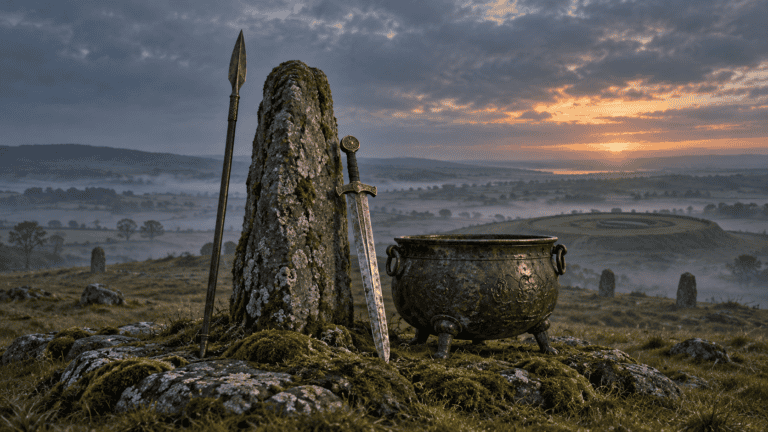
In the battle, “Ogma the champion found Orna the sword of Tethra, a king of the Fomorians.” The saga adds that he “unsheathed the sword and cleansed it,” and the sword related everything it had done, “for it was the custom of swords at that time” to recite their deeds.
The saga reports that Ogma and Indech, king of the Fomorians, “fell in single combat.” Lebor Gabála Érenn agrees: “In that battle there fell Ogma s. Elada at the hands of Indech.” Yet the saga later has Lugh, the Dagda and Ogma chasing the Fomorians, who “had carried off the Dagdae’s harper.”
MacCulloch noticed the same puzzle. He wrote that Ogma fought and died at Mag Tuired in one telling, while other accounts have him survive, capture Tethra’s sword and join the quest for the Dagda’s harp.
Ogma and the Invention of Ogham
The second half of Ogma’s reputation rests on In Lebor Ogaim, the ogham tract. Calder’s edition prints it from two medieval manuscripts, the Book of Ballymote and the Yellow Book of Lecan.
What the Ogham Tract Says
The tract sets out the script’s place, time and person, almost like a schoolbook. It says ogham was invented “in the time of Bres son of Elatha king of Ireland.” It then explains, “Now Ogma, a man well skilled in speech and in poetry, invented the Ogham.”
According to the tract, he made it “as a proof of his ingenuity,” and so that “this speech should belong to the learned apart, to the exclusion of rustics and herdsmen.” It even gives the script parents: “the father of Ogham is Ogma, the mother of Ogham is the hand or knife of Ogma.”
The First Message Ever Written
The tract also names the first thing written in ogham: seven b’s cut on a single switch of birch. Those marks carried a warning “to Lug son of Ethliu” about his wife. Their meaning, the tract says, was this: “Thy wife will be seven times carried away from thee into faeryland or into another country, unless birch guard her.”
That message explains why the alphabet starts as it does. “On that account, moreover, b, birch, takes precedence,” the tract says, “for it is in birch that Ogham was first written.” Another passage in the Primer says that seven birches were brought to Lugh.
Is the Name Ogham Really From Ogma?
Here the evidence splits. David Stifter of OG(H)AM, a UK and Irish research project at the Universities of Glasgow and Maynooth, notes that the script’s name recalls Ogma’s. But he says no actual causal connection between the two can be proven.
A separate article on the word ogam from the same project argues that it comes from an ordinary noun built on an Indo-European root meaning to push or drive forward. Its first sense may have been a furrow, later a groove or notch. MacCulloch had also suspected that the link with Ogma might be a folk etymology.
Ogma and the Gaulish Ogmios
In Gaul, there was a god with a strikingly similar name. Ogmios was identified with the Roman Hercules and honored as a god of eloquence. Whether he and Ogma were once the same figure is one of the open puzzles of Celtic and Irish gods.
Lucian’s Strange Portrait
A vivid description of Ogmios comes from the 2nd-century Greek author Lucian of Samosata. In his essay Heracles, translated by H. W. and F. G. Fowler in 1905, he writes that Heracles is known among the Gauls “under the local name of Ogmius.”
The god is “as old as old can be,” bald in front, with skin “wrinkled and tanned.” He holds a club and a bow, and leads people “fastened by the ears with thin chains composed of gold and amber,” linked to his tongue. A Gaul explains the image: “We Gauls connect eloquence not with Hermes, as you do, but with the mightier Heracles.”
Are Ogma and Ogmios the Same God?
MacCulloch thought so. He called Ogmios identical with Ogma and saw the Irish god’s epithet as an echo of the smiling face in Lucian’s account.
Stifter is far more cautious. He calls the connections among Ogma, Ogmios and the word ogam, if there are any, beguiling but unclear. Anyone exploring Irish versus Celtic mythology meets the same lesson: Similar names do not always mean a shared god.
| Feature | Ogma (Ireland) | Ogmios (Gaul) |
|---|---|---|
| Main Source | Cath Maige Tuired and the ogham tract | Lucian’s Heracles |
| Strength | Champion who hurls a giant flagstone | Shown as Heracles with club and bow |
| Speech | “Well skilled in speech and in poetry” | God of eloquence, people chained to his tongue |
| Chains | Held back by warriors with chains before battle | Leads people by chains of gold and amber |
| Appearance | Swarthy | Old, bald in front and tanned |
Why Ogma Still Matters
Whatever the truth about his name, the script that tradition credits to Ogma survives on real stones. Maynooth University reports more than 400 surviving ogham stones, about 360 of them in Ireland, with the highest concentrations in Kerry, Cork and Waterford. The inscriptions consist of the names of individuals, sometimes followed by the father’s name.
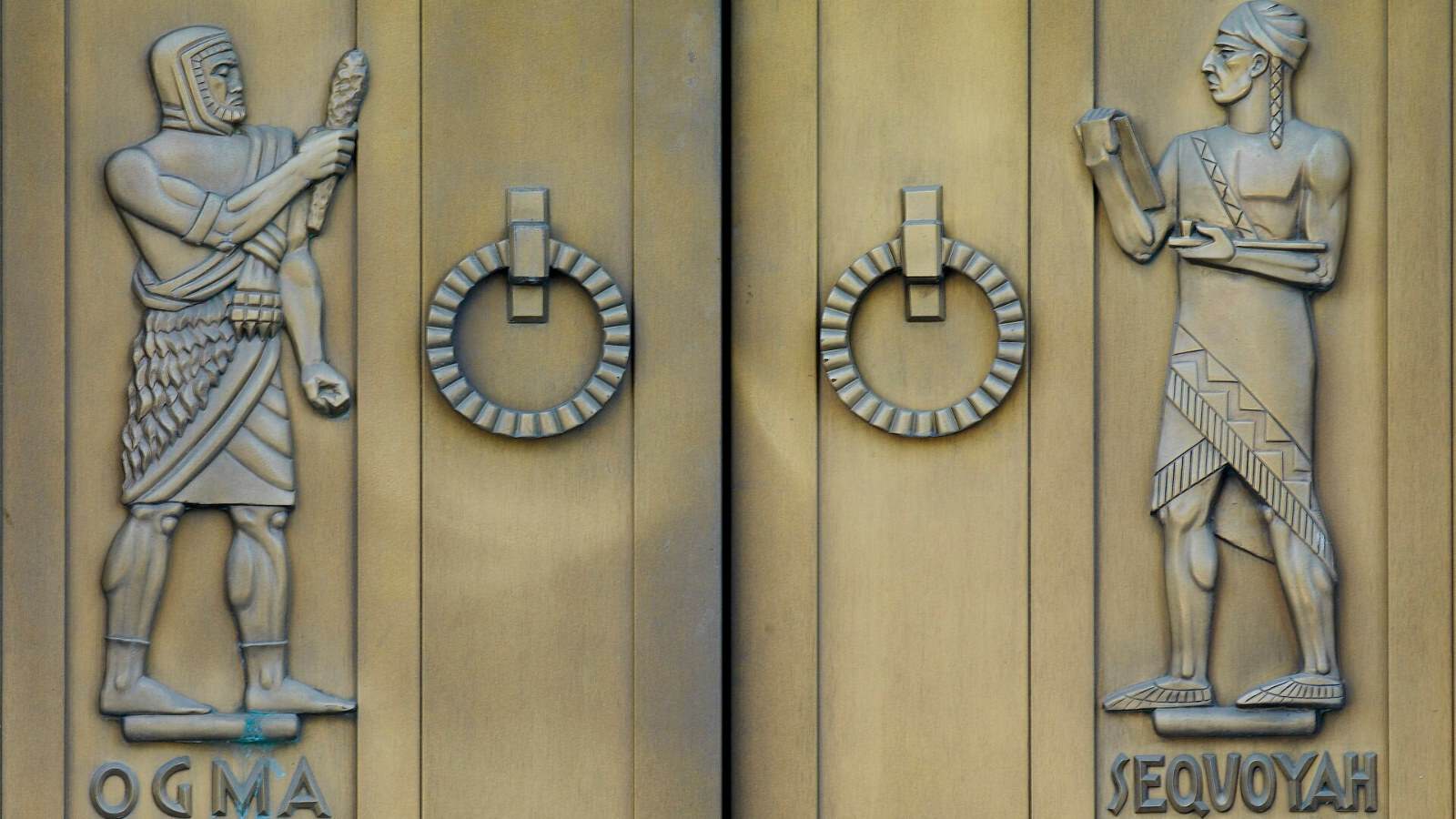
The bronze doors of the John Adams Building at the Library of Congress, designed by sculptor Lee Lawrie, include a figure of Ogma holding a raised club. For anyone exploring the Irish gods, he stands out as a deity who links brute strength with the written word.
Common Questions
Ogma’s two sides can make him confusing. Here are quick answers to common questions.
What Is Ogma the God Of?
Ogma is best described as the champion of the Tuatha Dé Danann and a patron of speech and writing. The saga stresses his strength, while the ogham tract calls him skilled in speech and poetry and credits him with the script.
Is Ogma the Brother of the Dagda?
Yes, in Cath Maige Tuired. The saga calls the Dagda and Ogma “the two brothers,” and the ogham tract names Bres as his brother, too.
How Did Ogma Die?
Both Cath Maige Tuired and Lebor Gabála Érenn say Ogma fell fighting Indech, king of the Fomorians, in the Second Battle of Mag Tuired. Oddly, the saga later shows him joining the pursuit of the Fomorians anyway.
Did Ogma Really Invent Ogham?
The tradition comes from the ogham tract, not from history. The OG(H)AM research says any real link between his name and the word ogam cannot be proven. The stones themselves are part of Ireland’s archaeological record, carved by real people, while the story of their invention belongs to Irish mythology.
Image credit: Ogma and Sequoyah, bronze door figures by Lee Lawrie, Library of Congress John Adams Building, Washington, D.C. Photograph by Carol M. Highsmith, 2007, Library of Congress Prints and Photographs Division (LC-DIG-highsm-02779), public domain, via Wikimedia Commons. Cropped to 16:9.