In Short
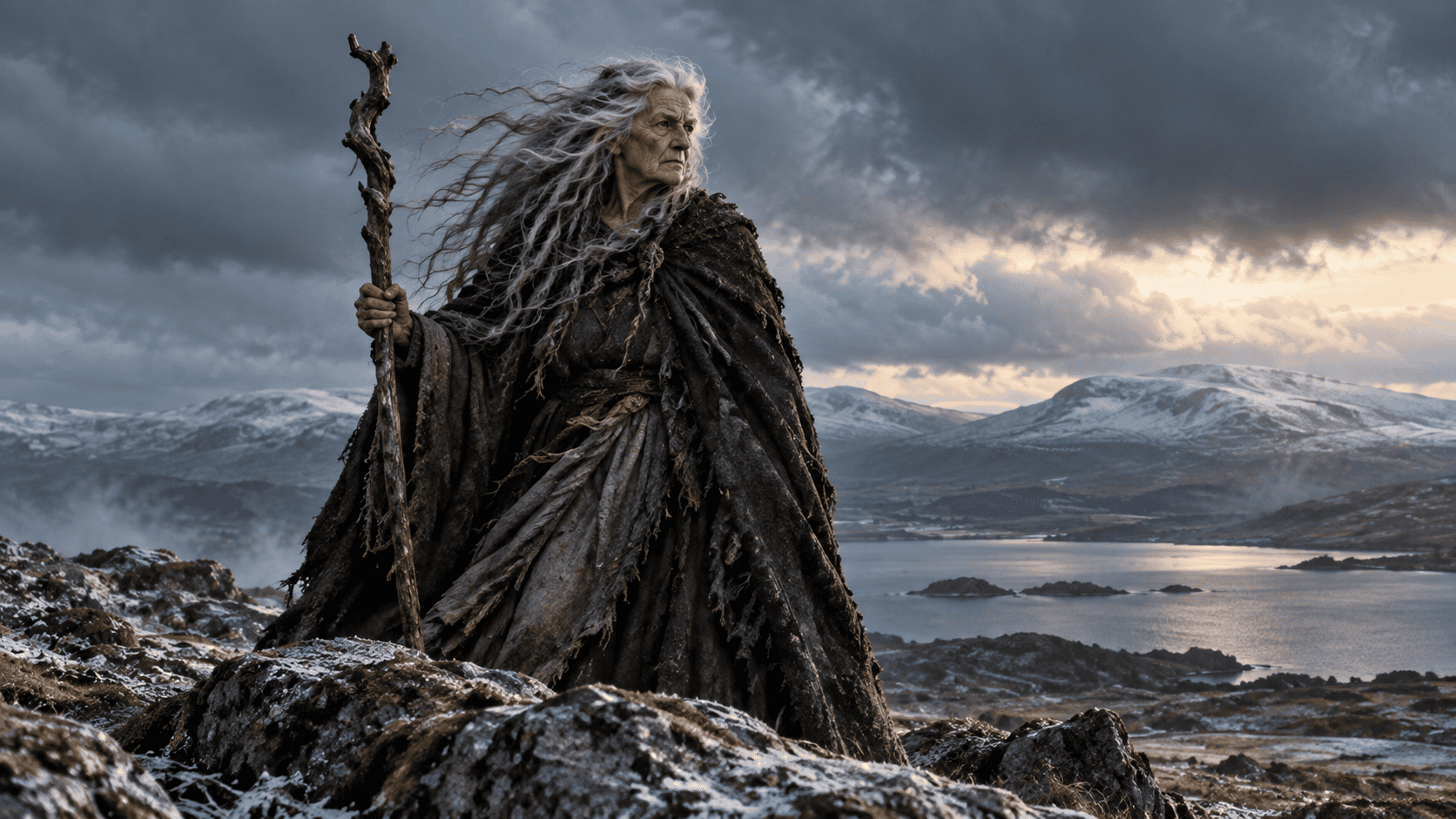
The Cailleach (pronounced KAL-yukh, “old woman” or “hag”) is a divine hag of Irish and Scottish tradition, an ancient giantess linked to winter, storms, and the shaping of the land. In Ireland she is best known as the Cailleach Bhéarra, the Hag of Beara, who lived through seven youths and outlived seven husbands, and whose lament for her lost beauty is one of the great poems of early Irish literature. Folk tradition credits her with building mountains and cairns from stones dropped from her apron, and the rock said to be the Hag herself still looks out to sea on the Beara Peninsula in County Cork.
| Irish name | An Chailleach; Cailleach Bhéarra, the Hag of Beara |
|---|---|
| Pronunciation | KAL-yukh; Cailleach Bhéarra, roughly KAL-yukh VAIR-uh |
| Meaning | “Old woman,” from a word for “veiled one” |
| Associated with | Winter, storms, mountains, cattle, great age |
| Famous poem | “The Lament of the Old Woman of Beare,” about the 9th century |
| Places | The Hag of Beara stone, Kilcatherine; Loughcrew; Hag’s Head, County Clare |
| In Scotland | The Cailleach Bheur, bringer of winter |
| Harvest custom | The last sheaf of the harvest was called “the cailleach” |
Who Is the Cailleach?
On a hillside above Coulagh Bay, on the Beara Peninsula in County Cork, a gray rock sits looking out over the sea. Visitors leave coins, shells, and ribbons on it. Local people will tell you that it is not really a rock at all, but an old woman turned to stone: the Cailleach Bhéarra, the Hag of Beara, waiting out the centuries by the Atlantic.
The Cailleach is one of the oldest and most mysterious figures in Irish and Scottish tradition. She is a divine hag: an enormously old woman, sometimes a giantess, who shapes mountains, drives storms, herds wild cattle, and brings the winter. She is not quite a goddess in the way the Tuatha Dé Danann are, since she appears more in folklore and place names than in the great medieval sagas, but she has the power and the age of one.
What the Name Means
In modern Irish, cailleach simply means “old woman,” and it can also mean “hag” or “witch.” The word goes back to Old Irish caillech, “veiled one,” from caille, “veil,” which in turn was borrowed from the Latin pallium, a cloak. In early Ireland, the veiled women were nuns and widows, and caillech could mean either. Over time, it came to mean any old woman, and then the great supernatural hag of folklore.
Her most common title in Ireland, Cailleach Bhéarra, links her to the Beara Peninsula. The folklorist Gearóid Ó Crualaoich suggested that the name may originally have been connected with a Gaelic word meaning “sharp” or “shrill,” fitting a spirit of winter and wild places.
Seven Youths and Seven Husbands
The oldest written account of the Hag of Beara comes from medieval Irish manuscripts. According to a note that introduces her famous lament, she had fifty foster-children in Beara, and she passed through seven periods of youth, one after another, so that every man who lived with her died of old age, while she grew young again. Her grandsons and great-grandsons, the note says, became whole tribes and peoples.
That detail explains much of her meaning. She outlives kings, husbands, and generations. She is older than any family and the ancestor of many. Some scholars see her as a version of the sovereignty goddess of early Ireland, the divine woman representing the land, who was ritually married to each new king and outlived them all, as the land outlives those who rule it.
The Lament of the Old Woman of Beare
In a poem written in Old Irish around the ninth century, the Hag of Beara speaks for herself. It is one of the most moving poems of early Irish literature. In it, she has grown old and become a nun, and she looks back on a youth spent among kings, drinking mead and wine, and wearing a new smock every day. Now she drinks whey among withered old women, and her arms, which once embraced princes, are bony and thin.
Its most famous image is the tide. An island in the sea, she says, is lucky: the flood tide always returns to it after the ebb. But for her, the ebb has come, and no flood will follow. The poem was probably written by a monk, and it turns the ageless goddess into a very human old woman facing the end of her life, but her grief for her lost youth is still recognizable more than a thousand years later.
The Hag of Beara Stone
The rock above Coulagh Bay, near the old church site of Kilcatherine, is said to be the Cailleach herself. In one local legend, the Hag lived on into Christian times and stole the prayer book of a saint, Caithighearn, while he slept. The saint woke, chased her, caught her, and turned her to stone, where she remains to this day. Others say she sits there looking out to sea, waiting for her husband, the sea god Manannán mac Lir, to return. People still leave offerings on the rock.
The Shaper of the Land
Folk tradition across Ireland credits the Cailleach with shaping the landscape. She was said to carry stones in her apron as she strode across the country, and wherever she dropped them, they became mountains, islands, and cairns. The best-known example is Loughcrew, in County Meath, whose hills are called Sliabh na Caillí, “the Hag’s Mountain.” Their ancient passage tombs and cairns were said to have been formed from stones that fell from her apron as she leapt from hill to hill, and a great stone at one of the cairns is still known as the Hag’s Chair.
Many other places carry her name. Hag’s Head, Ceann Caillí, is the southern tip of the Cliffs of Moher in County Clare, where the rock is said to resemble her face gazing out to sea. In County Sligo, it was told that she could wade across Lough Arrow and the water would reach only to her armpits.
The Cailleach and Fionn mac Cumhaill
A well-known legend links the Cailleach to Fionn mac Cumhaill. On Slieve Gullion, in County Armagh, there is a small lake on the summit. According to the story, the Cailleach Bhéarra tricked Fionn into diving into it to fetch a ring she claimed to have dropped. When he came out, he had become a withered old man with snow-white hair. The Fianna forced her to restore his youth, but his hair stayed white for the rest of his life. It was said that anyone who bathed in the lake would turn gray.
The Queen of Winter in Scotland
In Scotland, the Cailleach Bheur was the spirit of winter itself. She was said to rule the season from Samhain, at the start of November, until Bealtaine, at the start of May, bringing storms and snow with her staff. According to one tradition, she marked the beginning of winter by washing her great plaid in the whirlpool of Corryvreckan, between the islands of Jura and Scarba, until it was white, and then spreading it over the land as snow.
In 1917, the Scottish writer Donald Mackenzie retold her stories as the tale of Beira, Queen of Winter, who keeps the young Bride prisoner until the spring sets her free. Mackenzie’s version is much loved and widely repeated, but it is a literary retelling, and the idea that the Cailleach and Brigid are two faces of one goddess is largely a modern one.
The Cailleach and Imbolc
A popular weather belief connects the Cailleach with Imbolc, at the start of February. On that day, it is said, she goes out to gather firewood for the rest of the winter. If she wants winter to last a long time, she makes the day bright and sunny so that she can gather plenty. If the day is wet and stormy, she is asleep, and she will soon run out of fuel, so winter is almost over. The logic makes the belief easy to remember: a fine Imbolc means a long winter, and a foul one means an early spring.
The Last Sheaf
In parts of Ireland and Scotland, the last sheaf of corn cut at harvest was called “the cailleach.” Farmers raced to finish their harvest before their neighbors, because whoever finished last had to take in the cailleach and keep her through the winter, which was thought to bring bad luck, or at least the neighbors’ jokes. The custom reflects the old idea of the Cailleach as the spirit of the dying year, arriving just as the fields are bare.
Is the Cailleach Good or Evil?
Neither, in the simple sense. She is harsh, like winter, and frightening, like the storms and wild places she ruled. Parents in County Sligo would threaten to tell the Cailleach Bhéarra about naughty children. But she is also a creator, the shaper of the hills and the mother of whole peoples, and her lament shows her as deeply human. She is best understood as the spirit of age and endurance: the old woman who was there before everyone else, and will still be there afterward.
Sources and Further Reading
- Gearóid Ó Crualaoich, The Book of the Cailleach: Stories of the Wise-Woman Healer, Cork University Press (2003).
- Kuno Meyer, trans., “The Lament of the Old Woman of Beare,” in Otia Merseiana 1 (1899).
- Gerard Murphy, ed. and trans., Early Irish Lyrics, Clarendon Press (1956).
- Donald A. Mackenzie, Wonder Tales from Scottish Myth and Legend, Blackie and Son (1917).
- Dáithí Ó hÓgáin, Myth, Legend and Romance: An Encyclopaedia of the Irish Folk Tradition, Ryan Publishing (1990).