In Short
Manannán mac Lir (pronounced MAN-uh-nawn mac LEER, “Manannán, son of the sea”) is the sea god of Irish mythology and the lord of the Otherworld islands across the western ocean. He rides over the waves in a chariot, sails a boat that needs no oar or sail, and wraps himself and his land in a cloak of mist. He is a shapeshifter, a trickster, and a guide who brings mortals into the Otherworld and gives them magical gifts. He is also the patron god of the Isle of Man, whose name his own may share, where he was remembered as the island’s first ruler.
| Name | Manannán mac Lir, “son of the sea” |
|---|---|
| Pronunciation | MAN-uh-nawn mac LEER |
| God of | The sea, mist, and the Otherworld |
| Realm | Emain Ablach and Tír Tairngire, islands across the sea |
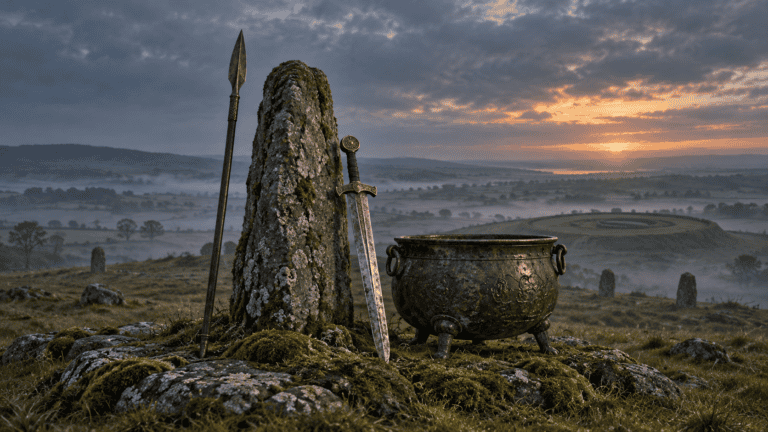
| Treasures | The boat Scuabtuinne, the horse Énbarr, the sword Fragarach, a cloak of mist, the crane bag |
| Wife | Fand |
| Son | Mongán, a legendary king of Ulster |
| Foster-son | Lugh, in some versions |
| Island | The Isle of Man, which he was said to have ruled |
| Key tales | Immram Brain; Echtrae Cormaic; Serglige Con Culainn |
Who Is Manannán mac Lir?
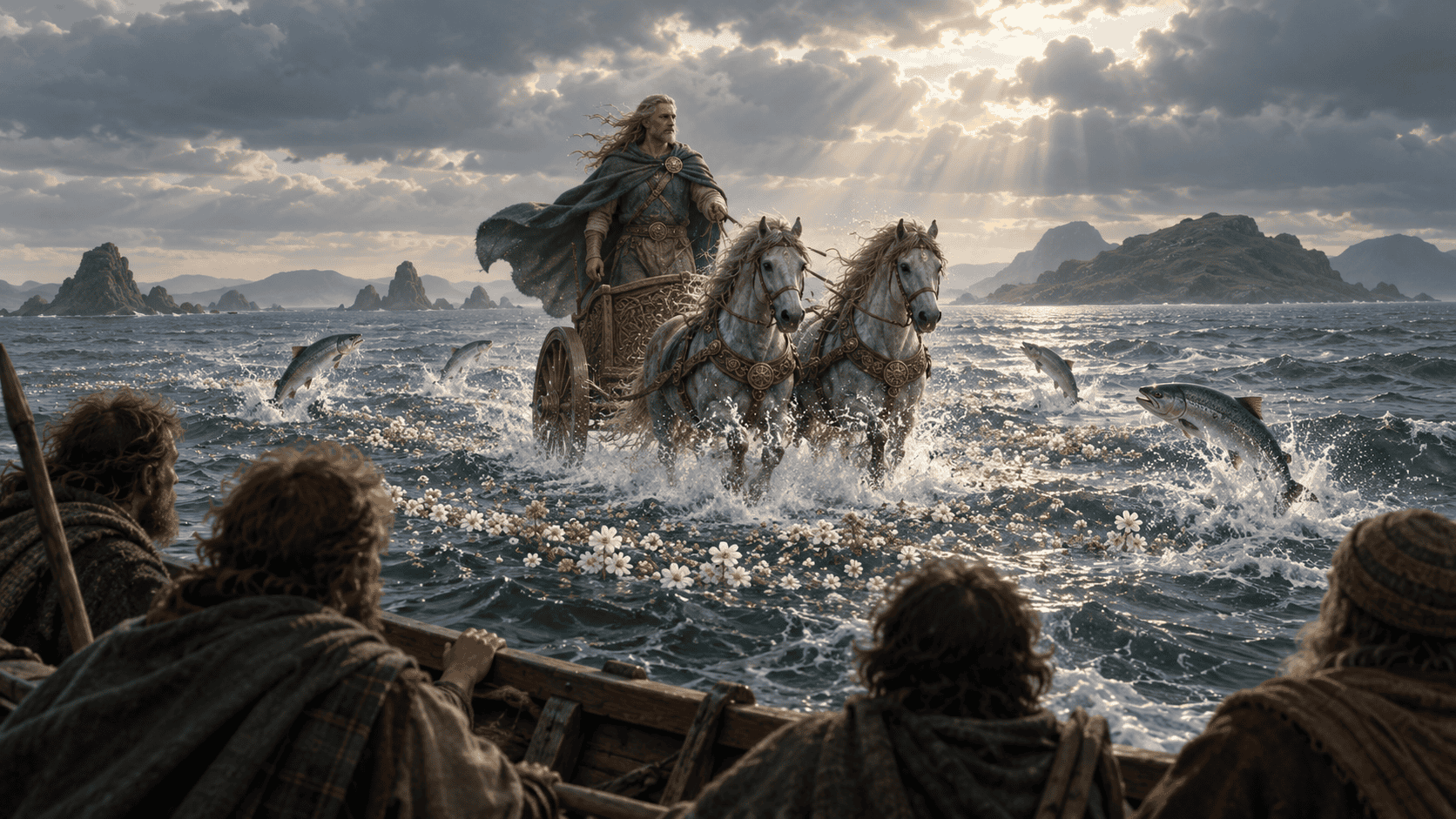
A boat is crossing the open sea when the sailors see a man driving a chariot over the waves toward them, as if the water were solid ground. He greets them and tells them that what they see as the sea is, to him, a flowering plain, and that the leaping salmon are his calves and lambs. He is the lord of that sea, and he knows where they are going before they do.
That is Manannán mac Lir, the sea god of the Irish, as he appears in one of the oldest Irish tales. He is the ruler of the ocean and of the Otherworld islands that lie across it, a master of illusion and mist, and a figure who moves easily between the world of the gods and the world of mortals. Of all the Irish gods, he is the one most often found helping, testing, or tricking human beings.
What His Name Means
Mac Lir means “son of Ler,” and ler is an old Irish word for the sea, so the name is usually understood as “son of the sea.” Whether Ler was ever thought of as a separate god, the father of Manannán, is uncertain. The Lir of the famous Children of Lir story is a lord of the Tuatha Dé, and it is not clear that he was meant to be the same figure.
The name Manannán is often connected with the Isle of Man, whose Irish name is Manainn, so that Manannán would be “the one of Man.” Scholars debate which came first, the god or the island’s name, but the link between them is very old.
The Lord of the Otherworld Islands
Manannán rules over the Otherworld across the sea. His realm is called Emain Ablach, “Emain of the Apples,” and Tír Tairngire, “the Land of Promise.” It is a place of endless feasting, music, and youth, where apple trees are always in fruit, and where Manannán’s own pigs are killed and eaten each night and are alive again in the morning. Many of the Irish tales in which mortals visit the Otherworld, from the voyages of Bran to the adventures of Cormac, bring them into his kingdom.
The Voyage of Bran
The scene of the chariot on the waves comes from Immram Brain, “The Voyage of Bran,” a tale first written down in the seventh or eighth century. Bran and his companions have set out across the sea for the Otherworld when they meet Manannán driving toward Ireland. In a long poem, he describes his sea as a plain full of flowers, and the leaping salmon as calves and lambs. He also foretells that he will soon father a son in Ireland, a hero named Mongán, who will be born to the wife of an Ulster king.
The story of Mongán, Manannán’s son, was a favorite of medieval Irish writers. Mongán was said to have the gift of shapeshifting and knowledge of all things, like his father, and some stories claimed he was a rebirth of Fionn mac Cumhaill.
Cormac and the Cup of Truth
In Echtrae Cormaic, “The Adventure of Cormac,” Manannán appears to the High King Cormac mac Airt as a stranger carrying a silver branch hung with golden apples, which makes beautiful music that soothes the sick and the wounded to sleep. Cormac longs for it, and the stranger agrees to give it to him in exchange for three wishes. Then he takes, one by one, Cormac’s daughter, his son, and his wife.
Cormac follows them, and after crossing a great mist, he finds himself in the Otherworld, in the hall of Manannán, who reveals himself and returns his family. He also gives Cormac a golden cup that breaks into three pieces if three lies are spoken over it, and becomes whole again if three truths are spoken. It was used to judge truth from falsehood, and when Cormac died, the story says, the cup vanished with him. The tale shows Manannán as a tester of mortals, whose gifts come with lessons.
Fand and Cú Chulainn
Manannán’s wife was Fand, a beautiful woman of the Otherworld. In Serglige Con Culainn, “The Wasting Sickness of Cú Chulainn,” Manannán had left her, and she fell in love with the Ulster hero Cú Chulainn, who spent a month with her in the Otherworld and promised to meet her again. When Cú Chulainn’s wife, Emer, found out, she came with fifty women armed with knives to kill Fand. The two women confronted each other, and each was moved by the other’s love for Cú Chulainn.
Then Manannán came back for Fand, and she chose to go with him. As she left, Manannán shook his cloak between Fand and Cú Chulainn, so that they would never meet again. Cú Chulainn fell into a deep grief, and the druids gave him and Emer a drink of forgetfulness, so that he would forget Fand and Emer would forget her jealousy. It is one of the most human of all the Otherworld stories, and it shows the power of Manannán’s cloak to part lovers forever.
Manannán’s Treasures
Manannán owned some of the most famous magical treasures in Irish mythology. Each one reflects his power over the sea, travel, and concealment.
- Scuabtuinne, “the Wave-Sweeper,” a boat that needed no oars or sails and went wherever its owner wished.
- Énbarr, “Splendid Mane,” a horse that could gallop over the sea as easily as over land.
- Fragarach, “the Answerer,” a sword that could cut through any armor.
- His cloak, which could make its wearer invisible and could separate people forever, as it did Fand and Cú Chulainn.
- The crane bag, a bag made from the skin of a crane that had once been a woman, holding many treasures, and later passed to Fionn mac Cumhaill.
In Oidheadh Chlainne Tuireann, “The Fate of the Children of Tuireann,” the young god Lugh arrives from the Land of Promise riding Énbarr and carrying Fragarach, gifts from Manannán, who in some versions is his foster-father.
Protector of the Tuatha Dé Danann
When the sons of Míl conquered Ireland and the Tuatha Dé Danann withdrew into the fairy mounds, Manannán was said to have helped them survive. According to a medieval tale, he gave them three gifts: the féth fíada, a magical mist or veil that made them invisible to mortals; the Feast of Goibniu, which kept them from aging; and Manannán’s pigs, which provided endless food. In a sense, Manannán gave the old gods the powers that later folklore would give the fairies: invisibility, immortality, and a hidden world of plenty.
Manannán and the Isle of Man
The Isle of Man, in the Irish Sea between Ireland and Britain, claims Manannán as its own. In Manx tradition, he was the island’s first ruler, and he protected it by wrapping it in mist whenever enemies approached, so that they sailed past without ever finding it. According to Manx tradition, recorded in the nineteenth century, the islanders paid him rent each year by carrying bundles of green rushes to the hilltops at Midsummer.
A sixteenth-century Manx ballad also calls him the island’s first king, and the Manx still honor him today. His name appears in place names, songs, and modern festivals on the island, where he is regarded as a kind of guardian spirit.
Manannán the Trickster
In later folklore, Manannán often appears in disguise as a trickster: a clown, a juggler, or a ragged old man, who arrives at a king’s court, plays pranks, reveals hidden truths, and vanishes. These stories show the same qualities as the older tales: his love of illusion, his delight in testing people, and his habit of turning up where he is least expected.
Manannán Today
Manannán is still remembered along the coasts of Ireland, especially around Lough Foyle, between County Derry and County Donegal, where he was said to be associated with the lough’s entrance. Local people say “Manannán is angry today” when the sea is rough, and call the white-capped waves Manannán’s sea horses.
A statue of Manannán by the sculptor John Sutton was erected on Binevenagh Mountain in County Derry, looking out over Lough Foyle, as part of a local myths and legends trail. In January 2015, it was cut from its base and stolen, and in its place, the thieves left a wooden cross bearing the words “You shall have no other gods before me.” The theft made headlines around the world. Ramblers found the damaged statue in the forest nearby a month later, and a replacement was installed on the mountain in 2016.
Manannán mac Lir in Popular Culture
Manannán appears in many modern retellings of Irish myth, in fantasy novels and games, and in poetry. James Stephens retold his trickster stories in his 1920 book Irish Fairy Tales. He is also a central figure in modern Manx culture, and his statue on Binevenagh has become a popular stop for visitors on Northern Ireland’s Causeway Coast.
Is Manannán the Father of Niamh?
Many modern retellings of the story of Oisín and Tír na nÓg make Niamh of the Golden Hair the daughter of Manannán mac Lir. It is a natural idea, since he rules the Otherworld across the sea. But the eighteenth-century poem that gave the story its familiar form presents her father simply as the king of the Land of Youth, without naming him as Manannán.
Sources and Further Reading
- Kuno Meyer, ed. and trans., The Voyage of Bran Son of Febal to the Land of the Living, David Nutt (1895).
- Tom Peete Cross and Clark Harris Slover, eds., Ancient Irish Tales, Henry Holt (1936).
- Myles Dillon, ed., Serglige Con Culainn, Dublin Institute for Advanced Studies (1953).
- Charles W. MacQuarrie, The Biography of the Irish God of the Sea from The Voyage of Bran (700 A.D.) to Finnegans Wake (1939): The Waves of Manannán, Edwin Mellen Press (2004).
- Dáithí Ó hÓgáin, Myth, Legend and Romance: An Encyclopaedia of the Irish Folk Tradition, Ryan Publishing (1990).