In Short
The Cycle of the Kings, also called the Historical Cycle, is the group of medieval Irish tales about legendary and semi-historical kings, from prehistoric rulers such as Conaire Mór, pronounced KUN-ur-eh MORE, to historical ones such as Diarmait mac Cerbaill and Brian Bórú. Court poets and monastic scholars gave many of them written form between about the seventh and twelfth centuries, though exact dates are often uncertain and several tales were reworked over time. They survive mainly in manuscripts from about 1100 onward, some copied centuries later. Often set around Tara, the tales explore what makes a rightful king: just judgment, a symbolic marriage to the sovereignty of the land, and personal taboos that must not be broken.
| Also called | The Historical Cycle, the Kings’ Cycles |
|---|---|
| Subject | Legendary and semi-historical Irish kings |
| Time span of tales | Legendary prehistory to AD 1014 |
| Composed and copied | Many texts took shape c. 7th to 12th centuries; surviving copies are often later |
| Main setting | Tara, with Connacht, Munster, and Ulster |
| Key figures | Conaire Mór, Conn, Art, Cormac mac Airt, Niall, Suibhne |
| Core idea | Fír flathemon, “the ruler’s truth” |
| Key manuscripts | Lebor na hUidre, Book of Leinster, Yellow Book of Lecan |
| Landmark study | Myles Dillon, The Cycles of the Kings (1946) |
What Is the Cycle of the Kings?
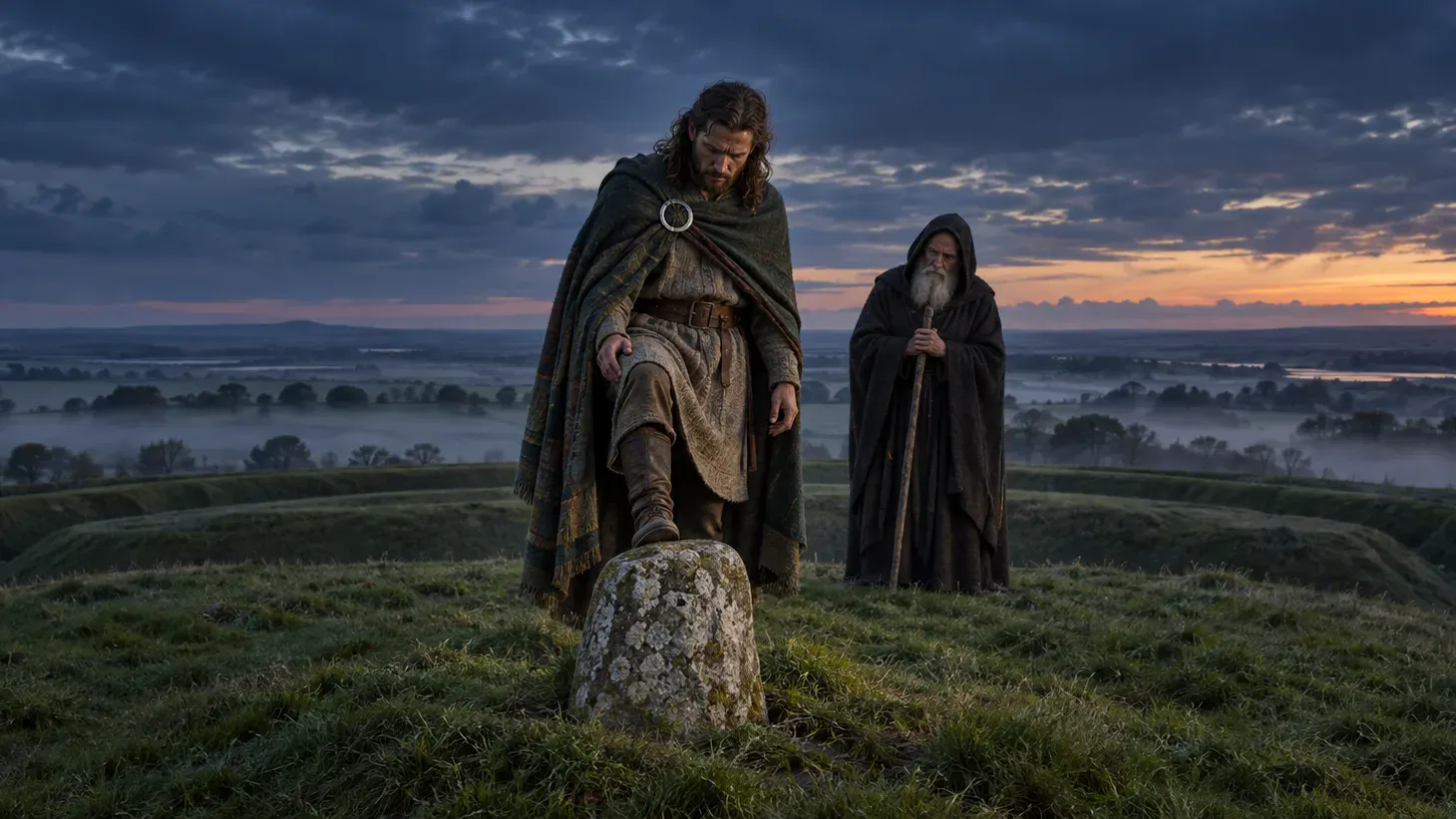
A king walks the ramparts of Tara and steps on a stone that screams beneath his feet. His druid counts the cries and tells him that each one stands for a king of his line yet to come. That is how Baile in Scáil opens, and it captures the Cycle of the Kings in a single scene: a story about the past, told to explain who had the right to rule.
The Cycle of the Kings is the body of Old and Middle Irish tales centered on Ireland’s kings, from almost wholly fictional rulers of the distant past to men whose deaths the annals record. It includes dynastic origin stories, battle tales, Otherworld adventures, and wisdom texts. It has no single hero at its center; its unifying subject is kingship itself.
Modern scholars sort early Irish saga into four groups: the Mythological, Ulster, and Fenian Cycles, and this one. The arrangement is a modern convenience; medieval tale lists sorted stories by type instead, under headings such as destructions, battles, and adventures. Myles Dillon’s 1946 book, The Cycles of the Kings, became the standard modern introduction to these stories, and the plural in his title is a reminder that the cycle is really several clusters of tales, each gathered around a different king.
Who Wrote These Tales and Why
The tales come from the world of the filid, the learned poets of early Ireland, and the monastic scholars who worked alongside them. A court poet kept the genealogy of the dynasty he served and knew the stories of its ancestors, and those stories were never neutral. A tale in which the goddess of sovereignty promises the kingship to one brother and not another is an argument about which family deserves to rule. That is why so many of these stories favor the Uí Néill, the dynasty descended from Niall of the Nine Hostages, while others argue for Munster’s Eóganachta or the Dál Cais of Brian Bórú.
The texts survive in a handful of great manuscripts. Lebor na hUidre, written at Clonmacnoise before 1106, holds an early copy of Togail Bruidne Dá Derga. The Book of Leinster, compiled around 1160 largely by Áed Ua Crimthainn, abbot of Terryglass, preserves Cath Maige Mucrama and much genealogy. The Yellow Book of Lecan, written mostly between 1391 and 1401, is especially rich in kings’ tales.
Kingship at the Heart of the Cycle
Early Irish kingship was understood in sacral terms: in these texts, a king’s own conduct was bound up with the health of the land. The tales express ideals, not records of how real kings governed, but those ideals shaped how medieval Irish writers judged their rulers. Three ideas run beneath nearly every tale in the cycle.
The Ruler’s Truth: Fír Flathemon
The Old Irish phrase fír flathemon means “the ruler’s truth” or “the justice of the ruler.” Its classic statement is Audacht Morainn (The Testament of Morann), a wisdom text compiled around AD 700 and edited by Fergus Kelly in 1976. In Kelly’s translation, it is through the ruler’s truth that plagues and great lightnings are kept from the people, that milk and corn are abundant, that fish swim in the streams, and that fair children are well begotten.
Why would a just king make crops grow? In this way of thinking, truth was not merely a personal virtue but a kind of cosmic order. A king who judged rightly kept his realm in harmony with that order, and the land answered with plenty. A false judgment broke the harmony, and nature itself recoiled. Under Conaire Mór, oak mast reached men’s knees every autumn and no thunder troubled Ireland. When the usurper Lugaid mac Con gives a false judgment at Tara, a version preserved in the Book of Ballymote has half of the house in which he spoke slide down the hill.
Marrying the Land: The Sovereignty Goddess
The second idea is that kingship was a marriage. The land, or the right to rule it, was imagined as a woman, and the rightful king was the one she accepted. Scholars call her the sovereignty goddess. In Baile in Scáil she pours red ale for Conn; elsewhere she appears as a hag at a well.
Scholars have often linked this literary image to real inauguration rites, pointing to two terms: banais ríghe, “the wedding feast of kingship,” and feis Temro, the Feast of Tara. D. A. Binchy, writing in 1958, interpreted the Feast of Tara as an inauguration in which the king was symbolically united with the goddess of the land. Whether any such ritual actually took place is still debated. The annals enter the last Feast of Tara under 560, held by Diarmait mac Cerbaill, but they say nothing about what happened at it. Máire Herbert’s 1992 essay “Goddess and King” remains a key study of the theme, and recent scholars also warn against reading every powerful woman in the tales as a disguised goddess.
Geasa and the Fall of Kings
The third idea is the geis (plural geasa), a personal taboo. Breaking a geis signals that a king has lost the favor that holds his reign together, and ruin follows. A blemish could also unseat a king: the seventh-century law text Bechbretha says Congal Cáech lost the kingship of Tara after bees blinded him in one eye.
Key Tales of the Cycle of the Kings
The table below gathers the best-known tales and the kings at their center. Settings for the earlier kings are traditional, not historical.
| Irish title | English title | Central king | Traditional setting |
|---|---|---|---|
| Togail Bruidne Dá Derga | The Destruction of Da Derga’s Hostel | Conaire Mór | Legendary, around the 1st century |
| Baile in Scáil | The Phantom’s Frenzy | Conn of the Hundred Battles | Legendary, 2nd century |
| Echtrae Airt meic Cuinn | The Adventure of Art Son of Conn | Conn and Art | Legendary, 2nd century |
| Cath Maige Mucrama | The Battle of Mag Mucrama | Lugaid mac Con, Art | Legendary, 2nd or 3rd century |
| Echtrae Cormaic | Cormac’s Adventure in the Land of Promise | Cormac mac Airt | Legendary, 3rd century |
| Tecosca Cormaic | The Instructions of King Cormac | Cormac mac Airt | Legendary, 3rd century |
| Echtra mac nEchach Muigmedóin | The Adventure of the Sons of Eochaid Mugmedón | Niall of the Nine Hostages | Semi-historical, 5th century |
| Aided Díarmata meic Cerbaill | The Death of Diarmait mac Cerbaill | Diarmait mac Cerbaill | Historical, died 565 |
| Cath Maige Rath | The Battle of Mag Rath | Domnall mac Áedo, Congal Cáech | Historical, AD 637 |
| Buile Shuibhne | The Frenzy of Suibhne | Suibhne of Dál nAraidi | Historical setting, AD 637 |
| Cogad Gáedel re Gallaib | The War of the Irish with the Foreigners | Brian Bórú | Historical, to AD 1014 |
The Great Kings and Their Stories
The cycle runs from kings who belong almost entirely to legend to kings whose battles the annals record, and the sections below follow that order.
Conaire Mór and Da Derga’s Hostel
Togail Bruidne Dá Derga is often ranked among the finest early Irish sagas, and it is the cycle’s great study of sacral kingship. Conaire’s father is a bird-man, Nemglan, who tells him to walk naked to Tara to be made king and then lays geasa on him. Among them, he must allow no plunder in his reign and must not let three red men go before him into the house of Red.
His reign begins in golden plenty, the ruler’s truth made visible. Then he spares his raiding foster brothers from the death they deserve, and after that one partial judgment his geasa fall one after another, until he reaches the hostel of Dá Derga, whose name is usually taken to mean “Red God.” Raiders led by his foster brothers attack, and Conaire, parched with thirst, is beheaded while his champion Mac Cécht scours Ireland for water. Because Ulster heroes such as Conall Cernach fight there, the tale is sometimes grouped with the Ulster Cycle.
Conn of the Hundred Battles and His Son Art
Conn Cétchathach, the ancestor claimed by the Connachta and the Uí Néill, is the king of Baile in Scáil. After the Lia Fáil cries out beneath him, a mist rises, and Conn finds himself in a house beside a golden tree. A crowned woman, the Sovereignty of Ireland, serves him red ale in a golden cup, and the phantom on the throne reveals himself as the god Lug, who names the kings who will follow Conn.
Echtrae Airt meic Cuinn shows the other side of the coin. Conn marries Bé Chuma, a woman banished from the Land of Promise, and at her demand exiles his son Art from Tara. That year Ireland has neither corn nor milk, and the druids blame the new queen: a king’s wrongful marriage blights his whole realm. Only after Art wins an Otherworld bride and drives Bé Chuma out does the land recover. Art later dies fighting Lugaid mac Con at the Battle of Mag Mucrama.
Cormac mac Airt, the Wise King
Cormac mac Airt is the cycle’s ideal king. He wins Tara with a judgment. When a woman’s sheep eat the queen’s woad, Lugaid mac Con rules that the sheep are forfeit, but the young Cormac rules that only their wool is owed, since the woad and the wool will both grow back. The people cry “a true judgment,” and Lugaid’s reign is doomed.
In Echtrae Cormaic, a Middle Irish tale, Cormac follows a stranger with a silver branch into a magic mist and reaches the realm of Manannán mac Lir. There he receives a cup that breaks into three when three lies are spoken over it and becomes whole when three truths are told. The cup is the ruler’s truth made into an object. His wisdom is gathered in Tecosca Cormaic, a ninth-century text in which he answers his son Cairbre’s questions on kingship, edited by Kuno Meyer in 1909.
Niall of the Nine Hostages and the Hag at the Well
Niall Noígíallach is the ancestor from whom the Uí Néill dynasties claimed descent, though Byrne, following James Carney, places his death around 452, decades later than the annals do. Echtra mac nEchach Muigmedóin, possibly an eleventh-century text, tells how Niall and his four half-brothers grow thirsty while hunting. At a well they find a hideous hag who demands a kiss for water. Three brothers refuse, and Fiachrae gives her only the barest kiss. Niall kisses her fully and lies with her, and she becomes the loveliest woman in the world: “I am the Sovereignty of Erin,” she says.
Why did the kiss matter? The kiss is the marriage to sovereignty, and only the man willing to embrace kingship at its ugliest earns its beauty. The woman explains this herself: sovereignty is loathsome at first, won through battle and conflict, and lovely at last to whoever holds it. Fiachrae’s grudging kiss earns his descendants a lesser kingship, a neat explanation of why the Uí Fiachrach ranked below the Uí Néill. The same loathly lady motif later surfaces in Chaucer’s “Wife of Bath’s Tale.”
Lóegaire, Saint Patrick, and the Last Feast of Tara
With Niall’s son Lóegaire, the cycle meets Christianity. Muirchú’s seventh-century life of Patrick has Lóegaire holding a pagan feast at Tara when Patrick lights his Easter fire in defiance of a royal ban. Muirchú has the king profess belief under threat, but Tírechán and later tradition keep him pagan. One tale says he broke an oath sworn by the sun and wind, and those same elements killed him.
Diarmait mac Cerbaill, who died in 565, held the last Feast of Tara recorded in the annals, entered under 560. Later tales have Saint Ruadán curse Tara after a quarrel over a fugitive the saint was sheltering. Diarmait’s death fulfills a prophecy of a threefold death: he is wounded by a spear, his hall is set on fire, and he takes refuge in a vat of ale, where a falling roof beam kills him.
Mag Rath, Mad Sweeney, and Guaire
The Battle of Mag Rath, near modern Moira in County Down, was fought in AD 637, when Domnall mac Áedo, king of Tara, defeated Congal Cáech of the Ulaid and his allies from Scottish Dál Riata. Around this real battle grew a cluster of tales: Fled Dúin na nGéd (The Feast of Dún na nGéd), Cath Maige Rath, and Buile Shuibhne. John O’Donovan edited the first two in 1842, and J. G. O’Keeffe edited the third in 1913.
Buile Shuibhne tells of Suibhne, king of Dál nAraidi, who is cursed by Saint Rónán Finn and driven mad by the din of the battle. He lives in the treetops like a bird, composing poems on cold and the beauty of the woods, until he is killed at Saint Moling’s monastery at St Mullin’s, County Carlow. The tale reached its present form in the twelfth century or later, and its surviving manuscripts date from the seventeenth and eighteenth centuries.
Guaire Aidne, king of Connacht, who died in 663, became the cycle’s emblem of generosity. An Old Irish poem, translated by Kuno Meyer in 1901 as “King and Hermit,” imagines a dialogue between Guaire and his brother Marbán, a hermit who prefers his woodland hut to any royal hall.
Brian Bórú in Later Tradition
Brian Bórú, killed at the Battle of Clontarf on Good Friday 1014, is fully historical; an inscription in the Book of Armagh calls him imperator Scotorum, “emperor of the Irish.” His legend owes most to Cogad Gáedel re Gallaib, written probably between 1103 and 1111, during the reign of his great-grandson Muirchertach Ua Briain. It casts Brian as Ireland’s savior from the Vikings, a picture historians treat with caution, because the text was written to support the Ua Briain claim to the high kingship.
Myth, Annals, and King Lists
The Cycle of the Kings stands beside other records of the past: the annals, the king lists, and the genealogies. The same kings appear in all of them, and medieval scholars drew no hard line between saga and history. The Annals of the Four Masters give legendary kings such as Conaire Mór precise reign dates, which modern historians regard as later constructions.
Modern scholarship separates the threads. Francis John Byrne’s Irish Kings and High-Kings, first published in 1973, showed how the idea of a high king ruling all Ireland was shaped largely by Uí Néill political claims. The real power of the kings of Tara varied greatly from one ruler to the next, and a claim to supremacy rarely meant control over every Irish kingdom. Scholars therefore read these tales as literature and political argument, revealing more about the centuries that wrote them than about the reigns they describe.
Later Influence of the Kings’ Tales
The cycle’s strongest mark on modern literature comes through Suibhne. Flann O’Brien made Sweeney a character in his comic novel At Swim-Two-Birds (1939), and Seamus Heaney’s translation, Sweeney Astray, published by Field Day in 1983, brought the tale to a wide audience.
Common Questions
These are the questions readers most often ask about this cycle.
Why Is It Called the Historical Cycle?
Its tales are attached to kings believed to be real, who appear in the annals and king lists, and some of them genuinely were. The name reflects the subject matter, not the accuracy of the stories.
Is the Cycle of the Kings Real History?
No, though it contains history. Later kings such as Diarmait mac Cerbaill and Brian Bórú were real men, but poets with political aims shaped their stories. Earlier kings such as Conaire Mór belong almost entirely to legend.
Sources and Further Reading
- Myles Dillon, The Cycles of the Kings, Oxford University Press (1946).
- Francis John Byrne, Irish Kings and High-Kings, 3rd ed., Four Courts Press (2001; first published 1973).
- Fergus Kelly, ed. and trans., Audacht Morainn, Dublin Institute for Advanced Studies (1976).
- Kevin Murray, ed. and trans., Baile in Scáil: The Phantom’s Frenzy, Irish Texts Society 58 (2004).
- Ralph O’Connor, The Destruction of Da Derga’s Hostel: Kingship and Narrative Artistry in a Mediaeval Irish Saga, Oxford University Press (2013).
- J. G. O’Keeffe, ed. and trans., Buile Suibhne (The Frenzy of Suibhne), Irish Texts Society 12 (1913).
- D. A. Binchy, “The Fair of Tailtiu and the Feast of Tara,” Ériu 18 (1958).
- Máire Herbert, “Goddess and King: The Sacred Marriage in Early Ireland,” in Women and Sovereignty, ed. Louise Olga Fradenburg, Edinburgh University Press (1992).
- Bart Jaski, Early Irish Kingship and Succession, Four Courts Press (2000).
- Kuno Meyer, ed. and trans., Tecosca Cormaic: The Instructions of King Cormac mac Airt, Royal Irish Academy, Todd Lecture Series 15 (1909).