In Short
The triskele, pronounced TRIS-keel, is a design of three spirals or three bent limbs radiating from a common center. Ireland’s most famous example is the triple spiral carved inside the passage tomb at Newgrange, County Meath, around 3200 BC, more than two thousand years before La Tène art reached the island. Nobody knows what the Neolithic builders meant by it. Popular readings such as life, death, and rebirth, or maiden, mother, and crone, are modern interpretations, while its use as a sign of the Christian Trinity belongs to later centuries.
| Also called | Triple spiral, triskelion, tri-spiral |
|---|---|
| Word origin | Greek triskelēs, “three-legged” |
| Best-known Irish example | Orthostat C10, Newgrange chamber |
| Size of C10 carving | About 30 by 28 cm |
| Date of Newgrange | About 3200 BC |
| Later Irish uses | La Tène metalwork, Book of Durrow, Book of Kells |
| Original meaning | Unknown |
Three Spirals in the Dark
Walk to the end of the stone passage at Newgrange, into the recess at the back of the chamber, and you will find it on the right-hand wall: three joined spirals cut into an upright slab, roughly 30 by 28 centimeters. For more than five thousand years it sat in near-total darkness. Today it is among the most reproduced pieces of prehistoric art in Ireland.
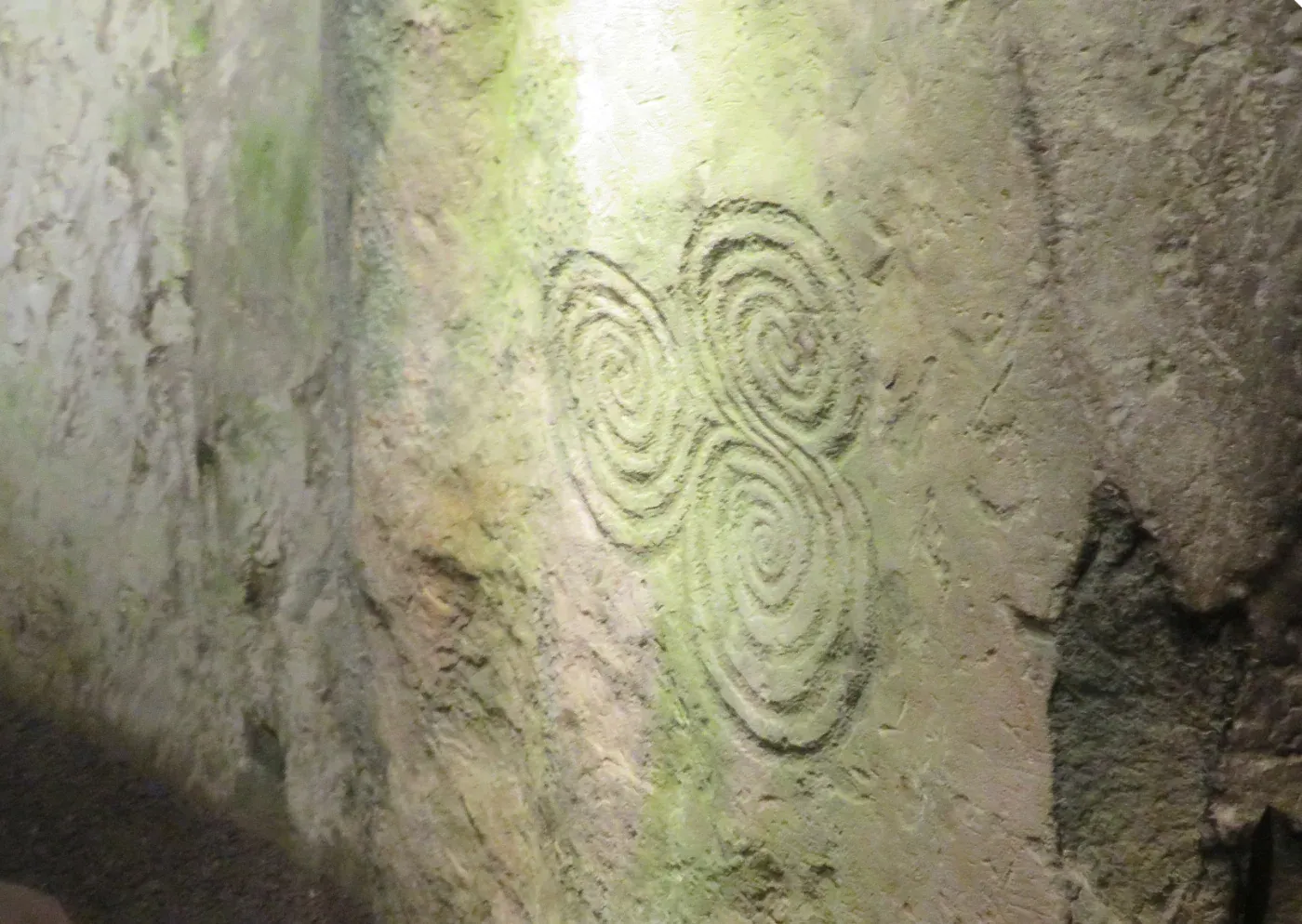
That fame has produced a great deal of confident explanation, much of it guesswork. Here is what the triskele is, where it appears in Irish art, and which of its meanings are documented and which are modern.
Triskele, Triskelion, or Triple Spiral?
The three names overlap, but they are not perfect synonyms, and the difference matters when reading museum labels.
Both triskele and triskelion come from the Greek adjective triskelēs, meaning “three-legged,” built from tri- (three) and skelos (leg). The Greeks did not use the word as a name for a symbol. Nineteenth-century antiquarians and coin collectors borrowed it as a label for the three-legged emblem on ancient coins, and from there it spread to every three-armed design.
In practice, “triskelion” usually means the version with three human legs, as on the Manx flag, while “triple spiral” describes the curving Newgrange form. “Triskele” is the umbrella term for both. Archaeologists often prefer the neutral “tri-spiral” for the Newgrange carving, to avoid importing later meanings into a Stone Age design.
The Triple Spiral at Newgrange
Newgrange is a passage tomb in the Brú na Bóinne complex, in the bend of the River Boyne. It was built around 3200 BC, older than the Great Pyramid of Giza. Michael J. O’Kelly excavated it from 1962 to 1975. Much confusion online comes from mixing up two different carved stones.
The Entrance Stone
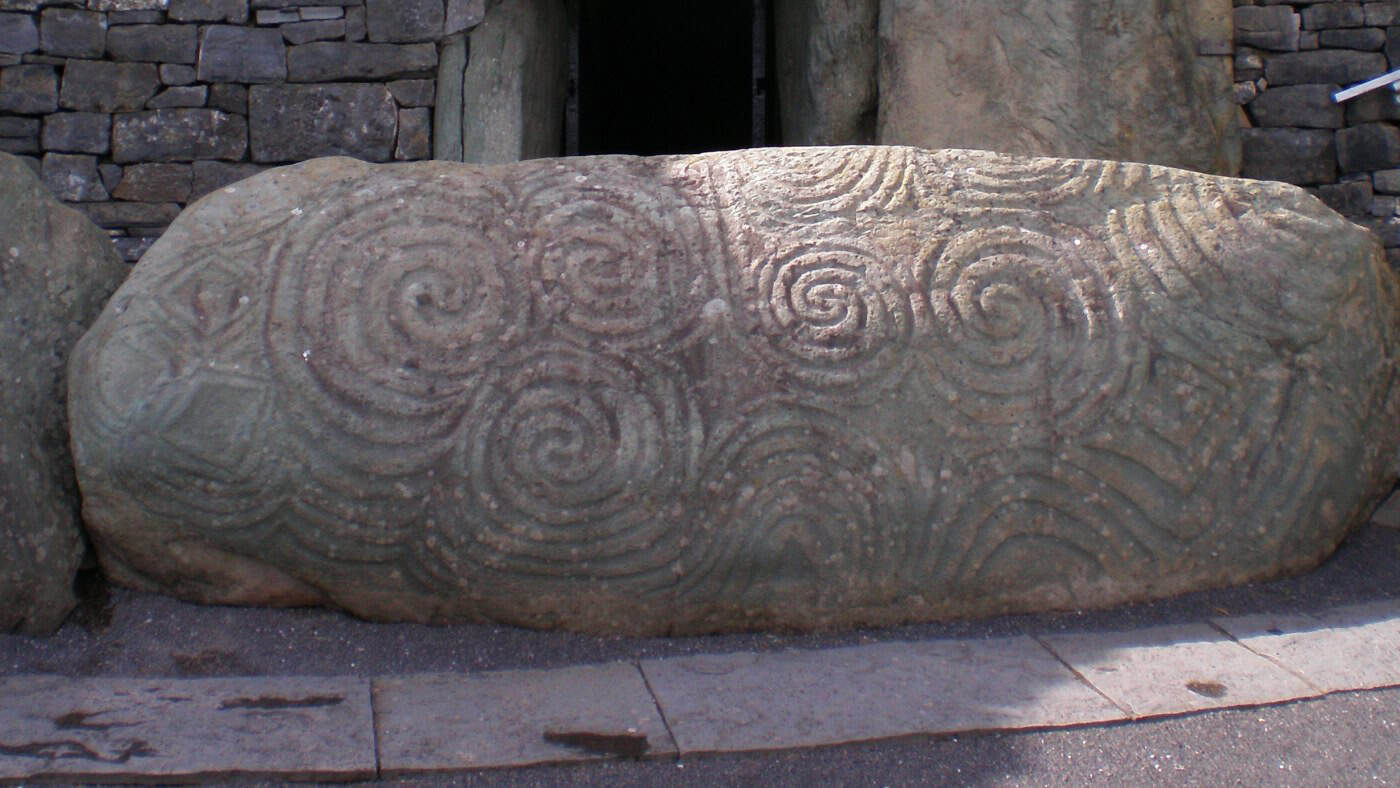
The stone most people photograph is kerbstone K1, the great entrance stone that lies across the front of the passage. It is about 3 meters long, weighs around five metric tons, and is covered in deeply cut spirals, lozenges, and arcs. Some descriptions call one group of its linked spirals a triple spiral, but the arrangement differs from the classic motif. The entrance stone is a composition of many spirals, not the famous emblem itself.
Orthostat C10 in the Chamber
The true triple spiral, the one copied onto jewelry and logos, is carved on orthostat C10. This is the upright stone on the right-hand side of the end recess, deep inside the chamber.
Sources disagree on whether the winter solstice sunbeam entering through the roof-box reaches C10 itself. What is certain is that the carving sits in the end recess, the part of the chamber the sunlight is aimed at.
What Did the Neolithic Builders Mean?
The honest answer is that we do not know. The people who built Newgrange left no writing, and the carvings are separated from the earliest Irish texts by roughly four thousand years. Any meaning assigned to C10 is an interpretation, not a recovered fact.
Scholars have offered hypotheses. Some link spirals to the sun’s yearly movement or to calendar counting; others compare megalithic patterns to images seen in trance states. None can be proven.
One point is firm. The Newgrange spirals predate the arrival of La Tène art in Ireland by well over two thousand years. Calling the C10 carving “Celtic” is therefore a mistake of chronology, even though later Irish artists made the triskele their own.
The Triskele in Iron Age and Early Christian Art
The motif returns in a different form in the Iron Age, when the La Tène style, named after a site in Switzerland, reached Ireland in the last centuries BC.
La Tène Metalwork
La Tène craftsmen loved swelling curves, trumpet shapes, and pinwheel patterns turning around a center, and triskeles were among the designs this style brought to Ireland. The Petrie Crown, a bronze ornament usually dated to around the first century AD and now in the National Museum of Ireland, shows the spiral and trumpet curves from which such patterns are built. These are not copies of Newgrange: the La Tène triskele grew from a separate European tradition.
Manuscripts and Church Treasures
The motif then passed into early Christian art. The Book of Durrow, made around 700 and now in Trinity College Dublin, includes triskeles among the spirals in its carpet pages and around its evangelist portraits. One full carpet page, folio 3v, is filled with trumpet spirals. The Book of Kells, made around 800, carries this ornament further, packing its spiral roundels with tiny interlocking spirals. Similar work appears on contemporary metalwork, including the enameled mounts of hanging bowls.
Many modern writers say early Irish Christians used the triskele for the Trinity. That is plausible, but the manuscripts never label it so. It is better understood as inherited ornament that a Christian viewer could read as Trinitarian.
The Three Legs of Man and Sicily
The three-legged triskelion shows three human legs bent at the knee, running around a center. It has nothing to do with Newgrange, though the two are often confused.
On the Isle of Man, the three legs appear in a European roll of arms of about 1280, and heraldic research places the device with Man from about 1270. The earliest surviving example on the island is a fourteenth-century carving on a cross at Kirk Maughold. The motto Quocunque Jeceris Stabit, usually translated “whichever way you throw it, it will stand,” first appeared on a Manx coin in 1668, and the Manx flag was formally adopted in 1932.
Sicily’s version, the trinacria, places a Gorgon’s head, usually identified as Medusa, at the center, often with wheat ears. It appears on coins of Syracuse in the fourth century BC and was adopted on the official regional flag of Sicily in 2000. The name likely refers to the island’s three headlands. The old theory that Man borrowed its arms from Sicily rests on thin evidence.
Meanings: Documented Versus Modern
What the triskele “means” depends on which triskele and which century. It helps to separate the meanings into layers.
- Documented heraldic emblems: the Manx and Sicilian three legs, standing for those places.
- Plausible Christian reading: the Holy Trinity, in a culture that valued threefold forms, though not labeled as such in early sources.
- Modern spiritual readings: life, death, and rebirth; past, present, and future; mind, body, and spirit; land, sea, and sky.
- Modern neopagan reading: the maiden, mother, and crone of the Triple Goddess, a framework popularized by Robert Graves in The White Goddess (1948) and later Wicca, with no ancient Irish source.
None of the readings in the last two groups can be traced to Newgrange or to early Irish texts. They are real meanings for people today, but they are not ancient Irish belief.
Triple Motifs in Irish Tradition
Early Irish literature loves threes, which makes it tempting to tie the triskele to Irish goddesses. That connection is drawn by modern writers, not medieval texts.
The Morrígan is often grouped with Badb and Macha, and sometimes with Nemain or Anand, as a set of sisters or as aspects of one war goddess. Brigid offers an even clearer triad: the ninth-century Sanas Cormaic, or Cormac’s Glossary, describes Brigit as a goddess worshipped by poets and says her sisters were Brigit the woman of healing and Brigit the woman of smithcraft. The medieval Triads of Ireland likewise arrange wisdom in threes.
No early source, however, links any of these figures to a spiral symbol. Saying the Newgrange triskele “represents” Brigid or the Morrígan pairs two unrelated things that both come in threes. Some modern pagans use the symbol this way, but it is not evidence of ancient belief.
The Triskele in Modern Use
The triple spiral is now one of the most familiar symbols of Irish heritage, and its modern uses are wide.
Jewelers sell Newgrange spirals in silver and gold, and the design is a common tattoo, often chosen to mark three people, three life stages, or Irish ancestry. In Ireland, the Irish Hospice Foundation’s Hospice Friendly Hospitals program uses a spiral emblem, inspired by ancient Irish art, to mark end-of-life care in hospitals, where it stands for the cycle of birth, life, and death. Beyond Ireland, a triskele is the logo of the United States Department of Transportation, and the Breton triskell is a popular badge of identity in Brittany.
One caution: a few white-supremacist groups use angular three-armed designs, so anyone choosing a tattoo or logo is better served by the rounded Newgrange form.
Common Questions
A few questions come up again and again about the triple spiral.
Is the Triskele a Celtic Symbol?
Partly. The Newgrange triple spiral is Neolithic and predates La Tène culture by more than two thousand years. The triskele did become a favorite La Tène and early Christian motif in Ireland, so it is fair to call later examples part of that art tradition.
What Is the Difference Between the Triskele and the Triquetra?
The triskele is built from three spirals or legs radiating from a center. The triquetra is made of three interlaced arcs forming pointed loops, and it belongs to the knotwork family rather than the spiral family.
Can You See the Newgrange Triple Spiral in Person?
Yes, on a guided tour of the chamber run from the Brú na Bóinne Visitor Centre. The carving is on the right-hand stone of the end recess, and it is smaller than most people expect.
Sources and Further Reading
- Michael J. O’Kelly, Newgrange: Archaeology, Art and Legend, Thames and Hudson (1982).
- George Eogan, Knowth and the Passage-Tombs of Ireland, Thames and Hudson (1986).
- Elizabeth Shee Twohig, The Megalithic Art of Western Europe, Clarendon Press (1981).
- Barry Raftery, Pagan Celtic Ireland: The Enigma of the Irish Iron Age, Thames and Hudson (1994).
- Bernard Meehan, The Book of Durrow: A Medieval Masterpiece at Trinity College Dublin, Town House (1996).
- Bernard Meehan, The Book of Kells, Thames and Hudson (2012).
- Whitley Stokes (ed.) and John O’Donovan (trans.), Sanas Chormaic: Cormac’s Glossary, Irish Archaeological and Celtic Society (1868).
- Image credit: Entrance stone at Newgrange, photograph by Arroy, 2007, public domain, via Wikimedia Commons.
- Photo: O’Dea, CC BY-SA 4.0, via Wikimedia Commons.