In Short
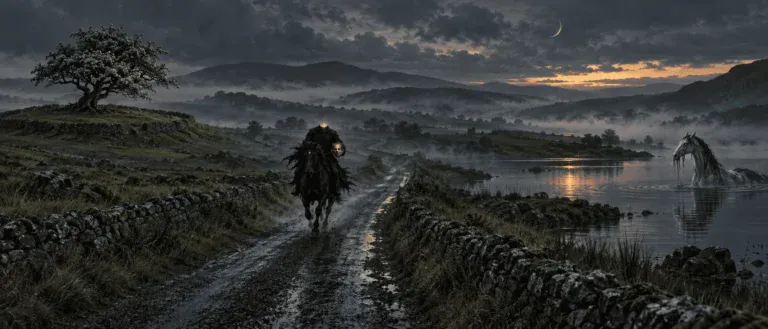
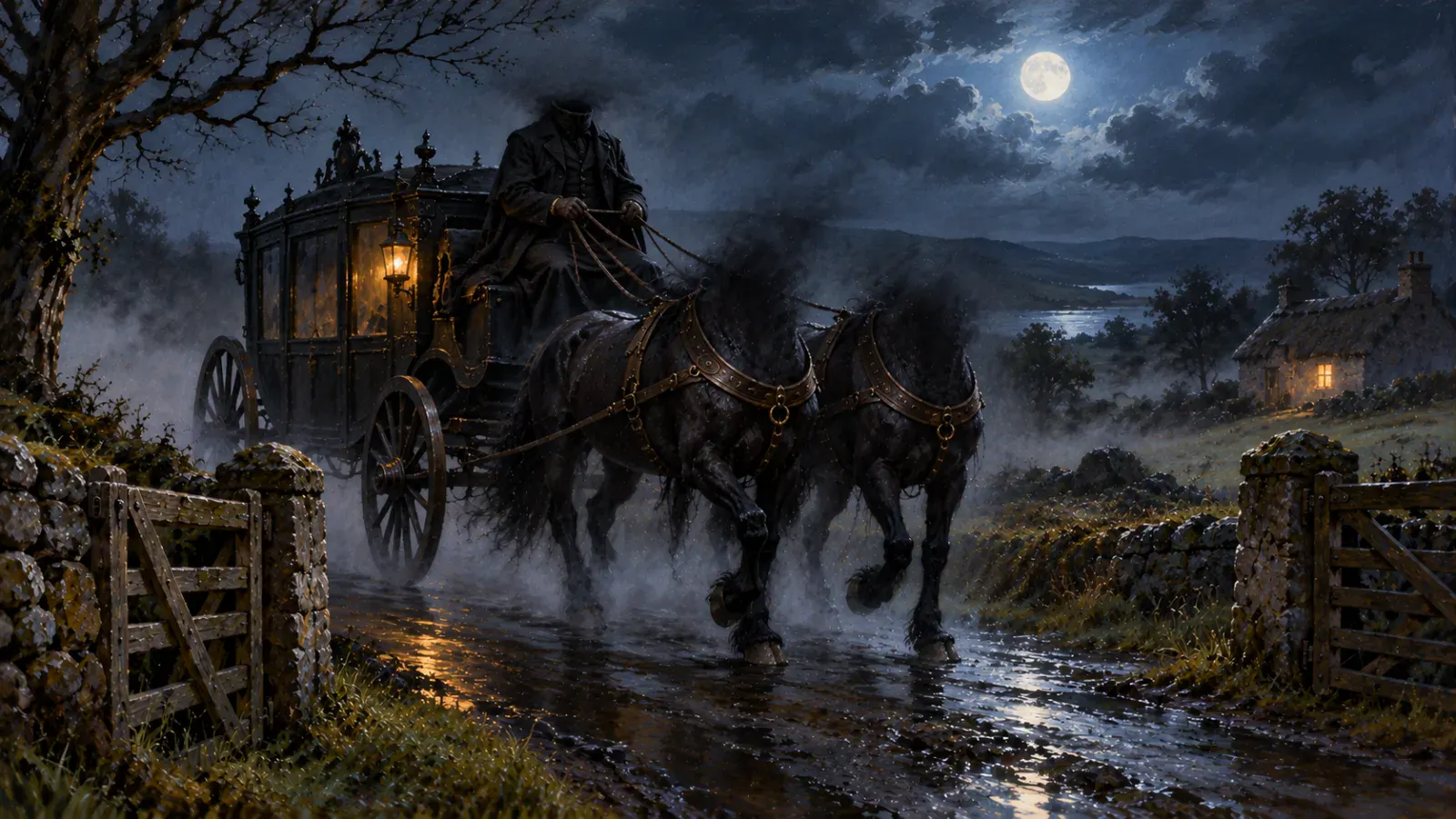
The cóiste bodhar, pronounced KOHSH-tyuh BOW-er, is the Irish death coach: a black, ghostly coach, often drawn by headless horses and sometimes driven by the headless Dullahan, whose arrival at a house foretells a death in the family. The name means “deaf coach” in Irish, and the standard Irish dictionary glosses it as a “headless coach, ghostly funeral hearse.” Nineteenth-century collectors anglicized it as “coach-a-bower.” Thomas Crofton Croker recorded it in 1828, and W. B. Yeats described it in 1888 as an omen that sometimes accompanies the banshee.
| Irish name | Cóiste bodhar |
|---|---|
| Literal meaning | “Deaf coach” (also “dull-sounding coach”) |
| Anglicized form | Coach-a-bower |
| Type | Death omen; phantom coach |
| Driver | Often the headless Dullahan |
| Omen | A death in the household or family |
| Key early source | T. Crofton Croker, Fairy Legends, Part II (1828) |
| Strongest region in the record | Munster, especially Cork and Clare |
The Coach That Comes at Night
Late one evening in County Cork, so the story goes, a man named Michael Noonan was driving a neighbor’s horse and cart home by moonlight when a great black coach passed him on the road. Six black horses pulled it, and when he looked closely, he could see no head on the coachman or on any of the horses. The next morning came word that the local gentleman had suffered a fit, and by the following night his home was a house of mourning. Thomas Crofton Croker printed the tale as “Hanlon’s Mill” in his Fairy Legends and Traditions of the South of Ireland (Part II, 1828).
The coach is called the cóiste bodhar. Like the banshee’s cry, it belongs to the Irish death omens that announce a death rather than cause it.
What the Name Means
In Irish, cóiste simply means “coach,” and bodhar means “deaf.” Niall Ó Dónaill’s standard Foclóir Gaeilge-Béarla (1977) lists cóiste bodhar directly, glossing it as “headless coach, ghostly funeral hearse.” The same dictionary gives cóiste na marbh, literally “coach of the dead,” as the ordinary word for a funeral hearse.
Why “deaf”? The word bodhar carries more than one sense. Ó Dónaill lists “deaf” first, but also “bothered, confused” and, of sound, “dull,” with the example toirneach bhodhar, “rumbling thunder.” So the name can be read as the coach of the dull, muffled, rumbling sound: the noise of wheels heard on a road where no coach should be. Some English writers instead call it the “soundless coach.” A third reading, that the coach is “deaf” to pleas, is a modern interpretation that the older collectors do not state.
The anglicized “coach-a-bower” is simply the Irish heard through English ears. In the southern pronunciation, bodhar sounds close to “bower,” rhyming with “power,” which is how the name reached Yeats and the Clare folklorist Thomas Johnson Westropp.
What the Nineteenth-Century Collectors Recorded
Most of what we know about the coach comes from three writers working between the 1820s and the 1910s, and each recorded a different piece of the tradition.
Thomas Crofton Croker (1828)
Croker, a Cork man, gave the coach its first substantial treatment in print. Part II of Fairy Legends (1828) includes a section on the Dullahan containing “The Good Woman,” “Hanlon’s Mill,” a ballad titled “The Death Coach,” and “The Headless Horseman.” The ballad opens, “‘Tis midnight! how gloomy and dark!” and imagines a headless coach, headless horses, and a headless driver racing out of Rathcooney churchyard through Glanmire and past Cork city. Its details are memorably grim: the wheel spokes are dead men’s thigh bones, and two hollow skulls serve as lamps. Croker is also the source for the best-known rule about the coach, the basin of blood, discussed below.
W. B. Yeats (1888)
Yeats, compiling Fairy and Folk Tales of the Irish Peasantry in 1888, leaned on Croker. In his note on the banshee, he wrote that “an omen that sometimes accompanies the banshee is the coach-a-bower (cóiste-bodhar),” describing it as “an immense black coach, mounted by a coffin, and drawn by headless horses driven by a Dullahan.” He then repeated Croker’s warning about the basin of blood.
Thomas Johnson Westropp (1910 to 1912)
The richest field record comes from Westropp’s “A Folklore Survey of County Clare,” published in the journal Folk-Lore. Westropp gave the death coach its own chapter. He judged that the “headless coach” or “coach a bower” seemed “of far later date than the banshee,” while noting that ghostly chariots, like that of Cú Chulainn, appear in very early tales. His stories are local and specific. At Lismehane, later called Maryfort, a servant reached to open the door of a coach that had driven into the paved court and saw a skeleton looking out. Near Ennistymon, a servant of the MacNamaras heard the coach pass in the night, and the next day Admiral Sir Burton MacNamara died in London.
Later, twentieth-century ghost writers such as Elliott O’Donnell carried the death coach into popular books of hauntings. These works are entertaining, but they are not folklore scholarship.
Rules and Beliefs
The death coach comes with a small set of beliefs about how to behave when it arrives, and not every belief appears in every source.
- Do not open the door. Croker, followed by Yeats, records that if you open the door when the coach rumbles up, a basin of blood will be thrown in your face.
- Throw the gates open. Westropp records that in Clare, “at sight or sound of the coach, all gates should be thrown open.” The coach will then pass without stopping to call for a member of the household, and it will only foretell the death of a relative at a distance.
- It may be heard rather than seen. Among Westropp’s Clare stories, an old woman named Norry Halloran told of being followed by the sound alone for a long way one dark evening around 1870, though it never reached her door.
- It follows families. Westropp notes a tradition that the coach was heard at the deaths of certain Westropps after 1873, which makes it, like the banshee, attached to particular households.
A further belief, widely repeated in modern retellings, holds that once the coach has come, it cannot return empty: someone must ride in it. It is not stated in Croker, Yeats, or Westropp, however, so its age is uncertain.
The Dullahan, the Banshee, and Other Omens
The coach is closely tied to two better-known figures. Its driver, when one is described, is the Dullahan, the headless rider who in Croker’s material either rides alone or drives the coach. The Dullahan is a being, however, while the cóiste bodhar is a vehicle and an omen.
The banshee is the coach’s closest relation in meaning. Both are attached to families, and both announce rather than cause death. Yeats explicitly paired them, calling the coach an omen that “sometimes accompanies the banshee.”
Parallels Beyond Ireland
Phantom death coaches and carts appear across Britain and Brittany, and they are best treated as parallels rather than sources. In Devon, Lady Mary Howard (christened 1596) is said to ride by night in a coach made from the bones of her four husbands, driven by a headless coachman, between Fitzford House in Tavistock and Okehampton; earlier versions recorded by Sabine Baring-Gould describe her as a hound instead. In Wales, the closest equivalent is the toili, a phantom funeral procession seen on the road before a real one. In Brittany, the Ankou drives a creaking cart at night, and when it stops at a house, someone inside must die. Anatole Le Braz recorded these beliefs in La Légende de la mort (1893).
Why a Coach?
Westropp’s sense that the coach is “of far later date than the banshee” points to an obvious explanation. Unlike the wailing woman, the coach needs a world of roads, carriages, and gentry houses, and it echoes the funerals of the eighteenth and nineteenth centuries, when a black-plumed hearse drawn by black horses carried the coffins of those who could afford one.
It is also striking that so many of the stories involve landed families. Croker’s “Hanlon’s Mill” ends at a gentleman’s house; Westropp’s coach drives into the courts of his own family’s houses. One reasonable reading, though it is an interpretation rather than a stated belief, is that the death coach is the Big House’s own omen: a grand, ominous vehicle for families who rode in grand vehicles.
The Cóiste Bodhar in Popular Culture
The death coach’s best-known screen appearance is in Walt Disney’s Darby O’Gill and the Little People (1959), adapted from Herminie Templeton Kavanagh’s Darby O’Gill stories (1903). When Darby’s daughter Katie lies gravely ill after a fall, a banshee wails and summons the Dullahan’s death coach to carry her soul away. Darby uses his last wish from the leprechaun king, Brian Connors, to take her place. Inside the coach, Brian tricks him into a fourth wish, which cancels all the others and frees him, and Katie recovers. The plot turns on the idea that the coach must not leave without a passenger.
In Ryohgo Narita’s Japanese light novel series Durarara!! and its anime adaptation, the Dullahan Celty Sturluson rides a black motorcycle that is really her headless horse in disguise, and the series identifies that horse with the cóiste bodhar.
Common Questions
These are the questions readers ask most often about the death coach.
Is the Cóiste Bodhar the Same as the Dullahan?
No. The Dullahan is a headless rider, and the cóiste bodhar is the black coach he sometimes drives. Croker and Yeats link them, but the Dullahan can ride alone, and the coach is often described with no driver named.
What Does “Cóiste Bodhar” Mean in English?
Literally, “deaf coach.” Because bodhar also describes a dull, rumbling sound, the name likely refers to the muffled noise of the coach’s approach. Irish dictionaries gloss it as a “headless coach” or “ghostly funeral hearse.”
What Should You Do If You Hear the Death Coach?
Tradition gives two answers. Croker warns never to open the door, or a basin of blood will be thrown in your face. In County Clare, Westropp was told to throw all the gates open, so that the coach would pass on and foretell a death at a distance rather than stop for someone in the house.
Sources and Further Reading
- T. Crofton Croker, Fairy Legends and Traditions of the South of Ireland, Part II, John Murray (1828).
- W. B. Yeats, ed., Fairy and Folk Tales of the Irish Peasantry, Walter Scott (1888).
- Thomas Johnson Westropp, “A Folklore Survey of County Clare,” Folk-Lore (1910 to 1912).
- Niall Ó Dónaill, ed., Foclóir Gaeilge-Béarla, An Gúm (1977).
- Patricia Lysaght, The Banshee: The Irish Supernatural Death-Messenger, Glendale Press (1986).
- Anatole Le Braz, La Légende de la mort chez les Bretons armoricains (1893).