In Short
In Irish folklore, the Dullahan is a death omen, and the worst thing that can happen is for the headless rider to stop at your door and call your name, because the person he names dies. Merely seeing him pass was a sign that someone nearby would soon die. But the oldest written stories are more surprising than the modern legend. In Thomas Crofton Croker’s tales from County Cork, one man who saw the headless death coach lived to hear that a local gentleman had died that night, and another, who rode beside a headless horseman on a stormy road, survived and even won a bet on a horse race.
| If he calls your name | You die |
|---|---|
| If he stops at a house | Someone in that house dies |
| If you only see him pass | A death is coming nearby, but not necessarily yours |
| If you open the door to the death coach | A basin of blood in the face, in one Cork tradition |
| Protection | Gold, in modern retellings; staying indoors and keeping the door shut |
| Stories to read | “Hanlon’s Mill” and “The Headless Horseman,” Croker, 1828 |
What the Tradition Says
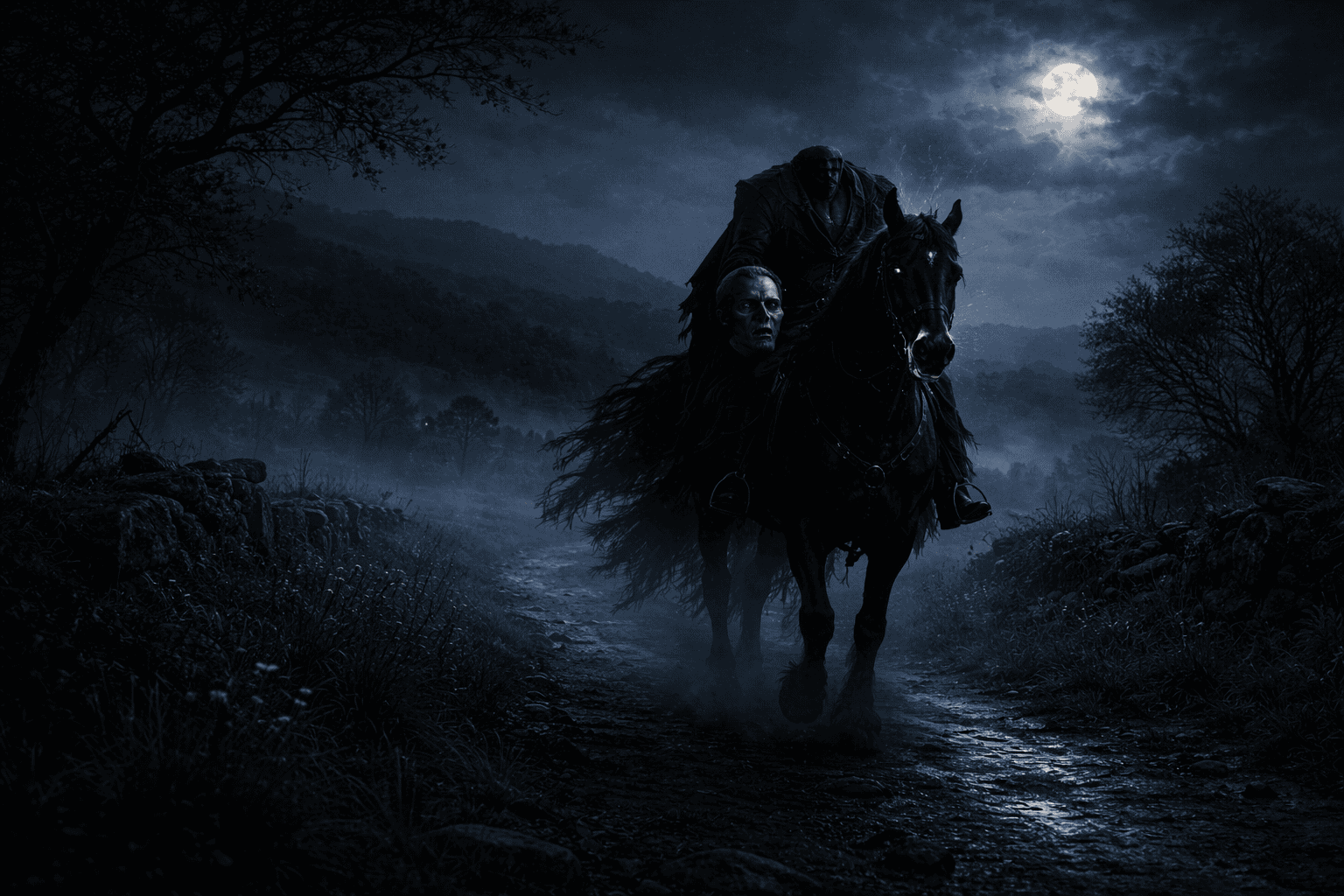
The Dullahan, the headless rider of Irish folklore, has one errand. He rides out at night on a black horse, carrying his own head, looking for the person whose time has come. When he reaches that person’s home, he stops and calls out their name, and the person named dies, often on the spot. Sometimes he drives the cóiste bodhar, the silent death coach, drawn by headless horses.
That is the heart of the legend, and it explains why the Dullahan is so feared. Most Irish death omens, like the keening of the banshee, are warnings: they tell a family that a death is coming. The Dullahan is not a warning. When he stops and speaks a name, the matter is already settled.
Seeing Him Is Not the Same as Being Called
People often assume that anyone who sees the Dullahan is doomed, but that is not quite what the old stories say. The danger lies in being named, not in being a witness. A traveler on the road at night might see the rider or the death coach pass by on its way to someone else. What that traveler learned was that a death was near, perhaps in a neighboring house, and that the rider was not coming for them, at least not that night.
This distinction matters because it shows what the Dullahan really is. He is not a monster that kills whoever crosses his path. He is a messenger of death, sent for one particular person. Everyone else is, strictly speaking, just in the way.
Hanlon’s Mill: A Witness to the Death Coach
Croker’s 1828 collection includes several stories grouped under the heading “The Dullahan,” and one of them shows exactly what seeing the death coach meant.
In “Hanlon’s Mill,” a man named Mick Noonan is lying in a cart on his way home one night in County Cork when he notices a great black coach traveling alongside him. It is drawn by six black horses with long black tails and driven by a coachman dressed all in black. Then Mick sees that neither the coachman nor the horses have any heads. The coach passes, and Mick gets home, frightened but unharmed. The next morning, word comes that the local gentleman, Master Wrixon of Ballygibblin, had a fit and died in the night.
Mick was not the one the coach had come for. He simply saw it on its way to the house where death was waiting.
The Headless Horseman: A Ride That Ended Well
Another of Croker’s tales, “The Headless Horseman,” turns the legend on its head. Its hero, Charley Culnane, is a bold rider riding home along the Blackwater from Ballyhooley on a stormy night shortly before Christmas, with a good deal of whiskey in him. At the foot of Kilcummer Hill, beside ruined walls that once belonged to the Knights Templar, a giant figure in an old-fashioned scarlet hunting coat, riding a huge white horse whose head floats along several yards ahead of its body, falls in beside him. Charley can see no head on the rider, until a hoarse voice from under the figure’s right arm tells him to look again. There, tucked under the arm, is the most hideous head Charley has ever seen.
Charley keeps his nerve and makes conversation, complimenting the horseman’s riding, his coat, and his horse. At last, the horseman challenges him to a race across country. They go over every ditch and wall, and Charley takes the lead. The horseman calls him to stop and explains: he broke his neck at the bottom of Kilcummer Hill a hundred years ago, and ever since, he has been looking for a man brave enough to ride with him. He promises that he will never desert Charley or his old mare, and vanishes into the sky.
Nobody believes Charley’s story. His neighbors blame the whiskey. But on St. Stephen’s Day, his old mare wins the race he had bet a hundred pounds on. The story is comic, but its message is clear: in Croker’s Cork, meeting a headless rider was not always a death sentence. Courage, and a little good humor, could turn the encounter to good fortune.
Opening the Door to the Death Coach
One more detail from Croker shows why people feared answering the door at night. In Doneraile, in County Cork, it was said that the death coach would stop at the houses in turn, and that anyone who opened their door to it would have a basin of blood thrown in their face.
The reason for the warning is easy to see. Opening a door at night to an unknown caller was always a risk in Irish folklore, because the caller might be a fairy, a ghost, or death itself. Keeping the door shut was a way of refusing to invite the Otherworld into the house. The basin of blood was the price of curiosity.
Can You Protect Yourself?
Modern books almost always say that the Dullahan fears gold, and that even a small gold object will drive him away. It makes a satisfying rule, but it cannot be traced to the early collectors, and no reason for it is ever given. It may be a genuine local belief that went unrecorded, or a later invention. Our guide to the Dullahan looks at this and other modern additions in more detail.
The older advice was simpler, and it follows from how the legend works. Stay indoors at night, especially when you hear hooves on the road. Do not open the door to a caller you cannot see. And if you do see the rider or the coach go by, remember that it has most likely come for someone else.
Why Does the Dullahan Mean Death?
Because he is death, or at least its messenger. A headless man is, plainly, a dead man, and in Croker’s tale, the horseman is the ghost of a rider who broke his neck a century before. Calling out a name was a way of summoning someone. When the Dullahan spoke a name at the door, he was calling that person away from the living, which is why no one wanted to hear their own name on the road at night.
Sources and Further Reading
- Thomas Crofton Croker, Fairy Legends and Traditions of the South of Ireland, part 2, John Murray (1828), including “Hanlon’s Mill” and “The Headless Horseman.”
- Katharine Briggs, An Encyclopedia of Fairies, Pantheon Books (1976).
- Patricia Lysaght, The Banshee: The Irish Supernatural Death-Messenger, Glendale Press (1986).
- Dáithí Ó hÓgáin, Myth, Legend and Romance: An Encyclopaedia of the Irish Folk Tradition, Ryan Publishing (1990).
- The Schools’ Collection, National Folklore Collection, University College Dublin (1937 to 1939), on dúchas.ie.