In Short
Irish folklore is the body of belief, custom and story carried in Irish communities and recorded from the eighteenth century onward. It covers the fairy folk, the festivals of the year, cures and charms, warnings about certain places, and thousands of tales collected from ordinary people, most famously in the Schools’ Collection of 1937 to 1939.
| What it covers | Belief, custom, story and practice, rather than gods and epics alone |
|---|---|
| Irish term | Béaloideas, literally oral instruction |
| Main beings | The Aos Sí, the fairy folk, and the solitary spirits |
| Marked by | Samhain, Imbolc, Bealtaine and Lughnasa |
| Recorded by | Collectors from the 1820s, then the Irish Folklore Commission from 1935 |
| Biggest archive | The National Folklore Collection, University College Dublin |
| Schools’ Collection | Around 5,000 primary schools, 1937 to 1939, now on dúchas.ie |
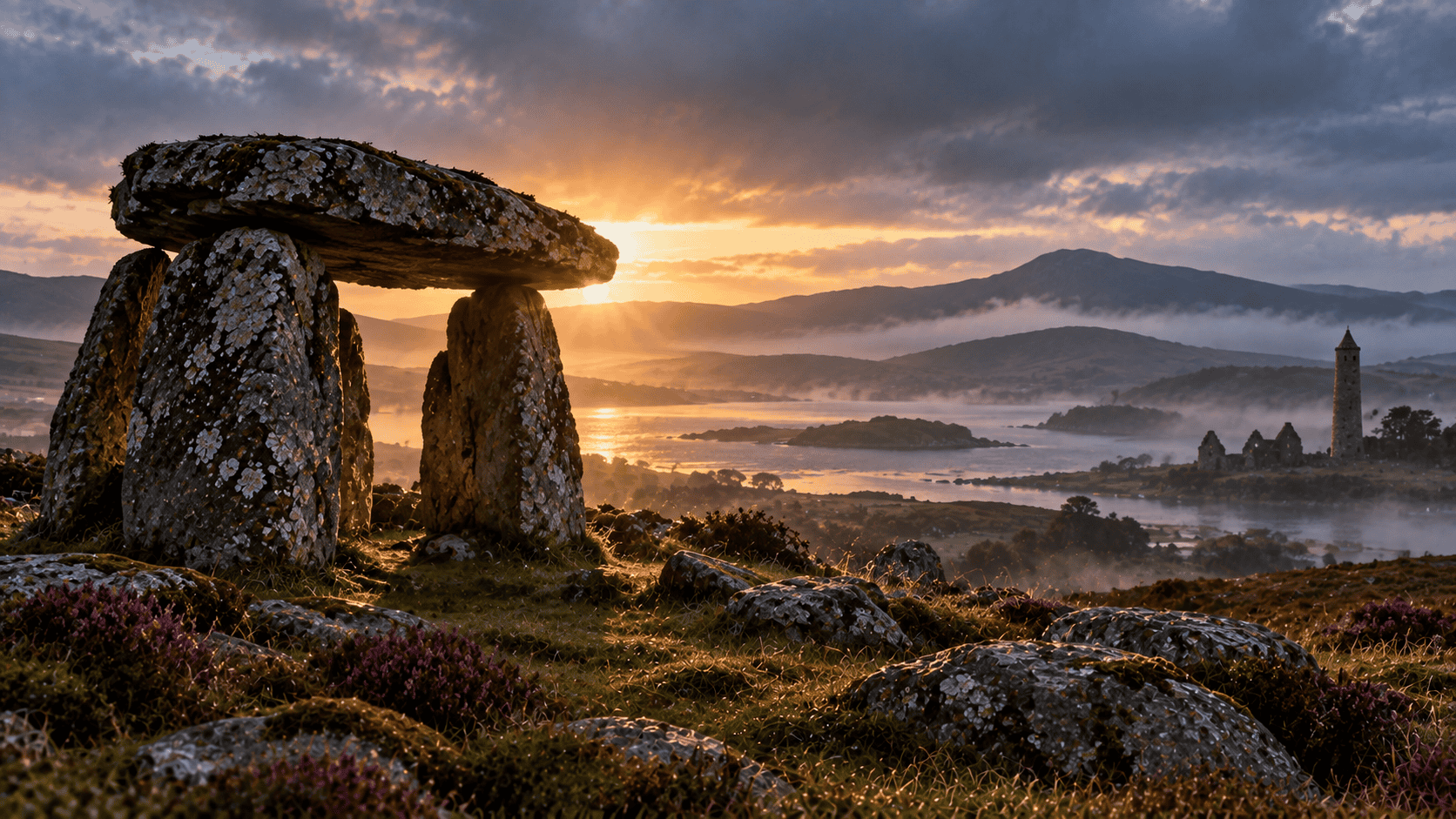
| Still visible in | Untouched fairy forts, lone hawthorns, holy wells, wake customs |
What Irish Folklore Is
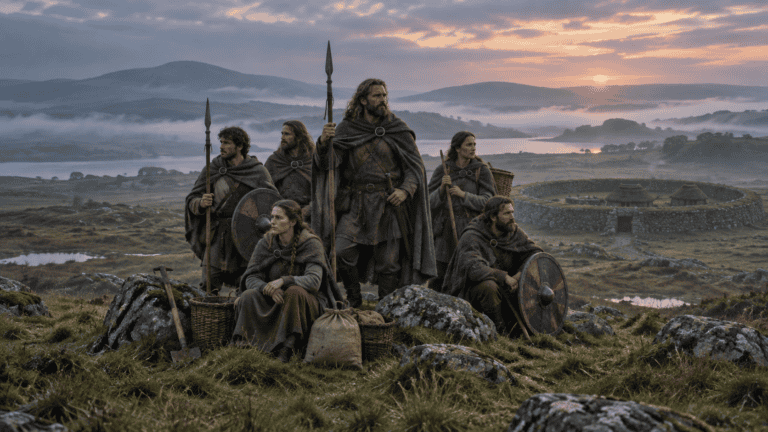
Irish folklore is what people believed, did and told one another, as distinct from what was written in the manuscripts. It takes in the beings thought to share the landscape, the customs that marked out the year, the cures kept in particular families, the warnings attached to particular fields, and the enormous stock of tales told at firesides across the country.
The Irish word is béaloideas, meaning oral instruction, and that is the useful emphasis. This material was not studied. It was passed on, adjusted with each telling, and tied closely to the place where it was told. A story about a fairy fort in Sligo was not a story about fairy forts in general. It was about that fort, and usually about someone the teller could name.
Folklore and Mythology Are Not the Same Thing
Irish mythology is the older, manuscript-preserved layer: the Tuatha Dé Danann, Cú Chulainn, the four cycles, written down by monastic scribes from roughly the eighth century. Irish folklore is the wider living tradition, most of it recorded from living people between about 1820 and 1970.
They are connected, and the connection is direct. When the Gaels defeated the Tuatha Dé Danann in the manuscript account, the old gods withdrew into the mounds. The Aos Sí of folk belief are those same beings, still resident, still requiring respect. A farmer in 1938 who would not cut a lone thorn was acting on a settlement described in a medieval text he had never read.
The practical difference is one of evidence. For mythology you are reading a scribe. For folklore you are usually reading a collector’s note of what a named person in a named townland said on a named day, which is a far better record of belief and a far worse record of antiquity.
The Fairy Folk
The center of Irish folk belief is the fairy folk, and the first thing to set aside is the modern picture of them. These were not small winged creatures. They were a people: powerful, easily offended, and living alongside humans on terms that had to be observed.
The rules were practical. Do not build on their ground. Do not cut their trees. Do not bring their food home. Do not thank them directly, and do not name them if you can avoid it, which is why they are so often called the good people or simply themselves.
Alongside the fairy host stand the solitary figures, each with its own function: the banshee who keens before a death, the púca who shapeshifts and misleads travellers, the Dullahan who rides headless, the merrow and the selkie in the water. The full guide to Irish creatures takes each one separately.
Belief in Practice
Folk belief was not an opinion people held. It was a set of things they did.
Protection
Iron near the door, salt in a pocket, a St. Brigid’s cross above the threshold, a coal in the churn. Much of this was routine rather than dramatic, the domestic equivalent of locking up at night.
Cures
Particular families held particular cures, often for a specific complaint and often passed in a fixed way, from a man to a woman or through a seventh son. A cure could not usually be bought, and payment was refused or accepted only in kind.
Warnings
A great deal of Irish folklore is a set of instructions about where not to go and what not to disturb. Fairy forts were left standing in the middle of working fields. Fairy rings were walked around. Death omens were watched for and read.
The fort was not feared exactly. It was left alone, the way you leave alone a neighbor’s field.
The common attitude in the Schools’ Collection accounts
The Year
The Irish year turned on four festivals, and each carried its own customs. Samhain at the start of November opened the boundary between worlds, and the whole apparatus of Halloween descends from it. Imbolc at the start of February belonged to Brigid, who is both goddess and saint, and was marked by making crosses from rushes. Bealtaine in May moved cattle to summer pasture between protective fires. Lughnasa in August marked the first of the harvest with assemblies, climbs and fairs.
These were not celebrations in the modern sense. They were the points at which the ordinary rules changed, which is why so much protective custom clusters around them.
How It Was Recorded
Irish folklore survives in writing because of a sequence of collectors, and their motives shaped what they wrote down.
The earliest substantial material comes from the 1830s Ordnance Survey, where John O’Donovan and others noted local tradition alongside placenames. Later in the century came the literary collectors: Patrick Kennedy, Lady Wilde, Douglas Hyde, Jeremiah Curtin and W. B. Yeats. Hyde is the one to trust most, because he recorded in Irish and printed the original alongside his translation. Yeats is the most influential and the least literal, since he was building a national literature rather than an archive.
The decisive shift came in 1935 with the founding of the Irish Folklore Commission, which sent trained collectors with recording equipment into Irish-speaking districts and gathered material systematically. Its greatest single project ran from 1937 to 1939, when schoolchildren in around 5,000 primary schools wrote down stories, cures, customs and local history from their parents and neighbors. That Schools’ Collection now sits in the National Folklore Collection at University College Dublin and is searchable online at dúchas.ie.
It is worth pausing on what that means. For a great deal of Irish folklore, you can read the actual page, in the child’s handwriting, with the name of the person who told it and the townland they lived in.
What Is Old and What Is Recent
Not everything sold as Irish folklore is old, and the site is careful about the difference.
The leprechaun is genuinely traditional but was a minor figure, one solitary fairy among many, until tourism and cartoons made him the emblem of the whole tradition. The four-leaf clover and much of what appears on St. Patrick’s Day merchandise is nineteenth and twentieth century in its current form. The Celtic tree calendar, widely repeated online, was devised by Robert Graves in The White Goddess (1948) and has no basis in Irish tradition.
The word Celtic deserves particular caution. Ireland, Scotland, Wales, Cornwall and Brittany have related languages and some shared inheritance, but their traditions are distinct, and material from all of them is routinely blended into a single system that nobody in any of those countries actually believed.
Why It Survived
Irish folklore lasted longer than most of its European equivalents, and the reasons are historical rather than mystical. Ireland remained rural and poor into the twentieth century. The oral tradition stayed functional because the alternative sources of authority, in print and in English, were often the property of the people who had taken the land. Belief carried in Irish, in places where Irish was still spoken, survived the transition better than belief carried in writing.
The collectors arrived in time. By the 1930s the tradition was weakening but still living, and the Commission caught it at the last point where the material could be gathered from people who had grown up inside it rather than reading about it.
Where to Start
For the beings, begin with the Irish fairies and then the Aos Sí. For everyday belief, read the Irish superstitions and the customs attached to them. For the older layer behind all of it, the mythology is the place to go. And for the places where belief is still visible in the landscape, start with the fairy forts.
Sources and Further Reading
- The Schools’ Collection, National Folklore Collection, University College Dublin (1937 to 1939), on dúchas.ie.
- Douglas Hyde, Beside the Fire: A Collection of Irish Gaelic Folk Stories (1890).
- Lady Wilde, Ancient Legends, Mystic Charms and Superstitions of Ireland (1887).
- The Irish Folklore Commission archives (1935 to 1971), National Folklore Collection, UCD.
- Diarmuid Ó Giolláin, Locating Irish Folklore: Tradition, Modernity, Identity, Cork University Press (2000).