In Short
Oweynagat, pronounced OH-ee-nuh-gat, is a cave at Rathcroghan near Tulsk, County Roscommon. Its name is an anglicized form of the Irish Uaimh na gCat, “Cave of the Cats.” A short stone-built souterrain leads into a natural limestone fissure. Two of its lintels carry ogham inscriptions. In medieval Irish literature, the cave of Cruachan is a doorway to the Otherworld. Nera passes through it on Samhain night, the Morrígan lives in it, and monsters, plague birds, and magic pigs pour out of it. A medieval scribe called it “Ireland’s gate of Hell,” the line behind its modern nickname.
| Irish name | Uaimh na gCat, “Cave of the Cats” |
|---|---|
| Location | Rathcroghan, near Tulsk, County Roscommon |
| Townland | Glenballythomas |
| Structure | Souterrain leading into a natural limestone cave |
| Size | About 47 meters in total, descending about 7 meters |
| Ogham | VRAICCI MAQI MEDVVI, “of Fróech, son of Medb” |
| Key texts | Echtra Nerai, Cath Maige Mucrama, Fled Bricrenn, the Dindshenchas |
| Nickname | “Ireland’s Gate to Hell” |
| Visiting | Through guided tours from Rathcroghan Visitor Centre, Tulsk |
The Cave Where the Otherworld Breaks Through
On Samhain night, two men hanged the day before still swing from a gallows outside the royal fort of Cruachan. Queen Medb and King Ailill offer a prize to anyone who will go out in the dark and tie a withy around a dead man’s foot. Only a warrior named Nera goes. Before dawn, he will follow an Otherworld host into a hole in the ground. That hole is Oweynagat.
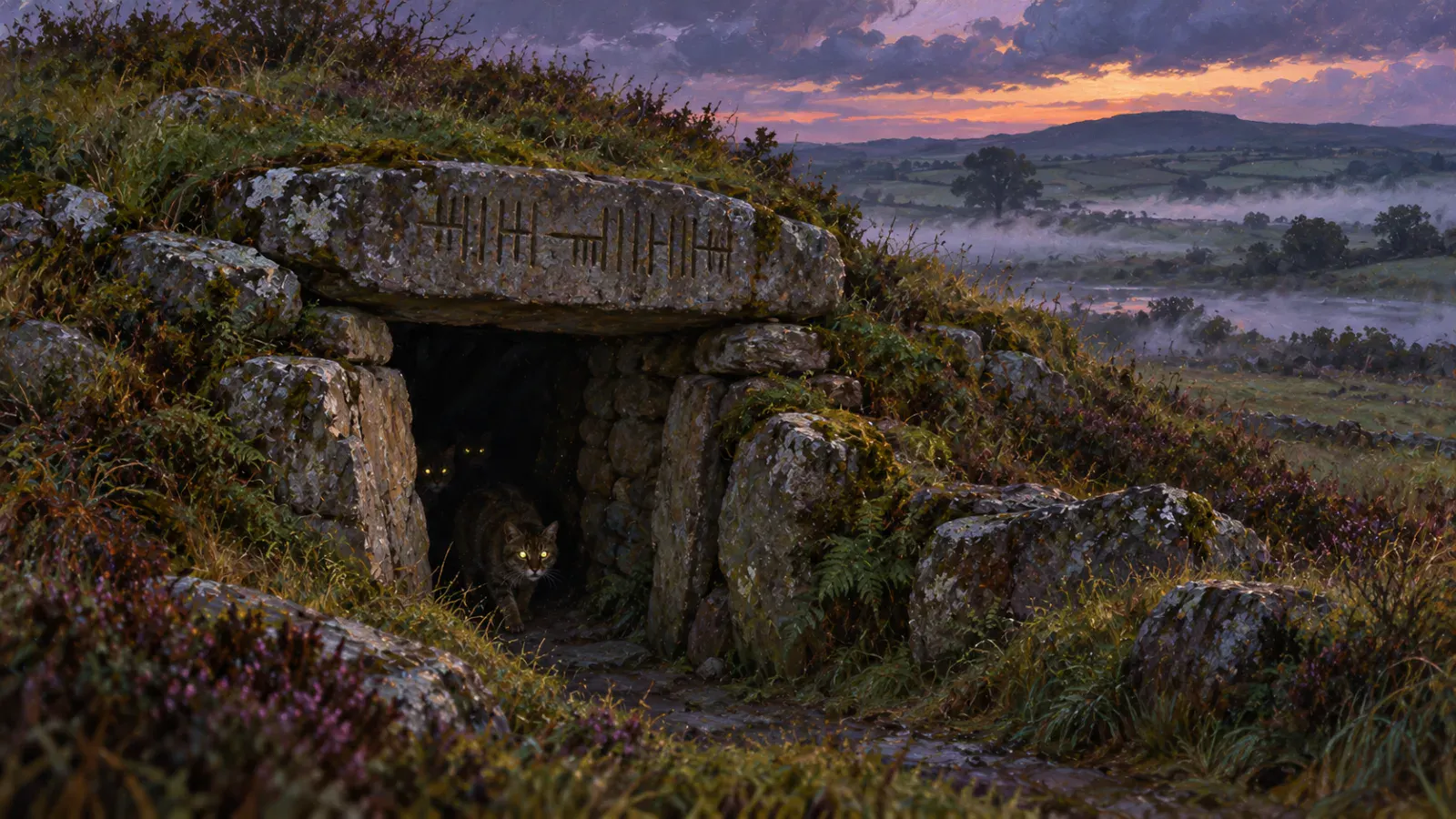
Today, the entrance is easy to miss: a low, lintelled opening at the edge of a field, about a kilometer south of Rathcroghan Mound. Yet few places in Ireland carry such a crowded medieval literature. In the old tales, the cave is a door to the síd of Cruachan, the Otherworld mound of the Aos Sí, and nearly everything that happens there happens at Samhain.
Where Oweynagat Is and What It Looks Like
Oweynagat lies in the townland of Glenballythomas, near Tulsk in County Roscommon. Rathcroghan is the modern name for Cruachan, the royal center of Connacht in medieval Irish literature. In the Ulster Cycle, it is the seat of Medb and Ailill, and their army sets out from here on the Táin Bó Cúailnge.
The cave has two parts. The first is a souterrain, a stone-lined artificial passage of a kind built across early medieval Ireland. It runs roughly 10 meters from the entrance and then breaks into a natural limestone fissure, a narrow rift that continues for about 37 meters more. The Irish cave survey kept by the University of Bristol Spelaeological Society gives a total length of about 47 meters and a depth of about 7 meters. The entrance once sat inside a small earthen mound, largely destroyed when a road was built beside it in the 1930s.
The Ogham Stones in the Entrance
The souterrain’s builders reused two older ogham stones as roof lintels. The clearer one, recorded by Samuel Ferguson in the 1860s and catalogued as CIIC 12, reads VRAICCI MAQI MEDVVI, usually translated “of Fróech, son of Medb.” The second stone is too damaged for a confident reading.
The inscription is tempting, because Fróech is a hero of the Cruachan tales. Scholars urge caution, however. R. A. S. Macalister declined to say whether it refers to the legendary queen at all. In the sagas, Fróech is the suitor of Medb’s daughter Findabair, not Medb’s son, and the form MEDVVI looks masculine, so the stone may name a man called Medb. The safest statement is that an early ogham stone names a Fróech and a Medb, and nobody can prove they are the saga figures.
Why It Is Called the Cave of the Cats
The medieval texts usually call the place simply the cave of Cruachan. The cats come from Fled Bricrenn (Bricriu’s Feast), in which Lóegaire Búadach, Conall Cernach, and Cú Chulainn compete for the champion’s portion and are tested at Cruachan by Ailill and Medb. In George Henderson’s 1899 translation, “three cats from the Cave of Cruachan were let loose to attack them.”
Lóegaire and Conall flee to the rafters and leave their food to the beasts. Cú Chulainn holds his place. When a cat stretches out its neck to eat, he strikes its head, but the blade glides off as if from stone. He neither eats nor sleeps until the cats vanish at dawn. Later writers took this episode as the origin of the name Uaimh na gCat. The link is reasonable, since the saga sends the cats out of this cave, but no early text says the cave was named for them.
The Adventure of Nera
Echtra Nerai (The Adventure of Nera), translated by Kuno Meyer in 1889, is the cave’s central story and one of the earliest portraits of Samhain as a night when the Otherworld stands open.
At the gallows, the withy keeps springing off the dead man’s foot until the corpse itself tells Nera to fasten it with a proper peg. Then the dead man asks for a drink, and Nera carries him on his neck to find one. The first house is ringed by a lake of fire, and the second by a lake of water. The third has washing tubs and a slop pail left out. The corpse drinks, spits the last mouthful over the sleepers, and they all die. The tale draws a household rule from this: tubs, slop pails, and an unguarded fire should never be left in a house at night. Nera carries the dead man back to the gallows.
Returning to Cruachan, Nera finds the fort in flames and a heap of his people’s heads. He follows the raiders “into the cave of Cruachan” and on into the síd. The Otherworld king gives him a house with a woman of the síd, and Nera fetches her firewood each day. Every day he watches a blind man carry a lame man to a well where the king’s golden crown, the crown of Brión, is hidden.
The woman tells Nera that the burning he saw was a vision of what will happen at the next Samhain, unless he warns Ailill and Medb. As proof, she sends him home with “fruits of summer” in winter: wild garlic, primrose, and golden fern. She also tells him she will bear him a son. Back at Cruachan, his companions are still sitting around the same cauldron, though Nera felt he had been away three days and three nights.
During the following year, the Morrígan takes his son’s cow to be bred with the Brown Bull of Cúailnge, a thread that leads toward the great Cattle Raid of Cooley. At the next Samhain, the men of Connacht strike first. They enter the síd, plunder it, and carry off the crown of Brión. Nera stays behind with his Otherworld wife and son, and the tale says he will not come out “till Doom.”
The Morrígan’s Fit Abode
The war goddess known as the Morrígan is the cave’s most famous resident. A poem in the Metrical Dindshenchas on the river Odras describes her coming “out of the cave of Cruachu, her fit abode.” In that poem, a woman named Odras pursues her after the goddess carries off a bull, and the Morrígan chants over the sleeping Odras and turns her into the stream that bears her name.
In Táin Bó Regamna, a prelude to the Táin, she meets Cú Chulainn while driving a cow brought “out of the fairy-mound of Cruachan” to be bred with the bull of Cúailnge. When he challenges her, she becomes a black bird and foretells how she will attack him in the coming war. That text names the síd rather than the cave, but the cave was understood as the way into that síd, and modern tradition treats Oweynagat as her home.
Monsters, Plague Birds, and Magic Pigs
The fullest list of what comes out of the cave is in Cath Maige Mucrama (The Battle of Mag Mucrama), preserved in the twelfth-century Book of Leinster and translated by Whitley Stokes in 1892. It names three plagues.
First came a triple-headed creature, tellén trechend in the Irish, now usually called the Ellén Trechend. It laid Ireland waste until Amairgin, father of Conall Cernach, killed it. Next came red birds whose breath withered everything it touched, until the Ulstermen brought them down with slings. Last came pigs. Nothing grew for seven years where they passed, their number changed whenever anyone counted them, and they vanished when shot at. When Medb and Ailill went to count them, one pig leaped over Medb’s chariot. She seized its leg, but the skin came away in her hand, and the herd was never seen again. The plain was named Mag Mucrama, “the plain of the pig counting.”
Why It Became Ireland’s Gate to Hell
The nickname is older than it sounds. In the same passage of Cath Maige Mucrama, the scribe calls the cave dorus iffirn na hÉrenn, “Ireland’s gate of Hell.” That was a Christian reading of a pre-Christian idea. In the tales, the síd was an Otherworld of feasting, summer fruit, and treasure, closer to Tír na nÓg than to a place of punishment. To a monk copying out stories of withering birds and demonic swine, however, an opening in the earth that let such things loose looked like a mouth of hell.
Local tradition kept the sinister reputation alive. A widely told Roscommon story says a woman chased a runaway cow into Oweynagat and came out at the Keshcorran caves in County Sligo, many miles away. Local accounts also describe the cave as an entrance to the underworld that opened at Halloween. Modern travel writers and broadcasters then made “Ireland’s Gate to Hell” its best-known name.
Samhain and the Halloween Connection
Almost everything in the cave’s literature happens at Samhain. In Echtra Nerai, the Otherworld host cannot come until the next Samhain, when the síde of Ireland are opened. That is why Oweynagat is often called a birthplace of Halloween. The festival was kept across Ireland, but this is where the medieval sources show most vividly what Samhain meant: a night when the boundary between worlds gave way.
Rathcroghan Visitor Centre in Tulsk draws on this story with an annual Origins of Samhain tour in the weeks around Halloween, following the festival from the royal mound to the mouth of the cave.
Oweynagat Within the Rathcroghan Complex
The cave is one monument in a much larger landscape. Rathcroghan holds more than 240 recorded archaeological sites, about 60 of them national monuments, spanning some 5,500 years. Its center is Rathcroghan Mound, a flat-topped mound about 89 meters across and 5.5 meters high. Nearby is Relig na Ríg, the “burial place of the kings.”
Medb dominates the place’s literature. The Dindshenchas derives the name Cruachu from Crochen, a companion of Étaín, and calls her the mother of Medb. Claims that Medb was born in the cave itself are later tradition.
Common Questions
These are the questions people most often ask about the cave.
Can You Visit Oweynagat?
Yes, but the cave is a protected national monument on private farmland. The best way to see it is a guided tour from Rathcroghan Visitor Centre in Tulsk. Whether tours go inside depends on conditions, and some recent tours have stopped at the entrance for safety reasons. When entry is allowed, expect a muddy crawl.
Why Is It Called the Cave of the Cats?
The usual explanation is Fled Bricrenn, where three magical cats from the cave of Cruachan attack Cú Chulainn, Conall, and Lóegaire. No medieval text says the cave was named for them, so the link is likely but unproven.
Is Oweynagat Really the Gate to Hell?
Only in a Christian reading. The phrase comes from a medieval scribe’s comment in Cath Maige Mucrama. In the older tales, the cave leads to the síd of Cruachan, not to a realm of punishment.
Sources and Further Reading
- Kuno Meyer, “The Adventures of Nera,” Revue Celtique 10 (1889).
- Whitley Stokes, “The Battle of Mag Mucrime,” Revue Celtique 13 (1892).
- Máirín O Daly, Cath Maige Mucrama: The Battle of Mag Mucrama, Irish Texts Society (1975).
- George Henderson, Fled Bricrend: The Feast of Bricriu, Irish Texts Society (1899).
- A. H. Leahy, Heroic Romances of Ireland, vol. 2, David Nutt (1906).
- Edward Gwynn, The Metrical Dindshenchas, parts III and IV, Royal Irish Academy (1913, 1924).
- John Waddell, Joe Fenwick, and Kevin Barton, Rathcroghan: Archaeological and Geophysical Survey in a Ritual Landscape, Wordwell (2009).
- Damian McManus, A Guide to Ogam, An Sagart (1991).