In Short
Newgrange is a Neolithic passage tomb in the Boyne Valley, County Meath, built around 3200 BC, which makes it older than Stonehenge’s sarsen circle and the Great Pyramid of Giza. A stone opening above its entrance, the roof-box, lets the rising sun shine down a 19-meter passage into the central chamber for about 17 minutes around the winter solstice. In medieval Irish literature the mound is Brú na Bóinne (broo nuh BOH-in-yuh), the home of the Dagda, which his son Aengus Óg won with a famous trick about “a day and a night.”
| Type | Neolithic passage tomb |
|---|---|
| Location | Bend of the Boyne, County Meath |
| Built | About 3200 BC (radiocarbon) |
| Mound | About 85 m across, 11 to 12 m high |
| Passage | About 19 m long |
| Kerbstones | 97 |
| Solstice light | About 17 minutes, around December 21 |
| UNESCO | World Heritage Site since 1993 |
| Mythic owner | The Dagda, then Aengus Óg |
The Morning the Sun Came Back
Before dawn on December 21, 1967, the archaeologist Michael J. O’Kelly stood alone in the dark chamber of Newgrange. Local visitors had told him and his wife, Claire O’Kelly, that the rising sun once lit a carved stone at the back of the chamber, and his team had uncovered a strange stone opening above the entrance that they called the roof-box. At sunrise a thin beam of light came through that slot, ran up the passage, and spread across the chamber floor. He was the first person known to have seen the event in modern times, and he had shown that the builders of Newgrange designed the monument around the shortest day of the year.
That beam of light made Newgrange famous, but the mound also has a second life: long after its builders were forgotten, medieval storytellers made it a palace of the gods.
What and Where Newgrange Is
Newgrange is a great circular mound on a ridge above the north bank of the River Boyne, about 8 kilometers west of Drogheda in County Meath. It stands inside a loop of the river known as Brú na Bóinne, the “mansion” or “palace” of the Boyne, which holds around 40 passage tombs dominated by three huge mounds: Newgrange, Knowth, and Dowth. In 1993 UNESCO inscribed the landscape as a World Heritage Site, “Brú na Bóinne: Archaeological Ensemble of the Bend of the Boyne.”
The English name is medieval: the land belonged to the Cistercian abbey of Mellifont, which worked it as a grange, or outlying monastic farm.
How Old Is Newgrange?
Newgrange was built around 3200 BC. The date comes from radiocarbon samples taken during O’Kelly’s excavation, including burnt soil used to seal the joints of the passage roof. Some sources round it to about 3100 BC.
That makes Newgrange older than the monuments most people picture as the oldest in the world. English Heritage dates the first earthwork at Stonehenge to about 3000 BC and the raising of its great sarsen stones to about 2500 BC, so Newgrange predates the sarsen circle by roughly 700 years. The Great Pyramid of Giza was built around 2560 BC, about six centuries after Newgrange.
The mound contains an estimated 200,000 tonnes of material. Inside, a corbelled roof of overlapping stone courses rises nearly 6 meters above the chamber floor and, built without mortar, has stood for more than five thousand years, although the O’Kellys recorded leaks in the chamber that conservation work later had to stop.
The Roof-Box and the Winter Solstice
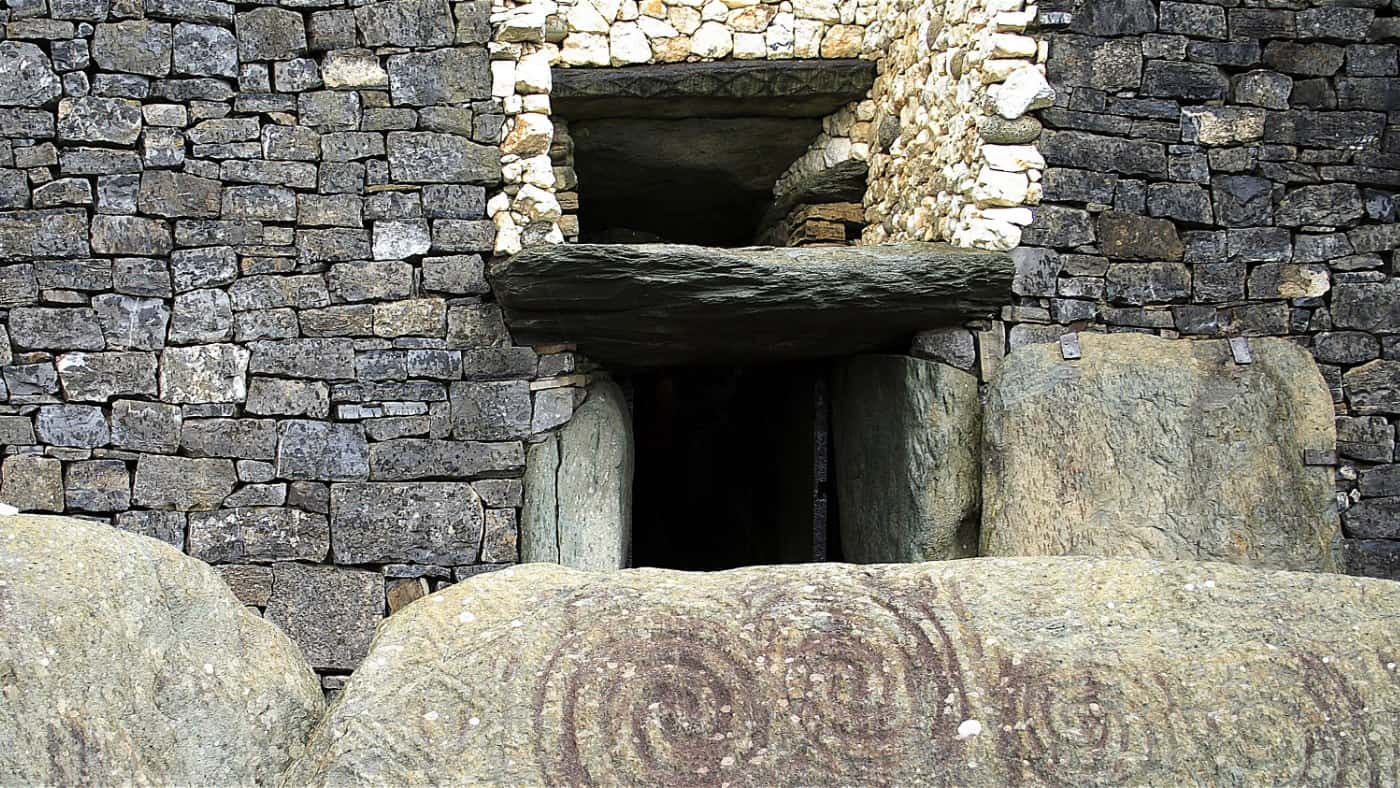
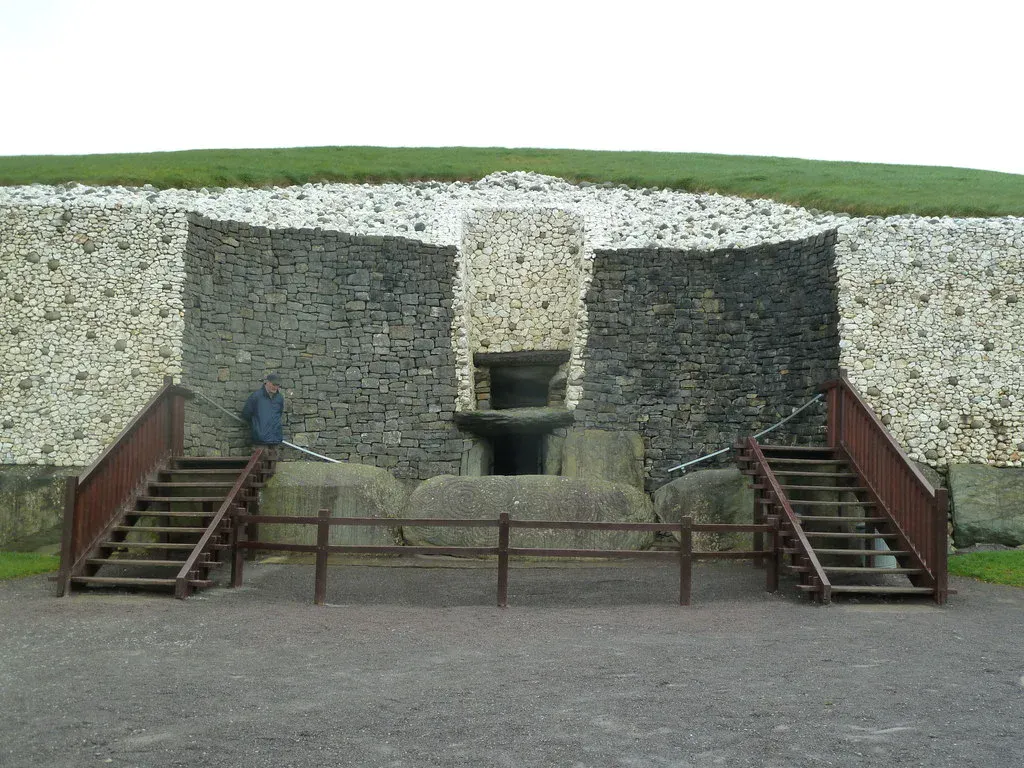
The feature that makes Newgrange unique is the roof-box, a rectangular opening built above the doorway. The passage climbs gently toward the chamber, so light entering at ground level would never reach the back. By admitting light at a higher point, the roof-box lets a narrow beam travel the full length of the passage.
What Happens at Sunrise
On clear mornings around the winter solstice, the beam enters about four minutes after sunrise and lights the chamber floor for about 17 minutes before narrowing and withdrawing. The effect is strongest for several days around December 21, because the sun’s rising point barely moves at that time of year, and a 2024 research report found that direct sunlight can enter the chamber for about 20 days on either side of that date. Many cloudy solstice dawns pass with no beam at all. Because the tilt of the earth’s axis has shifted slightly since the tomb was built, the beam no longer reaches quite as far into the chamber.
The Solstice Lottery
The chamber holds only a small group at a time, so the Office of Public Works (OPW), which manages the site, allocates places for the solstice sunrises by lottery. The draw covers the mornings of December 19 to 23, and each winner brings one guest. Each year many thousands of people enter for a few dozen places, and in recent years local schoolchildren have drawn the winners.
Kerbstones, Spirals, and the Triple Spiral
Newgrange is ringed at its base by 97 large kerbstones laid end to end, many of them carved. The Boyne tombs hold the largest concentration of megalithic art in western Europe, and nobody knows what its spirals, lozenges, and arcs meant to their carvers.
The Entrance Stone
The most famous carving is the entrance stone, known to archaeologists as K1, which lies across the doorway. Its face is covered with flowing spirals, including a linked triple spiral, along with lozenges and arcs, and a vertical line divides the design into two panels. Kerbstone K52, on the far side of the mound opposite the entrance, carries a similar dividing line.
The Triple Spiral in the Chamber
A smaller triple spiral, about 30 centimeters across, is carved on stone C10 in the end recess of the chamber. It is often said that the solstice beam strikes it, but O’Kelly checked in 1969 and found that the direct light falls short; the spiral is lit only by light reflected from the floor. The design is now sold as a “Celtic triskele,” but it is more than two thousand years older than the Iron Age art usually called Celtic, and readings of it as a triple goddess or as birth, life, and death are modern additions.
Rediscovery and Excavation
For centuries the mound was simply a grassy hill. In 1699 laborers working for the landowner, Charles Campbell, were taking stone from it when they uncovered the entrance. The Welsh antiquarian Edward Lhuyd (also spelled Lhwyd) visited that year and described the passage, the chamber, the carvings, and the stone basins in the side recesses.
The decisive excavation was led by O’Kelly of University College Cork from 1962 to 1975, and his report appeared in 1982. His team found human bone, beads, and pendants in the chamber, and Roman-period coins and jewelry outside the mound, left thousands of years later and considered possible votive offerings. O’Kelly also rebuilt the front of the mound as a steep wall of white quartz dotted with rounded granite cobbles, based on stone found spilled before the entrance. That reconstruction remains controversial, and some archaeologists think the quartz was laid as a flat spread on the ground.
Research continues. A 2020 study in Nature reported that a man buried in the chamber was the child of first-degree relatives, which the authors read as a sign of a ruling dynasty, though critics warn against generalizing from one individual.
Brú na Bóinne in Irish Mythology
Medieval Irish texts call Newgrange the Brug or Síd in Broga, the fairy mound of the Brug. The Christian scholars who wrote these tales did not know who built it; to them it was a síd, a dwelling of the Tuatha Dé Danann inside the hills. The tales link it with the Dagda (DAG-duh), the great father-god of the Tuatha Dé, and with Elcmar, but its usual resident is the Dagda’s son, Aengus.
The Conception of Aengus
The best known story opens Tochmarc Étaíne (The Wooing of Étaín), which survives in part in the twelfth-century Lebor na hUidre and more fully in the Yellow Book of Lecan. Here the Brug belongs to Elcmar, whose wife is Eithne, also called Boann (BOH-un). The Dagda desires her, so he sends Elcmar on an errand and holds back the night, so that nine months pass as a single day. Boann bears a son, Aengus (AYN-gus), and Elcmar returns suspecting nothing. The child is sent to be fostered by Midir at Brí Léith.
How Aengus Won the Brug: Two Versions
Medieval writers told two different stories of how Aengus gained the mound, and retellings often blur them.
In Tochmarc Étaíne, Aengus learns who his parents are and asks his father for land. The Dagda, here also called Eochaid Ollathair, advises him to enter the Brug armed on Samhain, a day of peace when no attack would be expected, and to threaten Elcmar’s life. To save himself, Elcmar grants Aengus kingship of the Brug for “a day and a night.” When Elcmar wants his home back, Aengus argues that the phrase means day and night without end. The Dagda rules in his son’s favor and compensates Elcmar with the nearby site of Cleitech.
In De Gabáil in t-Sída (The Taking of the Síd), a short text in the twelfth-century Book of Leinster, Elcmar does not appear. The Dagda, as king of the Tuatha Dé, has shared out the fairy mounds among his people. Aengus, called the Mac Óc (“young son”), arrives after the division and is told nothing is left. He asks for just a day and a night in the Dagda’s own dwelling, and the Dagda agrees. When the time is up, Aengus declares that the whole world is made of day and night, so it is the Dagda himself who must leave. The text describes a land of wonders, with three trees always in fruit and food and drink that never run out.
The trick works because the Old Irish phrase láa ocus aidche can mean “a day and a night” or “day and night,” in the sense of all time. In both versions the mound becomes Brug Maic ind Óc, the Brug of the Young Son. A later tale, Altram Tige Dá Medar, gives a third account, in which Manannán mac Lir helps Aengus expel Elcmar with a spell.
Some modern writers link the Dagda’s halting of time to the solstice, when the sun seems to stand still on the horizon. That connection is a modern interpretation; the medieval texts never mention the roof-box or the solstice light.
Boann and the River Boyne
Boann is the goddess of the river below Newgrange, and her name is usually explained as “white cow.” The Metrical Dindshenchas, the medieval lore of place names, tells how the river was made. Her husband, here called Nechtan, kept a secret well that only he and his cupbearers could safely approach. Boann walked three times around it, and three waves burst out, striking her foot, her eye, and her hand. She fled toward the sea, and the water followed her the whole way, becoming the river that bears her name. A second poem in the collection says she went to the well to hide her guilt after conceiving Aengus by the Dagda.
Newgrange in Later Tradition
The Brug kept its supernatural reputation for centuries. The Metrical Dindshenchas credits the Dagda with building it, and the Brug was remembered as a burial ground of pagan kings. In a story found in the medieval Senchas na Relec (The History of the Burial Places), the legendary high king Cormac mac Airt, who had turned toward Christianity, asked to be buried at Ros na Ríg instead of the pagan cemetery at the Brug. His followers ignored him, but the Boyne rose three times when they tried to carry his body across, and he was buried at Ros na Ríg.
Aengus stays linked to the mound in the Fenian Cycle. In Tóraigheacht Dhiarmada agus Ghráinne (The Pursuit of Diarmuid and Gráinne), whose oldest surviving copy dates from 1651, Aengus is the foster-father and protector of the hero Diarmuid. After Diarmuid’s death, Aengus carries the body to the Brug and, unable to restore him to life, says he will send a soul into it so that Diarmuid can talk to him each day.
Knowth and Dowth
Newgrange’s two great neighbors each have their own lore.
Knowth, upriver to the west, is the largest mound in the complex, about 95 meters across, and is surrounded by around 18 smaller satellite tombs. It has two passages, facing east and west, and its 127 original kerbstones make it the richest single collection of passage tomb art in western Europe.
Dowth, downriver to the east, is about the same diameter as Newgrange. Its short southern tomb catches the setting sun around the winter solstice, a sunset partner to Newgrange’s sunrise. The Metrical Dindshenchas explains its Irish name, Dubad, as “darkness”: King Bresal Bó-Díbad ordered the men of Ireland to build a tower to heaven in a single day, his sister held the sun still so the work could continue, and when the king lay with her the spell broke and night fell.
Visiting Newgrange
Newgrange can be visited only on a guided tour from the Brú na Bóinne Visitor Centre, on the south side of the river near Donore. Visitors cross a footbridge over the Boyne and take a shuttle bus to the mound. Tickets should be booked online in advance, and the tour enters the chamber, where guides re-create the sunrise with electric light. Knowth has its own tour from spring to autumn, while Dowth is not part of the guided tours. Allow about two hours for Newgrange and the exhibition.
Newgrange in Popular Culture
Newgrange has drawn Irish musicians and poets. Clannad recorded a song titled “Newgrange,” written by Ciarán Brennan, on their 1983 album Magical Ring. Seamus Heaney’s “Funeral Rites,” in his 1975 collection North, imagines a funeral procession moving toward “the great chambers of Boyne,” its head entering “the megalithic doorway.” Richard Murphy also wrote a poem titled “Newgrange,” collected in his Collected Poems.
Common Questions
These are the questions readers most often ask about Newgrange and its solstice.
Is Newgrange Older Than Stonehenge?
Yes. Newgrange was built around 3200 BC. Stonehenge began as an earthwork around 3000 BC, and its famous sarsen stones were raised around 2500 BC.
Can You See the Solstice Without Winning the Lottery?
Yes, from outside. Anyone can gather at the mound at dawn on the solstice mornings, but only lottery winners and their guests go inside.
Sources and Further Reading
- Michael J. O’Kelly, Newgrange: Archaeology, Art and Legend, Thames and Hudson (1982).
- Geraldine Stout and Matthew Stout, Newgrange, Cork University Press (2008).
- Osborn Bergin and R. I. Best (eds. and trans.), “Tochmarc Étaíne,” Ériu 12 (1938).
- Vernam Hull (ed. and trans.), “De Gabail in t-Sída,” Zeitschrift für celtische Philologie 19 (1933).
- Edward Gwynn (ed. and trans.), The Metrical Dindshenchas, Parts II to IV, Royal Irish Academy (1906 to 1924).
- Lara M. Cassidy and others, “A Dynastic Elite in Monumental Neolithic Society,” Nature 582 (2020).
- George Eogan, Knowth and the Passage-Tombs of Ireland, Thames and Hudson (1986).
- Winter Solstice Phenomenon at Newgrange: Research Report, National Monuments Service (2024).
- Image credit: “Newgrange Tomb Entrance,” photograph by Allen Karsina (2006), public domain, via Wikimedia Commons.
- Photo: Graham Hogg, CC BY-SA 2.0, via Wikimedia Commons.