In Short
The Ulster Cycle, once called the Red Branch Cycle, is the body of medieval Irish heroic tales about the Ulaid, the people who gave Ulster its name. The stories center on King Conchobar mac Nessa and his warriors at Emain Macha, EV-in MAH-kha, now Navan Fort in County Armagh, and tradition sets them around the time of Christ. The great hero is Cú Chulainn, and the great enemy is Medb, queen of Connacht. The tales survive in manuscripts from about 1100 onward, but parts of their language go back to the eighth century.
| Also called | The Red Branch Cycle |
|---|---|
| People | The Ulaid of eastern Ulster |
| Royal seat | Emain Macha (Navan Fort), County Armagh |
| Traditional setting | Around the time of Christ |
| Central tale | Táin Bó Cúailnge, the Cattle Raid of Cooley |
| Main figures | Conchobar, Cú Chulainn, Fergus, Medb, Ailill |
| Oldest manuscript | Lebor na hUidre, before 1106 |
| Oldest language | Old Irish, about the eighth century |
What Is the Ulster Cycle?
A pregnant woman is forced to race the king’s horses before the assembled men of Ulster. She wins, gives birth to twins at the finish, and curses every man who watched: in Ulster’s hour of greatest danger, its warriors will be as weak as a woman in labor. Only a teenage boy, Cú Chulainn, will be left standing to hold back an invading army. The curse sets up the most famous story in early Irish literature, and it is typical of the cycle: violent, proud, and tragic.
The Ulster Cycle is a group of prose tales, with verse passages, about the Ulaid, who ruled the northeast from Emain Macha near modern Armagh. Their king is Conchobar mac Nessa, and his warriors include Cú Chulainn, Fergus mac Róich, Conall Cernach, and Lóegaire Búadach. Their rivals are the Connachta of the west, led by Queen Medb and King Ailill from Cruachan, now Rathcroghan in County Roscommon.
Medieval Irish historians set these events around the time of Christ. Among the four groupings modern scholars use for early Irish narrative, the Ulster Cycle follows the Mythological Cycle and precedes the Fenian Cycle and the Cycle of the Kings. That four-cycle scheme is a modern convenience. Medieval scribes sorted tales by type instead, such as táin (cattle raid) and aided (violent death).
Why Is It Called the Red Branch Cycle?
The older name comes from a building. Medieval texts give Conchobar three halls at Emain Macha. The Cráebruad, or Red Branch, was the king’s own hall, apparently named for a great painted beam across its ceiling. Later writers used “Red Branch” for Conchobar’s whole warrior band, which is how the cycle got its older name.
The Manuscripts and the Age of the Tales
The tales come down to us in large compilations made by learned scribes. Three manuscripts matter most.
Lebor na hUidre, the Book of the Dun Cow
Lebor na hUidre, the oldest surviving manuscript written entirely in Irish, was produced at Clonmacnoise. Its main body was finished before 1106, the year one of its scribes, Máel Muire mac Céilechair, was killed. It holds the oldest copy of the Táin Bó Cúailnge, along with Fled Bricrenn, Compert Con Culainn, and Togail Bruidne Dá Derga.
The Book of Leinster
The Book of Leinster was compiled around 1160, largely by Áed Ua Crimthainn, abbot of Terryglass in County Tipperary. It holds the most complete version of the Táin and early copies of Scéla Mucce Meic Dathó, Longes mac nUislenn, Táin Bó Fraích, and the death of Cú Chulainn.
The Yellow Book of Lecan
The Yellow Book of Lecan was written mostly between about 1391 and 1401 by Giolla Íosa Mór Mac Fhirbhisigh and his pupils in County Sligo. It preserves part of the earliest Táin and Aided Óenfir Aífe.
Language pushes the stories back much further. Parts of the earliest version of the Táin are in eighth-century Old Irish, Fled Bricrenn is usually dated to the eighth century, and Scéla Mucce Meic Dathó to about 800. In other words, the Ulster Cycle was being written down some 700 to 800 years after the time in which it is set.
The Táin and Its Pre-Tales
The Táin Bó Cúailnge, pronounced TAWN boh KOOL-nyeh, is the cycle’s longest and most important tale. Medb and Ailill lead the armies of Ireland into Ulster to seize the great brown bull of Cooley. With the Ulstermen helpless under Macha’s curse, the seventeen-year-old Cú Chulainn defends the province alone at a series of fords, ending with a tragic duel against his foster-brother Ferdiad. It survives in three recensions: Recension I, pieced together from Lebor na hUidre and the Yellow Book of Lecan; the more polished Recension II in the Book of Leinster; and a later fragment. A separate page covers the Táin in depth.
A group of shorter remscéla, or “pre-tales,” explains how the Táin‘s characters and conditions came about. They include Longes mac nUislenn, Táin Bó Fraích, Echtrae Nerai, and De Chophur in Dá Mucado, the tale of two swineherds reborn as the two rival bulls.
Key Ulster Cycle Stories at a Glance
Dozens of Ulster Cycle stories survive. This table lists the best known, with Irish and English titles and the earliest manuscript for each.
| Irish Title | English Title | In Brief | Earliest Manuscript |
|---|---|---|---|
| Táin Bó Cúailnge | The Cattle Raid of Cooley | Connacht invades Ulster for the brown bull | Lebor na hUidre |
| Compert Con Culainn | The Conception of Cú Chulainn | The god Lug fathers the hero | Lebor na hUidre |
| Noínden Ulad | The Debility of the Ulstermen | Macha’s race and curse | Book of Leinster |
| Tochmarc Emire | The Wooing of Emer | Cú Chulainn trains in Scotland to win Emer | Lebor na hUidre |
| Fled Bricrenn | Bricriu’s Feast | Three heroes contest the champion’s portion | Lebor na hUidre |
| Scéla Mucce Meic Dathó | The Tale of Mac Dathó’s Pig | Ulster and Connacht brawl at a feast | Book of Leinster |
| Longes mac nUislenn | The Exile of the Sons of Uisnech | Deirdre’s flight and Conchobar’s treachery | Book of Leinster |
| Táin Bó Fraích | The Cattle Raid of Fróech | Fróech woos Medb’s daughter | Book of Leinster |
| Aided Óenfir Aífe | The Death of Aífe’s Only Son | Cú Chulainn kills his son Connla | Yellow Book of Lecan |
| Aided Con Culainn | The Death of Cú Chulainn | Broken taboos and three spears | Book of Leinster |
| Togail Bruidne Dá Derga | The Destruction of Dá Derga’s Hostel | A king breaks his taboos and dies | Lebor na hUidre |
The Major Tales Retold Briefly
Beyond the Táin, these stories carry the cycle’s best-known scenes.
The Debility of the Ulstermen
Noínden Ulad answers the question every reader of the Táin asks: why does Cú Chulainn fight alone? A rich farmer, Crunniuc, takes a mysterious woman named Macha as his wife and boasts that she can outrun the king’s horses. The king makes her race, although she is about to give birth. She wins, bears twins at the finish, and curses the men of Ulster: in their time of greatest need, they will be as weak as a woman in childbirth for five days and four nights, for nine generations. Boys, women, and Cú Chulainn are free of the curse, though the tale does not say why the hero is spared. The tale also explains a name: Emain Macha is commonly read as “Macha’s twins.”
Bricriu’s Feast and Mac Dathó’s Pig
In Fled Bricrenn, Bricriu Poison-Tongue builds a hall at Dún Rudraige, now Dundrum in County Down, and sets Lóegaire Búadach, Conall Cernach, and Cú Chulainn against each other over the champion’s portion. Judges favor Cú Chulainn, but the others refuse the verdict. At last a giant churl comes to Emain Macha proposing a beheading exchange. Only Cú Chulainn keeps the bargain, and the giant, revealed as Cú Roí, spares him. The same beheading game reappears centuries later in Sir Gawain and the Green Knight.
In Scéla Mucce Meic Dathó, Ulster and Connacht feast together over a giant pig. Cet mac Mágach of Connacht shames each Ulster warrior until Conall Cernach walks in and throws the head of Cet’s brother at him, and the feast ends in slaughter.
Cú Chulainn’s Life and Death
Several tales frame the hero’s life, which a separate page on Cú Chulainn tells in full. Compert Con Culainn makes him the son of the god Lug. In Tochmarc Emire, Emer’s father sends him to train with the warrior woman Scáthach in Scotland, hoping he will die there, but he masters the gáe bulg and fathers a son on Scáthach’s rival Aífe. Aided Óenfir Aífe tells how that son, Connla, comes to Ireland under orders not to reveal his name, and how Cú Chulainn kills him before learning who he is. In Aided Con Culainn, Medb’s allies force the hero to break his taboos, and Lugaid mac Con Roí kills him with a magic spear. Cú Chulainn ties himself to a standing stone to die on his feet, and his enemies dare not approach until a raven lands on his shoulder.
Deirdre, Fróech, and Dá Derga’s Hostel
Longes mac nUislenn tells of Deirdre, raised to be Conchobar’s wife, who flees to Scotland with Naoise. Conchobar lures the lovers home under Fergus’s guarantee of safety and has Naoise and his brothers killed. The betrayal drives Fergus into exile with Medb, which is why he marches against Ulster in the Táin. In Táin Bó Fraích, the Connacht warrior Fróech woos Medb’s daughter Findabair and survives a water monster, then agrees to fight in the Táin, where Cú Chulainn kills him. Togail Bruidne Dá Derga sits on a border between cycles. Its hero, Conaire Mór, is a king of Tara, which links it to the Cycle of the Kings, yet Ulster heroes such as Conall Cernach fight in the hostel, and it is usually counted as an Ulster tale.
The Main Characters of the Ulster Cycle
The same cast moves from story to story, so the cycle reads much like a family saga.
- Conchobar mac Nessa, king at Emain Macha, wise but capable of treachery.
- Cú Chulainn, Conchobar’s nephew and the greatest warrior of the cycle.
- Fergus mac Róich, a former king of Ulster who goes into exile in Connacht.
- Medb and Ailill, queen and king of Connacht, whose rivalry starts the Táin.
- Conall Cernach, Cú Chulainn’s foster-brother and avenger.
- Lóegaire Búadach, “the Victorious,” a rival for the champion’s portion.
- Emer, Cú Chulainn’s wife, praised for her wisdom and speech.
- Deirdre, whose doomed love for Naoise splits Ulster apart.
- Bricriu, the troublemaker who turns heroes against each other.
- Cathbad, Conchobar’s druid and prophet.
- Ferdiad, the foster-brother Cú Chulainn must kill at the ford.
The Warrior World: Honor, Taboo, Chariots, and Heads
The Ulster Cycle runs on a code of honor that can seem alien today. The tales seldom explain their customs, but the stories themselves show the reasons.
The Champion’s Portion
The curadmír, or champion’s portion, was the best cut of meat at a feast, given to the bravest warrior present. It mattered because it was a public ranking: to accept it was to claim first place among the heroes. Athenaeus, quoting the Greek writer Posidonius, describes the same custom among the Gauls.
Geasa: Why Heroes Were Bound by Taboos
A geis (plural geasa) is a personal prohibition or obligation, and the word is related to the Old Irish verb guidid, “prays” or “asks.” In the tales, geasa belong to kings and great heroes. Keeping them brings power and good fortune, and breaking them signals approaching doom. Cú Chulainn was forbidden to eat dog meat, a rule usually connected with his name, the “Hound of Culann.” He was also bound never to refuse food offered to him, because refusing hospitality was a grave insult in early Ireland. When an old woman offers him dog meat, he cannot keep both rules, and whichever he breaks weakens him before his last battle.
Chariots and Head-Hunting
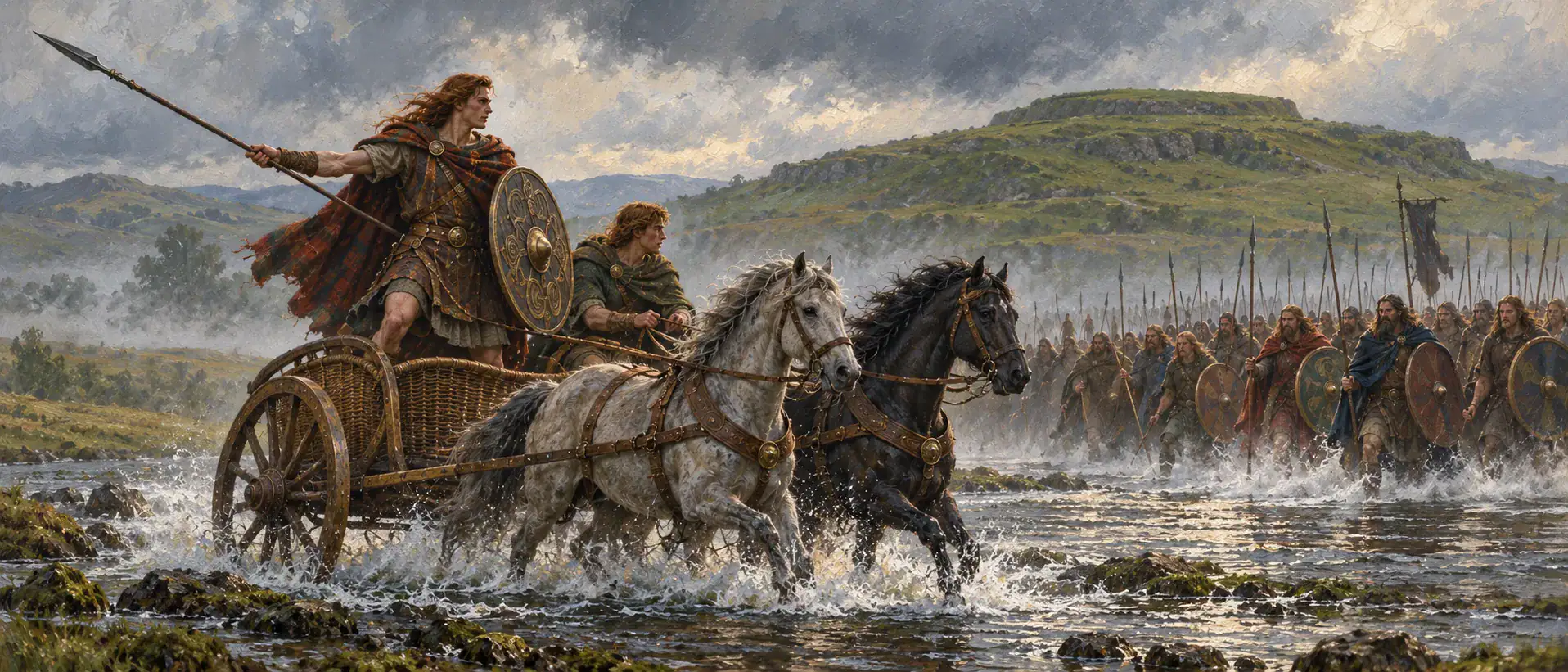
Heroes fight from two-horse chariots, and the charioteer, such as Cú Chulainn’s Láeg, acts as adviser and companion as well as driver. Warriors also take their enemies’ heads as proof of their deeds. Conall Cernach turned the brain of the Leinster king Mesgegra into a hardened ball, which Cet mac Mágach later slung into Conchobar’s skull. Conchobar lived seven more years, until, on hearing of the crucifixion of Christ, he flew into a rage and the ball burst from his head.
A Window on the Iron Age? The Scholarly Debate
For much of the twentieth century, the Ulster Cycle was read as a glimpse of pre-Christian Ireland. In his 1964 Rede Lecture, published as The Oldest Irish Tradition: A Window on the Iron Age, Kenneth Jackson argued that the tales preserved a genuine memory of Iron Age society, pointing to the chariots, feasting customs, and head-hunting that classical writers describe among the Gauls.
Later scholars have pushed back. Kim McCone, in Pagan Past and Christian Present in Early Irish Literature (1990), argued that learned churchmen composed the tales, drawing on the Bible and Latin learning. The archaeologist J. P. Mallory, in In Search of the Irish Dreamtime (2016), compared the objects in the tales with the archaeological record and found that they mostly match early medieval Ireland, not the Iron Age. Most specialists now read the cycle as medieval literature that reuses older native material, not as a historical record.
Emain Macha: The Archaeology of Navan Fort
Emain Macha is a real place. Navan Fort is a hilltop enclosure about 2.6 kilometers west of Armagh. Excavations in the 1960s revealed that around 95 BC, a circular timber structure about 40 meters across was raised there, with rings of oak posts around a huge central pillar. Tree-ring dating of that central post supplies the date. Soon afterward, the building was filled with stones, deliberately burned, and buried under the mound visible today. The date is close to the tales’ setting, but the building was a ceremonial monument, not a royal hall, and nothing there confirms Conchobar’s court.
The Ulster Cycle in Literature and Popular Culture
The Ulster Cycle became a foundation of the Irish Literary Revival. Lady Gregory’s Cuchulain of Muirthemne (1902), with a preface by W. B. Yeats, retold most of the major tales, and Yeats praised it as the best Irish book of his time. Yeats then wrote a series of Cú Chulainn plays, from On Baile’s Strand (1904) and At the Hawk’s Well (1916) to The Death of Cuchulain (1939), while J. M. Synge left Deirdre of the Sorrows unfinished at his death in 1909.
Thomas Kinsella’s The Táin (1969), illustrated by Louis le Brocquy, remains the classic English version, and Ciaran Carson’s The Táin (2007) offers a vivid newer one. Rosemary Sutcliff retold the hero’s story for young readers in The Hound of Ulster (1963), and Cú Chulainn still appears in murals, comics, and games.
Common Questions About the Ulster Cycle
One question comes up often from readers new to the Ulster Cycle stories.
Is the Ulster Cycle the Same as the Red Branch Cycle?
Yes. “Red Branch Cycle” is the older name, taken from Conchobar’s hall at Emain Macha. “Ulster Cycle” is the term most scholars use today.
Sources and Further Reading
- Cecile O’Rahilly (ed. and trans.), Táin Bó Cúailnge: Recension I, Dublin Institute for Advanced Studies (1976).
- Thomas Kinsella (trans.), The Táin, Dolmen Press (1969).
- Ciaran Carson (trans.), The Táin, Penguin Classics (2007).
- Tom Peete Cross and Clark Harris Slover (eds.), Ancient Irish Tales, Henry Holt (1936).
- Kenneth Hurlstone Jackson, The Oldest Irish Tradition: A Window on the Iron Age, Cambridge University Press (1964).
- Kim McCone, Pagan Past and Christian Present in Early Irish Literature, An Sagart (1990).
- J. P. Mallory, In Search of the Irish Dreamtime: Archaeology and Early Irish Literature, Thames & Hudson (2016).
- Lady Augusta Gregory, Cuchulain of Muirthemne, John Murray (1902).